
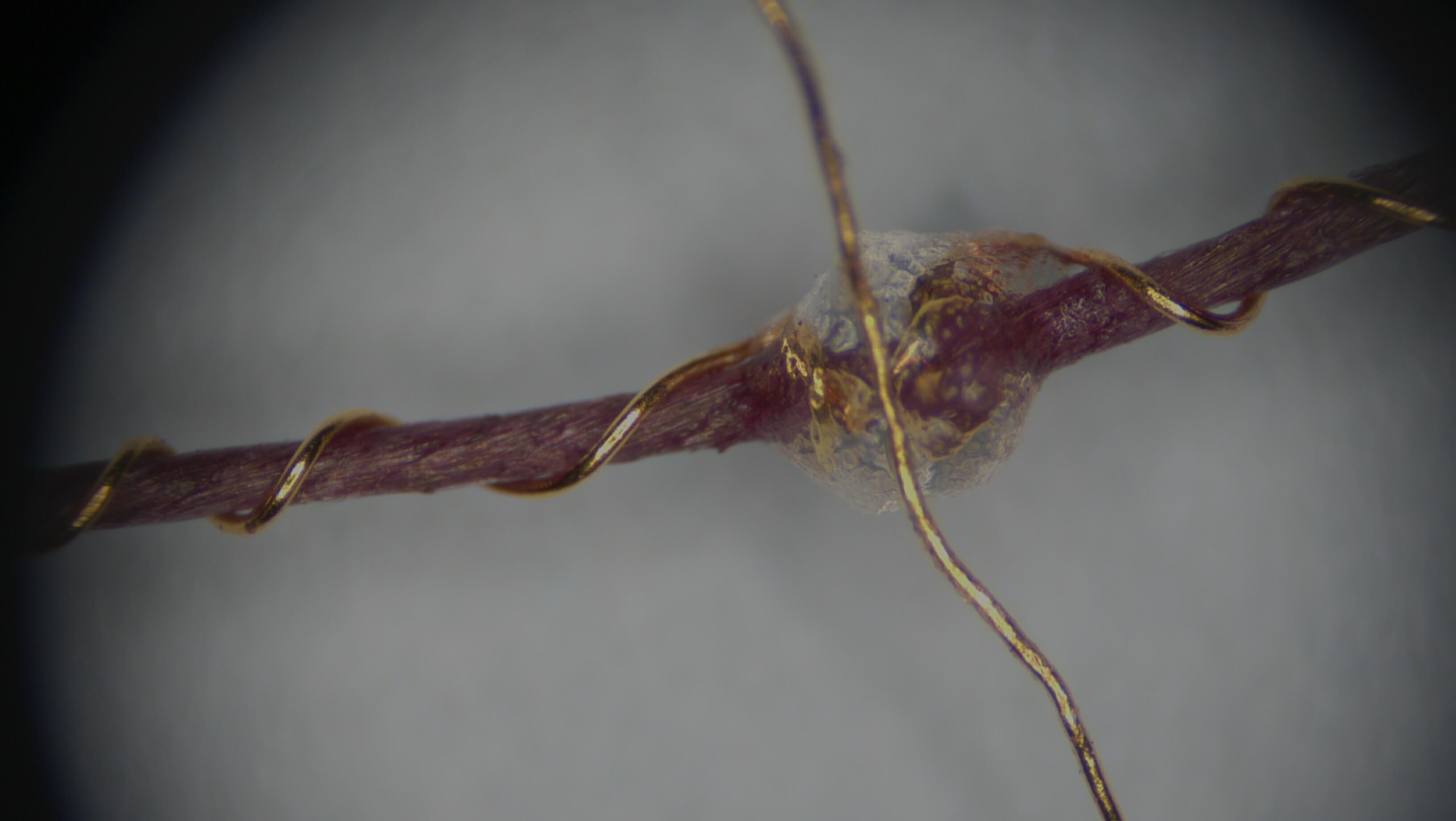
Professor Sameer Sonkusale and Rachel Owyeung from Tufts University speak with Jessica Owen about how they have made transistors and electronic devices entirely from thread.
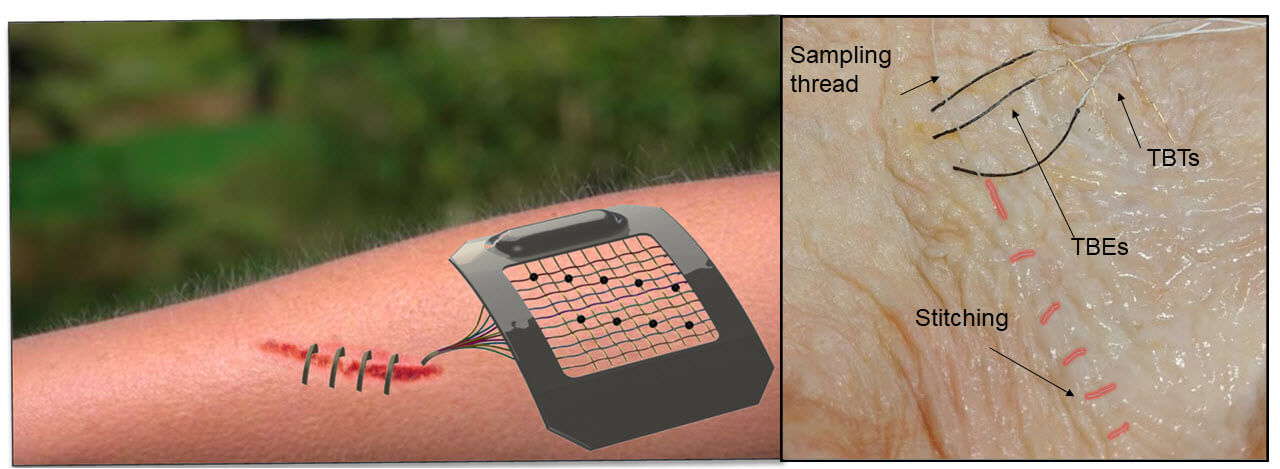
The field of smart textiles is quickly advancing. Both academics and market players are working with things such as conductive fibres to create smart fabrics and others are currently researching how to get a whole computer into synthetic polymers.
Now, a team at Tufts University in Massachusetts, US, has engineered the first thread-based, integrated platform of transistors and sensors, which enables all-thread based logic circuits and integrated circuits. The circuits replace the last remaining rigid component of many current flexible devices, and when combined with thread-based sensors, enable the creation of completely flexible, multiplexed devices.
“What we’re doing is developing sensors and electronics on a thread and exploring threads as a different substrate for these types of materials,” says Rachel Owyeung, a graduate student at Tufts University School of Engineering and first author of the study.
“Threads themselves are easily modifiable – you can tune them to have different properties such as mechanical properties. What we also like is that there are already manufacturing techniques that exist in order to make these devices.”
The thread that the team is working with is linen, enabling them to create electronic devices that could be woven into fabric, worn on the skin or even (theoretically) implanted surgically for diagnostic monitoring.
The fully flexible electronic devices could enable a wide range of applications that conform to different shapes and allow free movement without compromising function, the researchers say.
“There have been a few reports that have demonstrated transistor action on textiles or on wires, but for the most part this has been pretty unexplored in terms of actually using them on a linen thread as opposed to some metal wire where you get more of a uniform surface,” adds Owyeung.
Creating the thread-based transistor
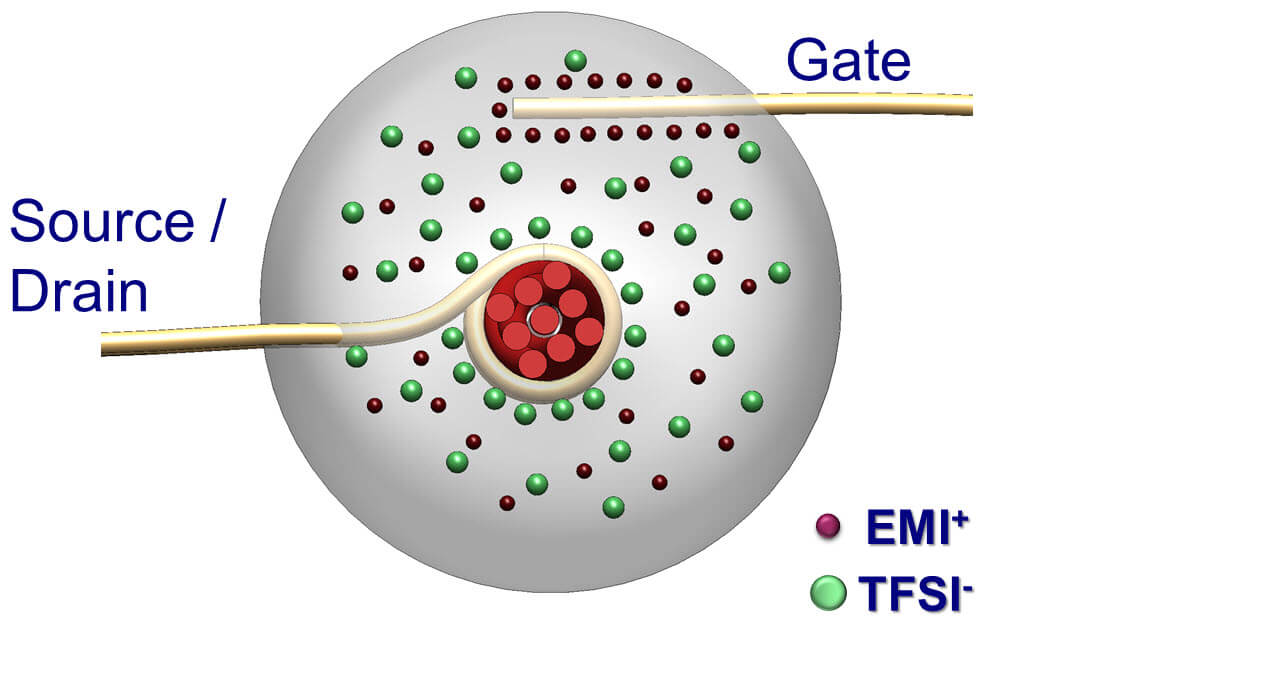
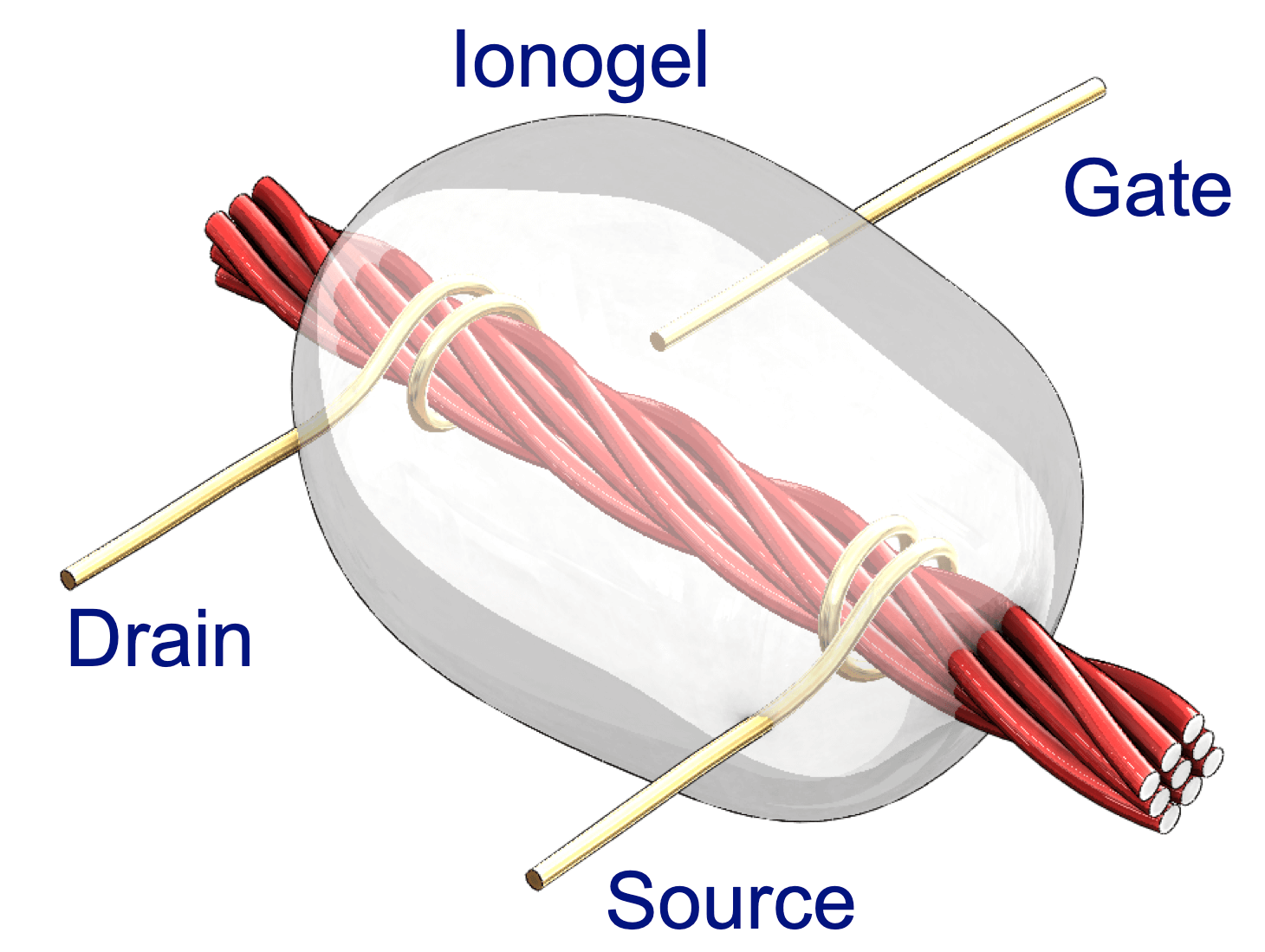
Making a thread-based transistor involves coating a linen thread with carbon nanotubes, which create a semiconductor surface through which electrons can travel. Attached to the thread are two thin gold wires – a ‘source’ of electrons and a ‘drain’ where the electrons flow out (in some configurations, the electrons can flow in the other direction). A third wire, called the gate, is then attached to material surrounding the thread, such that small changes in voltage through the gate wire allows a large current to flow through the thread between the source and drain – the basic principle of a transistor.
“We wanted to keep the fabrication pretty simple so we wanted to be able to do this without any clean room kind of fabrication process that you might need in a typical transistor,” explains Owyeung.
A critical innovation in this study is the use of an electrolyte-infused gel as the material surrounding the thread and connected to the gate wire. In this case, the gel is made up of silica nanoparticles that self-assemble into a network structure. The electrolyte gel (or ionogel) can be easily deposited onto the thread by dip coating or rapid swabbing. In contrast to the solid-state oxides or polymers used as gate material in classical transistors, the ionogel is resilient under stretching or flexing.
“In a transistor you want to control the flow of current from one end to the other, the threads are quite rough and don’t have a very uniform surface area, when you have a semiconducting channel that connects the two ends, you want to control that channel,” adds Sameer Sonkusale, professor of electrical and computer engineering at Tufts University School of Engineering and corresponding author of the study.
“You want to form a coating around that. A gel will cover the semiconducting area. In our language, we call it ‘perfect electrostatic control of the channel’, which gives you all around control of the flow.”
Applications and challenges
So far, this is the first iteration of the device and so it is still pretty large according to the researchers, especially in the general context of electronics and transistors.
“Transistors inside chips are in the range of a few nanometres, which is one billionth of a metre, but we are working in millimetres. You can see our transistor with the naked eye, whereas others you would probably need a microscope to zoom in and see,” says Sonkusale.
He goes on to say that the team envisions a whole range of applications for this device. One is using the thread for normal clothing and textiles where having electronics would be useful for monitoring bio signals like heart rate, ECG and so on. Additionally, the threads could also be used in the form of sutures (a medical device used to hold body tissue together).
“We are exploring a lot of other things at the moment, but there are a lot of opportunities here,” he adds. “I think textiles is the next real estate to conquer.”
The next step for the researchers is to improve the design and function of the device. For example, they would like to scale down the transistor, make the materials more bio-friendly and make the fabrication process more conducive. There is also the question of how the team would integrate this on a larger scale.
What’s more, “we are exploring commercialisation right now”, says Sonkusale. “We are still refining the transistor technology, but we hope that when we figure it out, we can integrate them with the rest of the thread-based portfolio.”
This research was supported by the National Science Foundation NSF IGERT grant #DGE-1144591.
Also contributing to this study were Trupti Terse-Thakoor and Hojatollah Rezaei Nejad, post-doctoral fellows in Sonkusale’s laboratory, and Matthew Panzer, associate professor at Tufts University School of Engineering.
The study has been published in ACS Applied Materials and Interfaces and is called Highly flexible transistor threads for all-thread based integrated circuits and multiplexed diagnostics.


