
The field of materials science – the research and discovery of new materials, particularly solids - incorporates elements of physics, chemistry and engineering. Researchers study not only how a material is created but are often at the forefront of creating new and complex materials, from nanotechnology to biomaterials and metallurgy.
Now, California State University Northridge has received a nearly US$4m grant from the NSF to continue support of a partnership between the university and Princeton University’s Center for Complex Materials. The partnership provides opportunities for minority CSUN students to work alongside scientists at Princeton and CSUN as they conduct research in the field of quantum materials.
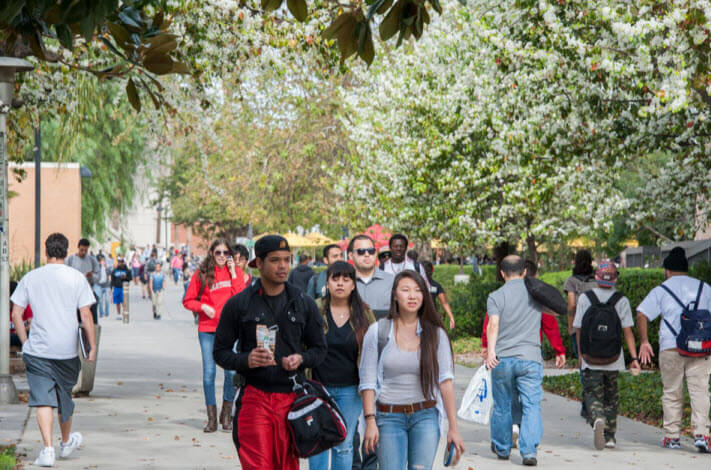
The partnership provides opportunities for minority CSUN students to work alongside scientists at Princeton and CSUN
“One of the benefits of a grant like this is the opportunity it offers our students to work with some of the leading researchers in the field,” says Gang Lu, professor of physics at CSUN, who has headed the project since 2012 with the help of an NSF Partnerships for Research and Education in Materials (PREM) grant. The new monies are a continuation of that initial award.
“Our students, especially undergraduates, are doing important research in the field of quantum materials, and their work has been published, and will continue to be published, in some of the leading scientific journals,” says Lu. “We, as scientists, also benefit. Hopefully, we are fostering and encouraging a new generation of researchers interested in entering the fields.
“The greater the diversity of people in the field, the greater the diversity of questions, ideas and perspectives there are only makes the research better,” he adds.
The CSUN and Princeton project focuses on such fundamental challenges as the energetics and dynamics of excited states in quantum materials. Research on quantum materials brings together scientists working on a variety of problems at the frontiers of physics, materials science and engineering. The properties of these systems are uniquely defined by quantum mechanical effects that remain manifest at high temperatures and macroscopic length scales.
Quantum materials have unusual magnetic and electrical properties that, if understood and controlled, could revolutionise virtually every aspect of society and enable highly efficient energy electrical systems and faster, more precise electronic devices. Quantum materials include systems based on metals, semiconductors, oxides and organics that have a range of potential applications including semiconductors, sensors, low-power memory modules, high-density storage devices and quantum computers. Quantum materials are also important components of the infrastructure for energy-related technologies.
“We’re talking about some serious, cutting-edge research that our students get to take part in,” continues Lu.
Lu says that since the partnership, a large cohort of CSUN students have taken part in the project, which includes sending five to six students to Princeton each summer to do research. During the school year, there are ample research opportunities at CSUN, as well as workshops and symposiums. There are also outreach efforts to local high schools to encourage students to consider going into the field.
“If we want the US to continue to be a leader in the world in materials research, then we need to ensure that the pipeline to graduate school and post-doctoral research has the bodies it needs, particularly when it comes to women and minorities,” says Lu.
One of the highlights of the project is the interaction between the CSUN undergraduates and the Princeton graduate students and post-doctoral fellows.
“Not only are they doing research together, there are numerous opportunities for the CSUN students to be inspired and to ask questions – questions about what it’s like to go to graduate school, possible career paths and things like that,” explains Lu.
“So many of our students are first-generation college students. While they can ask us, their professors, those questions, it can have so much more impact when the answers come from another student who appreciates what they are going through.”


