Japan’s Descente continues to grab market share in the competitive global knitwear market. By Julian Ryall, in Tokyo.
Already a world-leader in terms of knitted products for the sports clothing and outdoor wear sectors, this July, Japan’s Descente opened a state-of-the-art research and development centre that the company anticipates will help it to create 'the world’s fastest high-performance wear'.
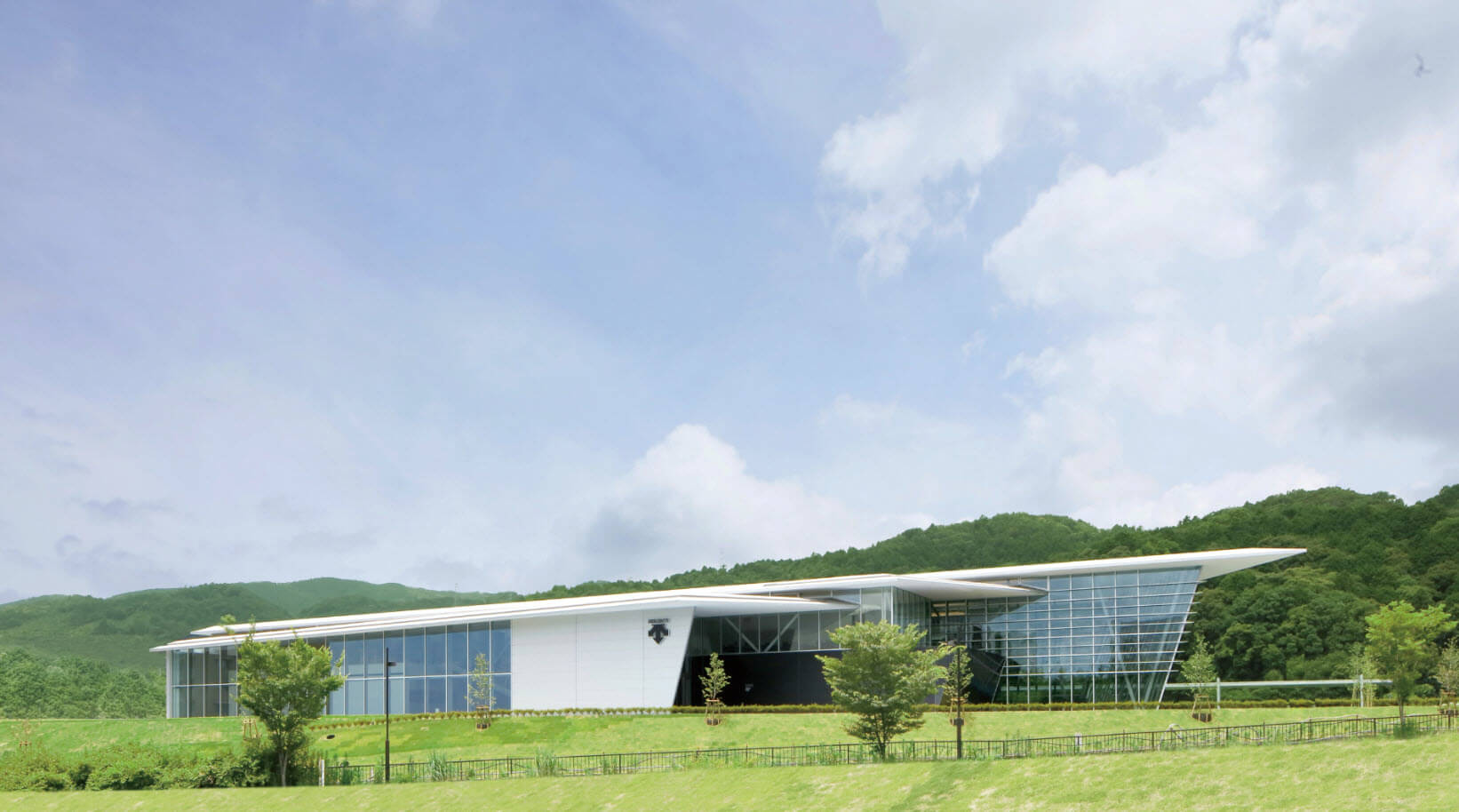 The state-of-the-art DISC research facility opened outside Osaka in July
According to the Osaka-based company, the new initiative is built on the concept of being ‘fast’. This, said a spokesperson, communicates both the idea of speed to help a competitor to win a race and the company’s drive to be recognised as the first-choice maker of apparel in the global sports clothing market.
The company admits, however, that competition in this sector is growing and that its fabric and product developers need to be at the top of their game to stay ahead of the pack in knitted fabrics to supply such world-renowned brands such as Le Coq Sportif, Umbro, Marmot, Srixon and Munsingwear. All of these brands are owned by Descente or have licensing agreements with this Japanese manufacturer.
“The major issues for us are ensuring quality, safety and delivery management,” says Nao Terada, of the company’s global planning division.
“We work with a range of materials for our products, including knitted fabrics, woven fabrics and nonwovens, but we have found there are a number of advantages to working with knitted fabrics,” Terada tells WTiN. “These can include relatively short delivery times and the ability for us to manufacture in small production lots as there is no need to prepare warp yarns.
“The wide variety of yarns that are available – cotton, wool, others that can be used in mixed spinning fabrics – and the ability to work between thick and thin yarn counts, makes it possible for us to create a wide range of knitted fabrics,” she adds.
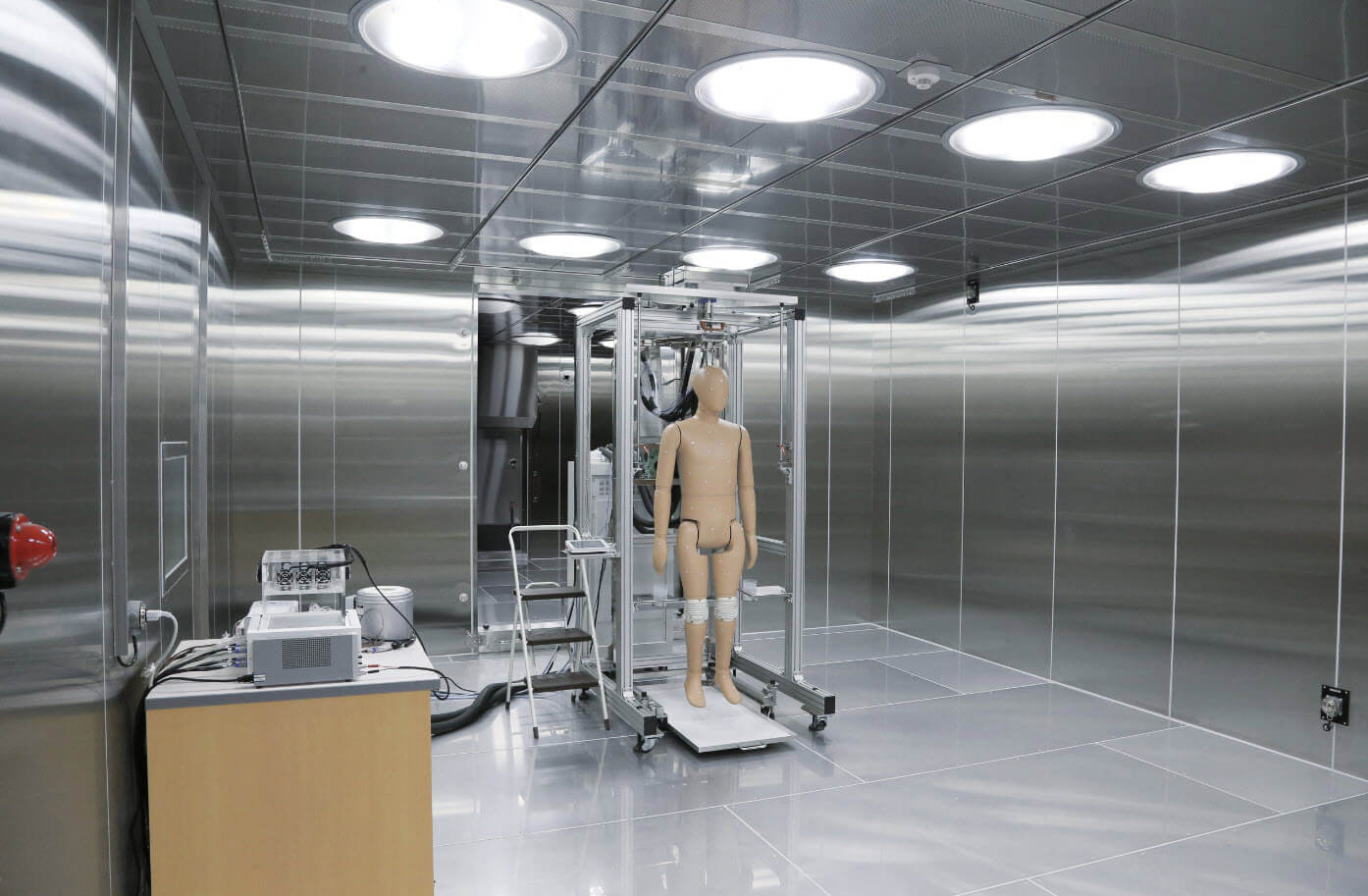
The facility includes an artificial rain chamber for testing fabrics
Descente Innovation Studio Complex
The hope is that DISC – the new Descente Innovation Studio Complex research and development facility – will lead to new breakthroughs in the sector.
Personnel at the 4,401 sqm centre, in Ibaraki City, Osaka Prefecture, have been tasked with five parallel missions – research and development, materials development based on a global strategy, product development, measures to enhance quality, and intellectual property strategies.
The facility incorporates a production studio where everything from swimsuits to knitted items can be manufactured; an evaluation laboratory where materials and processes – including knitted fabrics, secondary materials and printing processes – can be evaluated; and a sports performance studio with a 250 m, all-weather track that can be used by athletes to test new materials and products. The centre also includes an artificial rain chamber and a climate room in which other extreme weather conditions can be recreated to test fabrics’ and products’ ability to withstand the elements.
Descente says it intends to ‘produce highly functional, high-quality products’ and will expand its capabilities, using DISC as a base for collaboration between industry and academia and joint development of new fabrics with different industries.
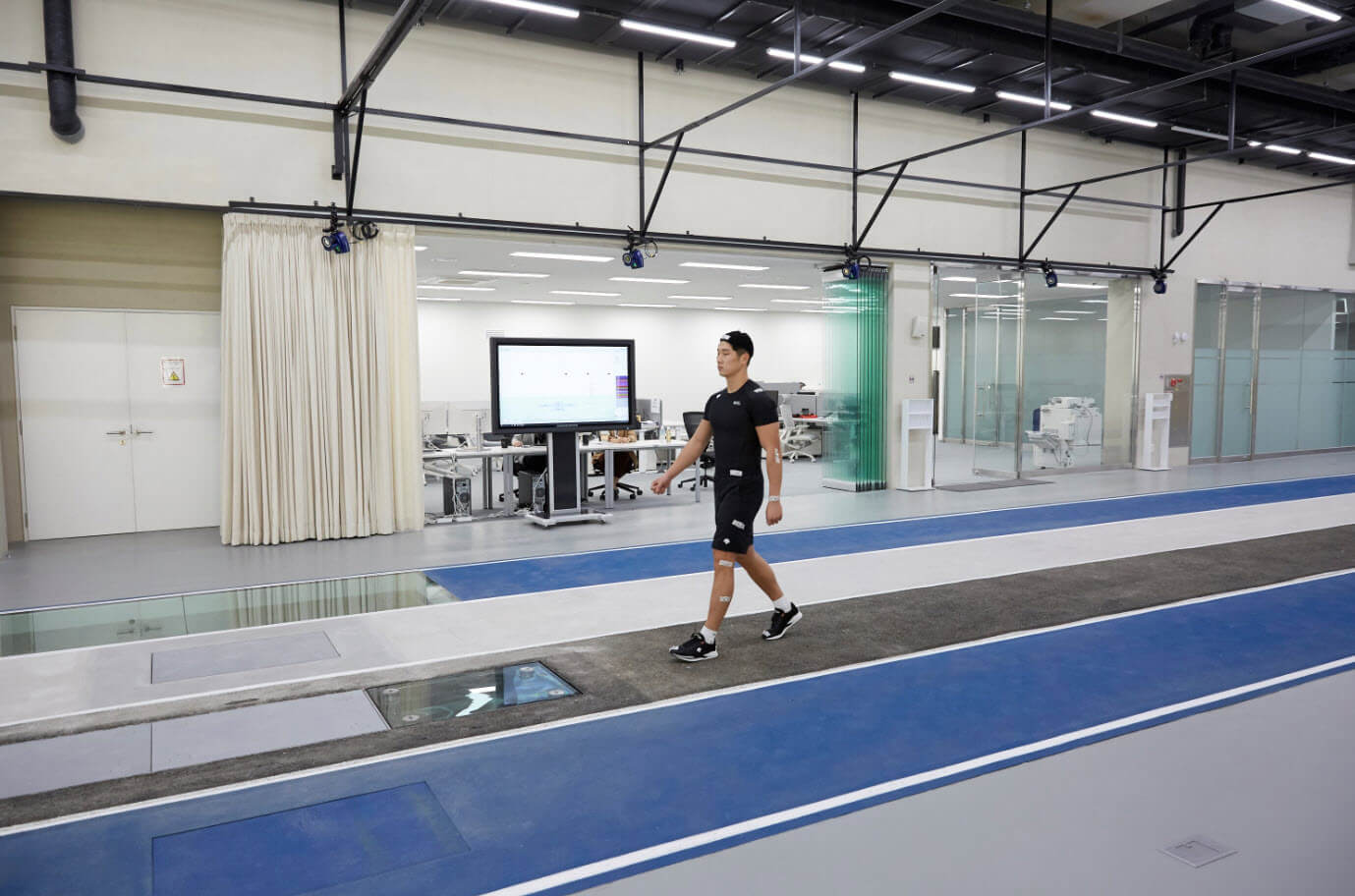
Athletes put Descente's latest fabrics through their paces at the DISC facility
Longstanding roots in innovation
The company can trace its history back to February 1935, when Takeo Ishimoto set up Tsuruya, a men’s clothing store. The firm began to develop sports clothing in the post-war years and was able to capitalise on rising popularity of baseball by developing baseball uniforms made from a pre-shrunk cotton fabric that had a wool-like finish.
It also saw the potential of skiing as a popular leisure past-time, teaming up with Japan’s first professional skier, Kazuyoshi Nishimura, to develop the RWSB – Rain-Wind-Snow-Break - windbreaker jacket.
The Descente brand was launched in 1957, with the three arrows that make up the logo depicting the three basic skiing techniques of traverse, schuss and side-slip. Four years later, the company adopted Descente Ltd as its official name and won the contract in 1968 to provide the Chunichi Dragons baseball team with its newly developed single-knit uniforms. The double-knit version was perfected the following year and by the late 1970s, Descente was supplying the uniforms to 11 of Japan’s 12 professional baseball teams.
The company has expanded its research and development into other sports – ski jumping, track and field, speed skating, cycling, swimming, golf and others – and built up a portfolio of 15 in-house purchased or licensed brands.
Research has also enabled the company to develop textiles such as ‘Solar a’, which converts sunlight into heat and improves thermal retention in a radical new skiwear, and Dimplex, a fabric with a dimpled surface that helped to reduce air drag for ski jumpers and downhill racers. More recently, the company released Deodash, a specialised fabric with deodorising properties that has been used in a range of golf clothing, and Unifit Pants for baseball players, with each leg made from a single piece of fabric in Descente’s unique three-dimensional construction process, meaning the finished item of clothing has fewer seams for added comfort and greater ease of movement.
Specialised facilities
The company operates four domestic manufacturing facilities, each specialising in a limited range of items. The Mizusawa plant, in the town of Oshu, Iwate Prefecture, focuses on producing Misuzawa Down and clothing that includes down jackets, while the Muraoka facility in Hyogo Prefecture is dedicated to manufacturing high-quality baseball clothing that is worn by both professional and amateur players.
Descente’s Yoshina factory, in Nara Prefecture, specialises in lines for track and field athletes, as well as swimwear ranges, while the Saito manufacturing base, in Miyazaki Prefecture, produces kits for teams in Japan’s professional football leagues, as well as swimwear items.
The company has more than 2,100 full-time staff, as well as units and affiliates around the world, including in China, the US, Singapore, the UK, Hong Kong and South Korea.
Terada says the company is constantly looking to develop new innovations and is continuing to introduce new processes into the manufacturing of its knitted ranges.
“One new process has been sublimation print dyeing, which is beneficial because it causes less harm to the environment, it can be done in small lots and enables us to meet short delivery schedules,” she says.
Another promising area has been in the introduction of adhesive sewing to replace the sewing together of knitted components and abolishing the use of yarn in that process.
Terada adds: “We do not expect much change in the base fabrics that we use, although we are anticipating further refinements and improvements in the areas of sublimation dyeing and advanced new bonding technologies.”