Year-on-year, digital textile printing technology establishes itself further in China, which boasts both the world’s second-largest economy and the biggest textile printing market.
Consequently, digital textile printing technology formed a large percentage of the solutions on show at ITMA Asia + CITME 2018, which was held in Shanghai at the National Exhibition and Convention Center (NECC).
Organisers reported a six-figure attendance across the week, with many of those visitors attracted to Hall 5, the hub for digital textile printing’s OEMs. Arguably the two biggest exhibitors in the hall were EFI Reggiani and MS Printing Solutions, both of which announced new solutions
Glimpse of the future
In a press conference at the show, EFI Reggiani confirmed the launch date of its eagerly-anticipated single-pass digital textile printer, Bolt. The machine is EFI’s first single-pass printer dedicated to the textile industry and is named after the famous Olympic gold-medal-winning Jamaican sprinter Usain Bolt. This is because the machine can print up to 95 sqm of fabric per minute, according to EFI vice president and general manager, Adele Genoni. BOLT is the fifth product EFI Reggiani has launched since mid-2017 and the machine has been described by EFI Reggiani’s sales and marketing director, Michele Riva, as the first second-generation single-pass printer to come to market.
At the EFI Reggiani booth, the company’s biggest focus was promoting the COLORS multi-pass printer, which was officially launched in April at the 2018 ITM exhibition in Istanbul, Turkey. The machine offers up to 12 colours and enables users the ability to print almost any configuration of inks in 1,800, 2,400 and 3,400mm widths, with a productivity of up to 560 sqm/hr, says Genoni. EFI was also promoting the work of its Mezzera division, which claims to be making its indigo dyeing technology much greener in an attempt to appeal to a Chinese market which is being restricted by recent environmental legislation.
One of EFI Reggiani’s biggest competitors, MS, reported a good show. The OEM sold a MS JP4 to an undisclosed Beijing-based company. MS business manager, Alessio Zunta, revealed that MS has now sold well over 200 machines in China, 80% of which are either the JP4 or JP7 multi-pass printers. Consequently, MS claims to have a 45% share of the Chinese market and is therefore the largest importer into the country. China has always been a key target market for MS, according to Zunta, who says that digital textile printing accounts for 7% of all printed textiles in the country.
Looking ahead to 2019, Zunta also revealed that MS will launch a brand-new machine at ITMA Barcelona in June, which he described as a mini Lario. It is understood that the new machine will come equipped with 64 print heads.
Meanwhile, Mimaki made a relatively short trip from Japan to showcase the TS55-1800 printer, the latest in a long line of digital print solutions from the Japanese OEM was officially launched in September but was making its Chinese debut. The company’s latest offering is a 76.3-inch, dye-sublimation transfer inkjet printer. The new model offers high-end features, such as low running costs, industry-leading productivity, and unattended continuous printing. One key feature of the machine is the optional use of a new Mini Jumbo Roll unit that can continuously feed 2,500 linear metres of heat transfer paper to the printer. This enables customers to substitute the use of Small Plotter Rolls with Mini Jumbo Rolls, which can save them over 20 per cent in print media cost, said Mimaki’s general manager, global TA solutions, sales division.
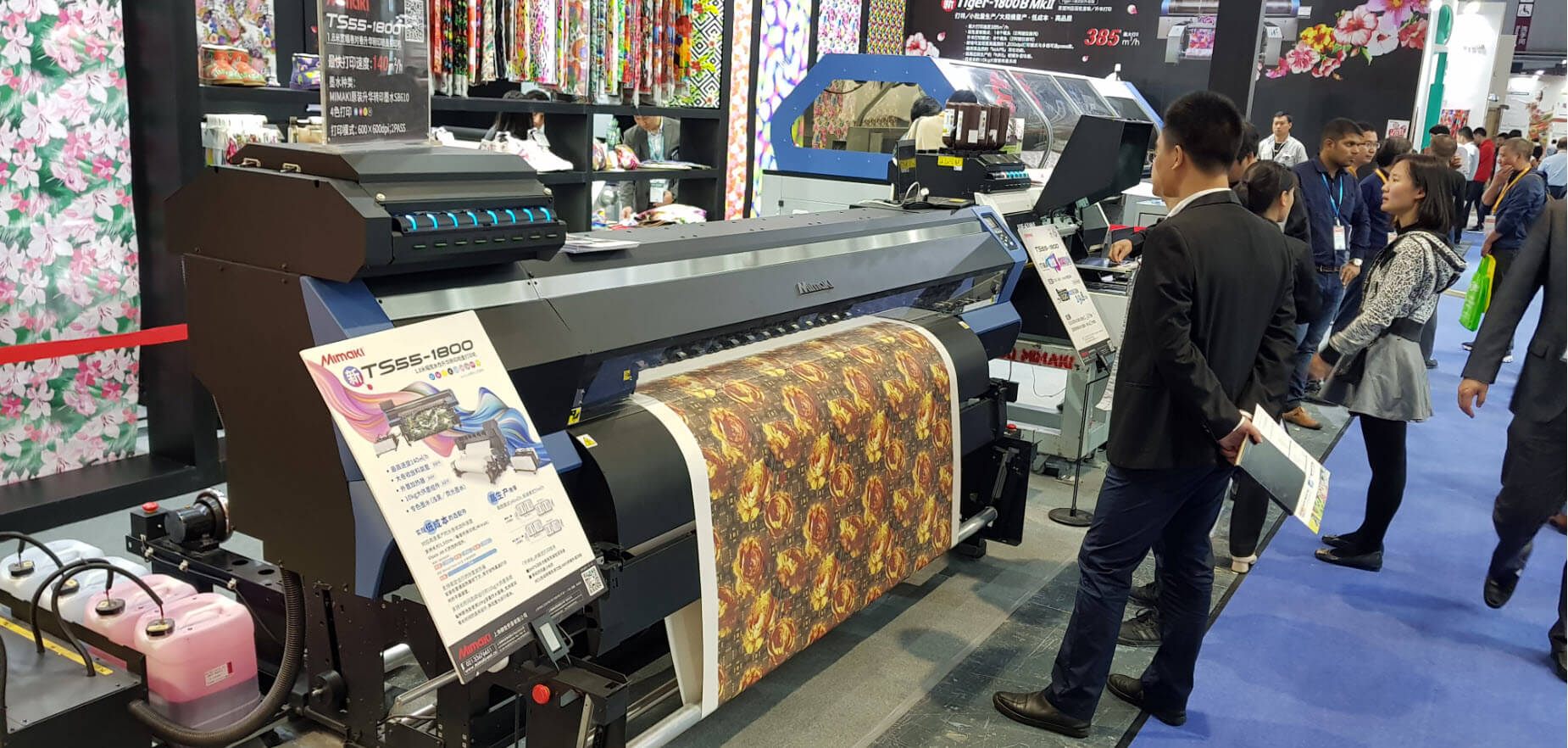
Mimaki is showcasing the TS55-1800 sublimation transfer printer for the first time in China
Elsewhere, India-based ColorJet was present in Shanghai to promote its fleet of digital textile machines. The company is new to the Chinese market and was focused on raising the company’s profile in the region rather than making sales, said ColorJet product manager, Smarth Bansal. At the OEM’s booth was the high-speed Metro digital textile printer equipped with 16 Kyocera printheads. It is the first time the industrial-scale machine, which can print 300 sqm/hr, has been showcased with 16 heads – which was in response to customer demand, added Bansal. Visitors could also view the Fabjet Grand 3.2m-wide direct-to-fabric pigment printer. Bansal added that the machine is an ideal solution for creating large customised patterns for the home furnishings business. Heavy-duty design with rigid structure also makes the machine suitable for rigorous shop-floor operating conditions.
Single-pass reaction
SPG Prints was promoting its single-pass Pike and multi-pass Javelin printers. Single-pass textile printers have yet to make significant headway in China as manufacturers tend to opt for cheaper multi-pass alternatives. Similarly, many Chinese textile print house do not require the high production speeds which single-pass printers afford. Ford example, SPG claims that its PIKE printer can print anywhere from 4-20 million linear meters of fabric per year. The Dutch-based OEM also provided visitors with information on what it claims is its full range of inks for all leading industrial print heads and fabrics. These include the PIKE, JAVELIN, QUASAR and NEBULA ink ranges.
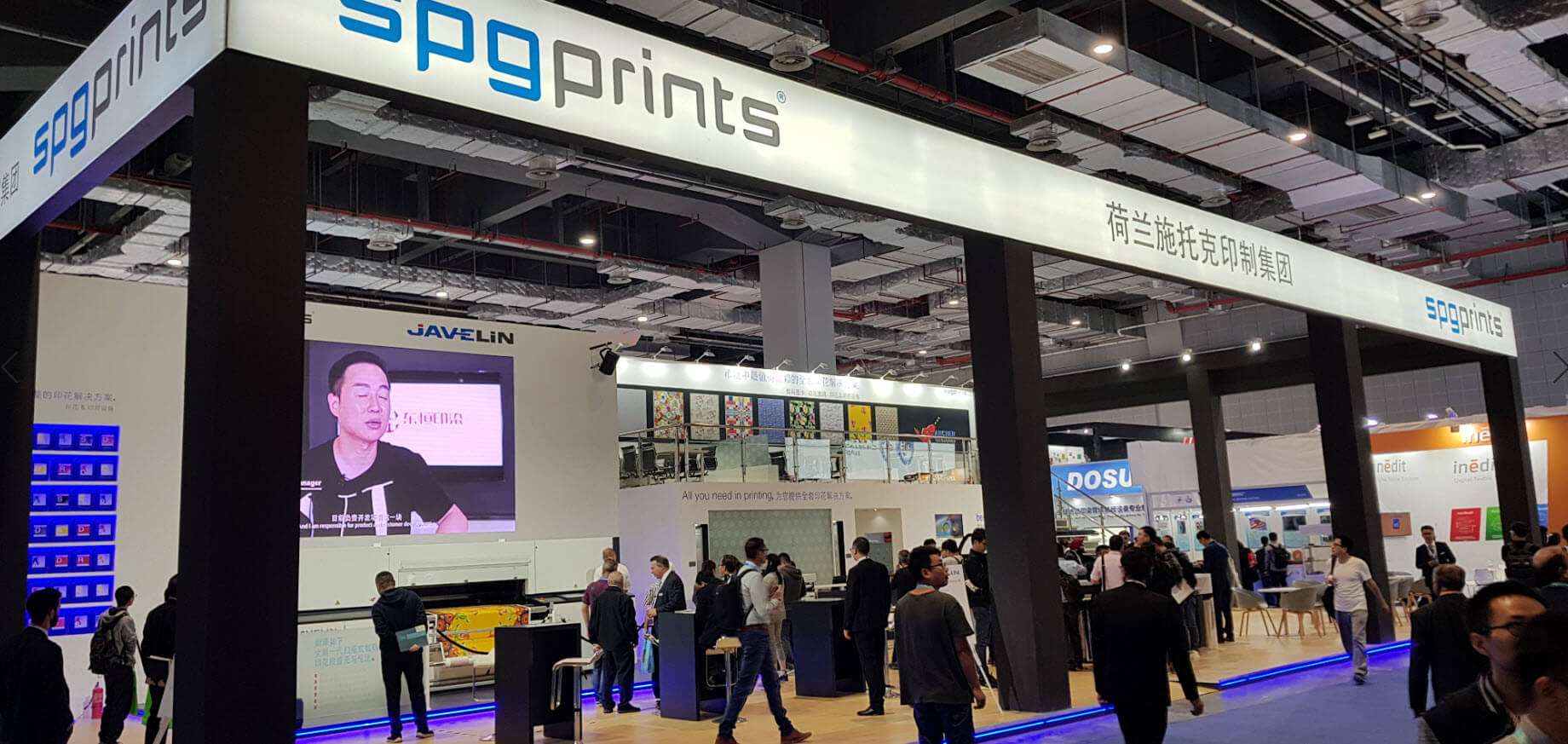
SPGPrints' booth in Hall 5
Chinese OEM Hopetech has reported sales of its single-pass printers in China – seven since the company began manufacturing digital solutions five years ago. The company’s single-pass printers are the BD01 and BD02 machines which are available to print direct-to-fabric or through dye-sublimation. The company also promoted a range of multi-pass machines, including the Z1, HF01, HF02 and HF03. The largest Chinese digital textile machinery OEM, Atexco, was also present at the exhibition where it promoted a wide range of its machinery and ink solutions in a bid to maintain its 70-80% share of China’s digital textile printing industry, the company claimed.
Zimmer Austria was also in attendance to showcase its Colaris range of digital textile machinery. Colaris machines are individually suited to various substrates and are targeted at varying industry sectors, such as fashion or interiors.
DTG
From a direct-to-garment printing perspective, ITMA Asia was awash with solutions for visitors to view. At the Kornit Digital stand was the company’s Storm series printer which, for the first time, was equipped with Kornit’s HD6 technology. The Kornit Storm HD6 is also loaded with a six-colour configuration and compatible with the company’s range of NeoPigment inks.
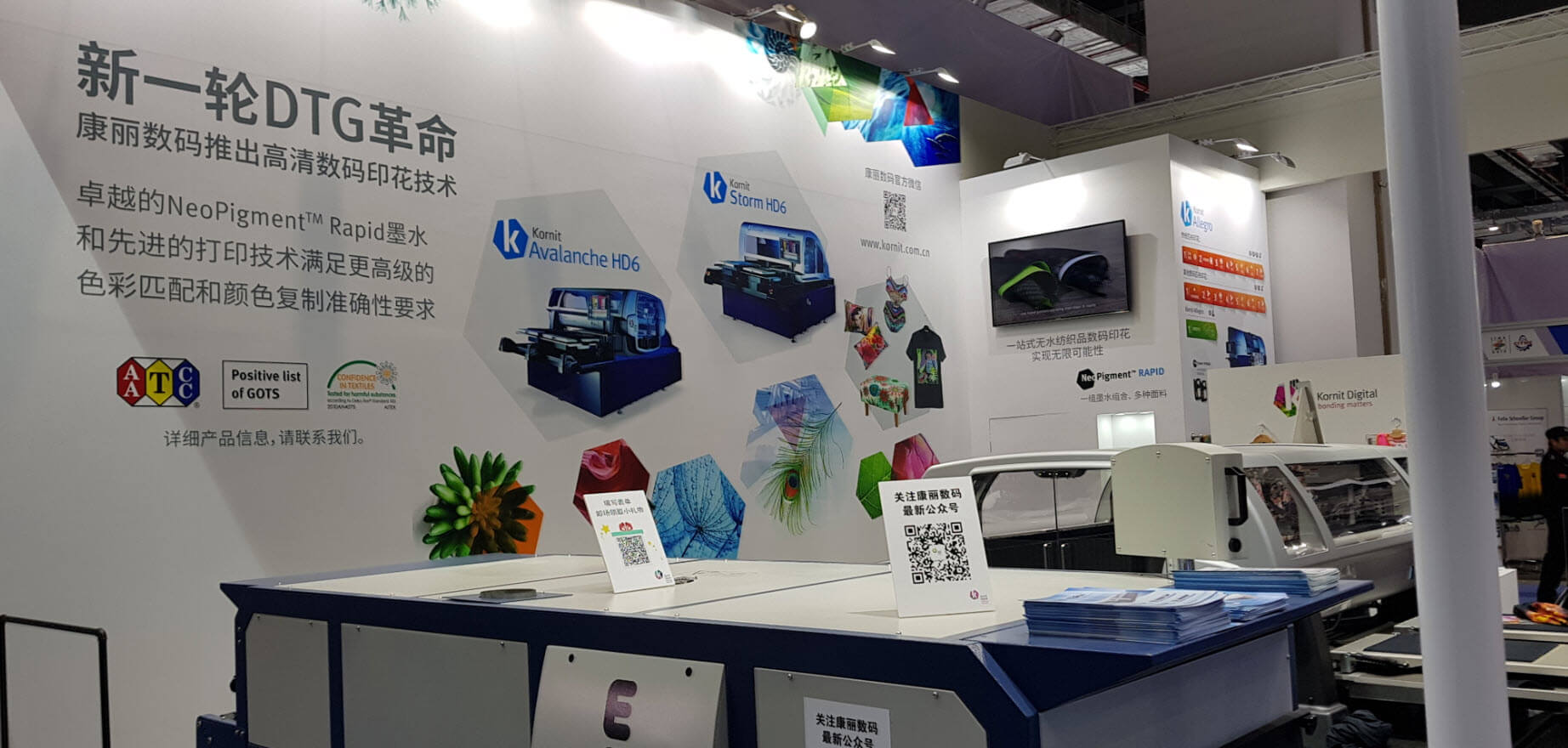
Kornit Digital Booth where the Storm HD6 machine is being promoted
Kornit Digital’s Asia-Pacific marketing director, Sandy Lui, explained: “The HD technology has been developed to meet customer demand.” And, with evolving trends like fast fashion and customisation influencing the fashion and apparel industry, textile manufacturers need to streamline their production workflows. According to Lui, this can be achieved through Kornit’s HD technology, which significantly reduces production time while maintaining quality.
Other features of the HD technology include a single-step process, significantly lower ink consumption to reduce print costs, a softer hand feel, increased uptime, ink savings delivered by the ink recirculation technology, and unlimited separations and colour per order, Kornit adds.
The Storm series of printers – which includes the Storm II, Duo, 1000, and Hexa – accounts for a large percentage of Kornit Digital’s sales in China. Currently, the Israeli-based DTG manufacturer has sold over 150 machines in the country and, according to Lui, aimed to add two or three more during ITMA Asia + CITME.
Another DTG machinery provider is Indian-based Aura, which was promoting its entire range of machinery at ITMA Asia. This included its dye-sublimation machine Aura Hexa, the Aura Max and Aura Max Plus, as well as the Nano and Aura Nano Plus printers. However, at company’s booth was the Aura Smart T-shirt printer which attracted most interest. Amit Chadha explained that the machine is designed to appeal to SMEs and large-scale textile manufacturers. The company believes the biggest challenge in DTG printing is the white ink itself, which is commonly associated with print head clogging and poor consistency.
To add to this, the price of white ink makes operational costs expensive. Chadha added that smaller printers on the market do not achieve adequate production speeds, whereas the industrial-scale DTG printers are too expensive and complicated to operate. Therefore, Aura markets its Smart printer as a middle ground for DTG manufacturers. Chadha claimed that the company has sold ‘300-350 machines in China’, including one Smart printer at the show. Nevertheless, despite the interest gathered by the Smart machine, Chadha doesn’t believe that pigment printing will narrow the gap to dye-sublimation printing in the Chinese market.
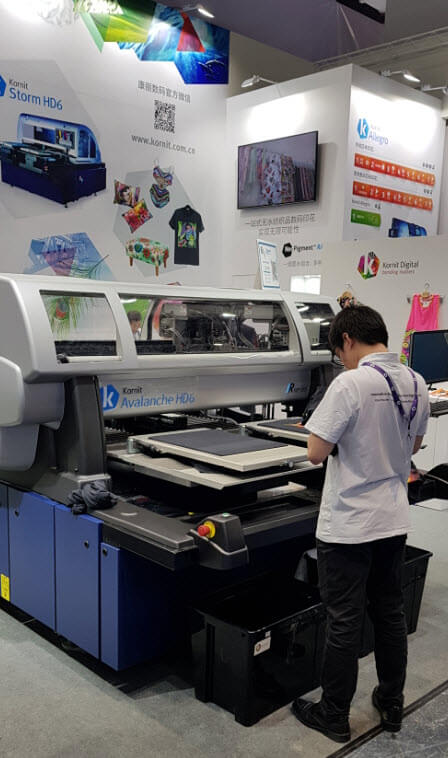
The Kornit Avalanche was the first of the OEM's DTG machines to be fitted with HD technology
Ink developments
Meanwhile, inks are pivotal to the textile printing industry becoming greener. Digital solutions are seen as a more sustainable alternative to traditional screen printing, but analysts claim that more still needs to be done.
At ITMA Asia, JK Group was promoting its Kiian Digital and J-Teck ink brands. Alongside the Italian ink provider were several domestic ink producers, such as Hongsam. Lanyu was one of the leading Chinese ink developers and was showcasing its entire ink range. Sublimation inks generate the most revenue for Lanyu as China is the OEMs biggest market. Sublimation inks actually account for 20% of the Chinese ink market according to the company. However, Lanyu also produces acid, disperse, reactive and pigment inks. Lanyu has also recently placed a focus on pigment inks as DTG printing around the world becomes more popular. Currently, the company is working on roll-to-roll printing with pigment inks. Additionally, although not its main priority, Lanyu showcased the BlueJet sublimation paper printer to attendees at ITMA Asia.
DuPont was also present once more in Shanghai following its appearance at TPF back in April this year. At ITMA Asia DuPont was promoting its latest Artistri pigment inks in response to the company’s prediction that textile pigment printing will grow significantly in China throughout the next five years.
Solutions to common issues such as colour management, which has affected many print houses following the initial implementing of digital printing technology, were also on show. One of the leading providers in this area is Datacolor, which prioritised ITMA Asia this year due to the growing demand for its products among textile print houses. In Shanghai, the company exhibited its latest spectrophotometer, SpectraVision, alongside the ColorReaderPro. SpectraVision, according to Datacolor’s global director, branding and marketing services, Qian Eschbach, “helps print houses achieve consistent results, reduce sampling times and minimise subjectivity. All of which help to boost revenue by increasing production time and minimising production errors.”
Design software
AVA CAD/CAM provided its expertise on digital design software. The company chose the event to launch AVA5.1 to the Chinese market. The software is an updated version of 5.0 which was launched at Messe Frankfurt’s Heimtextil exhibition back in January this year. Karlos Gordobil, AVA CAD/CAM’s business development manager, explained that “5.1 builds on AVA’s standout palette technology, enhancing this platform to allow individual workflows to be automated. This means that AVA customers can now be more productive as day-to-day tasks can be combined into a single click.”
Gordobil added: “The beauty of this technology is that it is completely customisable. AVA understand that our customers have different needs and workflows so this technology can be edited to suit a range of individuals, printing and finishing processes. Whether that is automatic separation methods, adding production effects, batch printing, or even building creative tools; it can all be done with the click of a button in 5.1.”
Sustainable finishing
Meanwhile, Spanish company Jeanologia capitalised on China’s ambition to become greener. The company chose ITMA Asia to present G2Dynamic because, according Jeanologia’s marketing manager, Carmen Silla, it “redefines the process of fabric finishing without using water and chemicals.” The company also exhibited its Laundry 5.Zero – the first garment finishing plant that guarantees zero contamination and achieves 85% savings in water consumption, Silla said. “Laundry 5.Zero encompasses everything needed by the Chinese textile industry to face the new technological era and achieve 5.Zero finishes (zero discharge, zero manual scraping, zero PP spray, zero stone washing and zero bleach), cutting production time and improving the appearance and quality of the product with a neutral cost and respecting workers’ health,” she added.
Digital textile solutions were more prevalent at the 2018 instalment of ITMA Asia and if analysts growth forecasts are correct then we can expect the digital textile printing hall to expand by 2020 when the biennial event returns to Shanghai’s NECC. We will be able to get a sense of that progress at next year’s ITMA Barcelona, which takes place on 20-26 June.