Japan strives to lead in the development of inkjet technologies thanks to the efforts of established OEMs Epson, Mimaki, Mutoh, Konica Minolta, Kyocera and Ricoh. Lately, these engineering giants have been turning their attention to the exciting opportunities in the textile printing market.
In this third edition of the Japan Digital Textile Conference, we begin to explore the central role of on-demand printing in the broader process of digitalisation that is reshaping the textile value chain, with a focus on customisation, fast turnaround and make-to-order. Speakers provided delegates with insider knowledge into the world of digital printing – addressing the ceramic industry, machinery and CAD software advancements, among other pertinent topics. It was also encouraging for the digital printing market to see Japanese textile companies emerging as champions of this accelerating trend as they build on a strong creative heritage to bring forward new ideas for the age of the internet, the cloud and the smartphone.
As WTiN’s lead analyst on this topic, I opened the conference by discussing the commercial impacts of digital printing technology. Currently, despite its benefits, digital printing accounts for only 5.5% of the whole textile printing industry. Nevertheless, while it looks like a very small market there is an obvious opportunity for all players in the supply chain, which is evident in the array of digitally-focussed technological breakthroughs of the last 20 years. I also shared the key findings of WTiN’s latest research on machinery and the global ink market and analysed trends in five key countries to remark the differences of these markets.
Conference moderator Akiyoshi Ohno, former head of digital textiles at Konica Minolta and now an independent consultant, pointed to the ceramic industry and its digitalisation journey. Digital printing on ceramics is a big market across Asia and in just five years the industry has become saturated, according to Ohno. Consequently, OEM’s in this sector are looking to target the textile market for new business opportunities, which is predicted to accelerate the growth of the digital textile printing industry. Ohno believes that textile printing manufacturers could learn a lot from the ceramic industry and the way it has implemented and utilised digital technology.
There have been many developments throughout the last two years but exploiting them isn’t always straightforward, therefore the second session was focussed on the perspective of the user.
The session started with a presentation by Helle Abild, the designer and owner of Bugi Studio, a small Denmark-based company. Abild explained her digital journey and the obstacles she has faced during a career which spans decades. Having become a CAD specialist, she is looking for an easy-to-use technology and her most critical issue has been colour profiling – a topic which was the focus of Dr Sanjiv Kamat’s presentation.
Kamat, vice president of Kothari Info Tech, drew the audience’s attention to three innovations: expanding colour gamut with fluorescent colours; improving profitability by making use of background colour; and workflow automation which enhances productivity and reduces the skill set required.
The last presentation of the second session was from Neenah Coldenhove’s senior sales executive, Gijsbert Harmsen, who offered insight into the world of sublimation papers. Harmsen pointed to Neenah Coldenhove’s dedication to sustainability and elaborated on the company’s strategy to achieve environmentally-friendly production. Harmsen also explained how to determine the optimal dye-sub paper for a print job and differences between coated and uncoated papers.
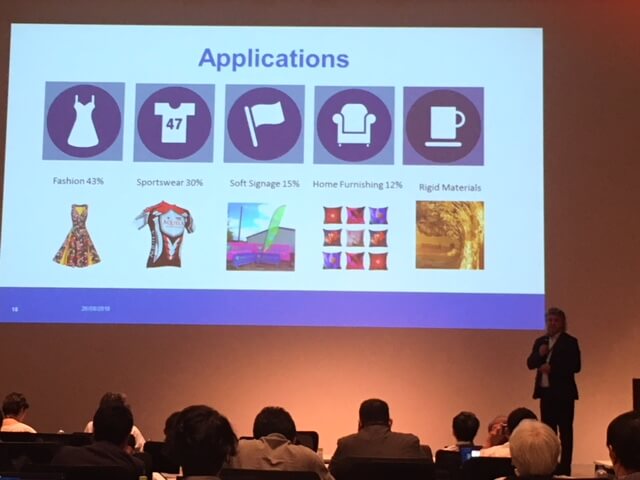
Neenah Coldenhove senior sales executive Gijsbert Harmsen provided insight into the world of sublimation papers
“The place of digital print in the Industry 4.0 revolution” was the theme of the conference’s third session, during which Kenichi Sugai, regional manager of Kornit Asia, and Jos Notermans, commercial manager digital textiles of SPG Prints, took to the stage.
Sugai used his presentation to explain fashion trends and they’re impact on production methods in the apparel industry. He also promoted sustainable short-term production for textile manufacturers. Sugai presented two case studies from Amazon Merch and Spoonflower, which were also referenced by other speakers during the event. This highlights the hysteria around emerging business models courtesy of digital technology.
Following Sugai, Nottermans pointed to mass production fashion retailers Zara, H&M and Uniqlo before highlighting the importance of digital printing to fast fashion. Today, higher variable (ink) costs, higher capital investment and increased maintenance (print head) charges are three issues impeding the growth of digital textile printing. Nottermans shared detailed calculations and comparisons to explain how SPG’s Javelin technology provides a cheaper alternative.

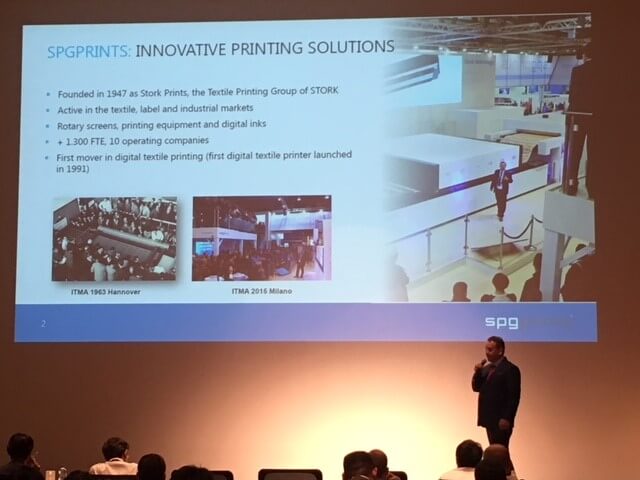
Jos Notermans, commercial manager digital textiles, SPG Prints
After listening to two inkjet technology giants, Tansy Fall, editor of WTiN’s Digital Textile magazine, looked at the technological developments from a broader perspective and explained the impact of Industry 4.0 on the textile and apparel industry. Fall referenced the Gartner Hype Cycle to chart the progress of both Industry 4.0 and digital textile printing, before forecasting the direction of traditional textile and apparel supply chains and the technologies that will support this shift.
After a break, the last session of the day started with Akihiko Tanaka, managing director of Lectra Japan, a company focussed on the creation and implementation of Industry 4.0 solutions. Tanaka analysed four megatrends: millennials, digitalisation, Industry 4.0 and China - he predicts these trends will define the future of the fashion and apparel industry. Tanaka also questioned why the adoption of digitalisation is so late to the textile industry and gave some tips to companies about what they need to do before going digital. As part of his roadmap, delegates listened to the challenges of Industry 4.0 and Lectra’s solution to empower its customers through industrial intelligence as they step into a new era of manufacturing.
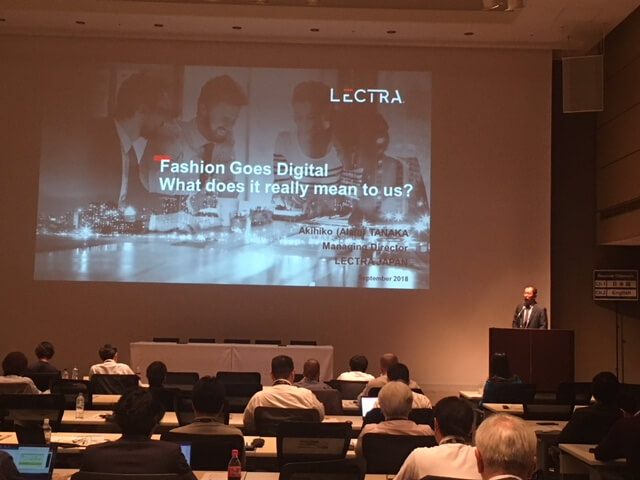
Akihiko Tanaka, managing director, Lectra Japan
Following Tanaka was Beckhoff Automation’s president, Toshimitsu Kawano, who offered insight into the future of the manufacturing industry guided by industrial IoT and AI. Kawano introduced recent trends that accelerate digitalisation by utilising IoT and AI. He gave examples from different sectors and also talked about his expectations for the textile industry.
Finally, before a panel discussion and the closing notes, Kenji Horie, marketing manager of Horie Weave Co Ltd, highlighted how a customer’s purchasing behaviour has shifted online, therefore forcing manufacturers to adapt to individual on-demand production as opposed to mass production. In this changing environment, Horie advised the necessity of developing systems that connect the factory and the Web before explaining in detail the open factory concept.
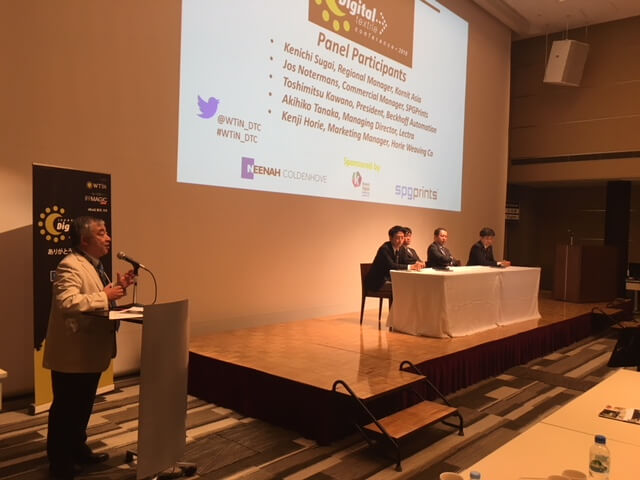
From L-R: Akiyoshi Ohno, Kenichi Sugai, Kornit Digital, Kenji Horie, Horie Weave Co Ltd, Akihiko Tanaka, Lectra Japan and Toshimitsu Kawano, Beckhoff Automation in the panel discussion
The speakers of the last session, including Kenichi Sugai from Kornit Digital, replied to questions during a panel discussion. They were asked how European OEMs could enter the Japanese market while top OEMs in the digital textile printing sector are already based in the country. The future of apparel manufacturing was another topic discussed during the session. The average age in Japan is increasing, as are workers skilled in sewing, which has led to a bottleneck. To combat the skills shortage, robotic sewing technology and sourcing skilled labourers from overseas were two solutions discussed by the panel.