EDANA Outlook returned this year for its 17th edition, bringing together leaders from across the nonwovens industry. Andy Rhodes looks back at the event.
Held towards the end of what has been another exciting year in the nonwovens industry, Croatia hosted the return of the annual EDANA Outlook conference, which sees academics, researchers and industry professionals discuss the latest developments, challenges and opportunities in the industry.
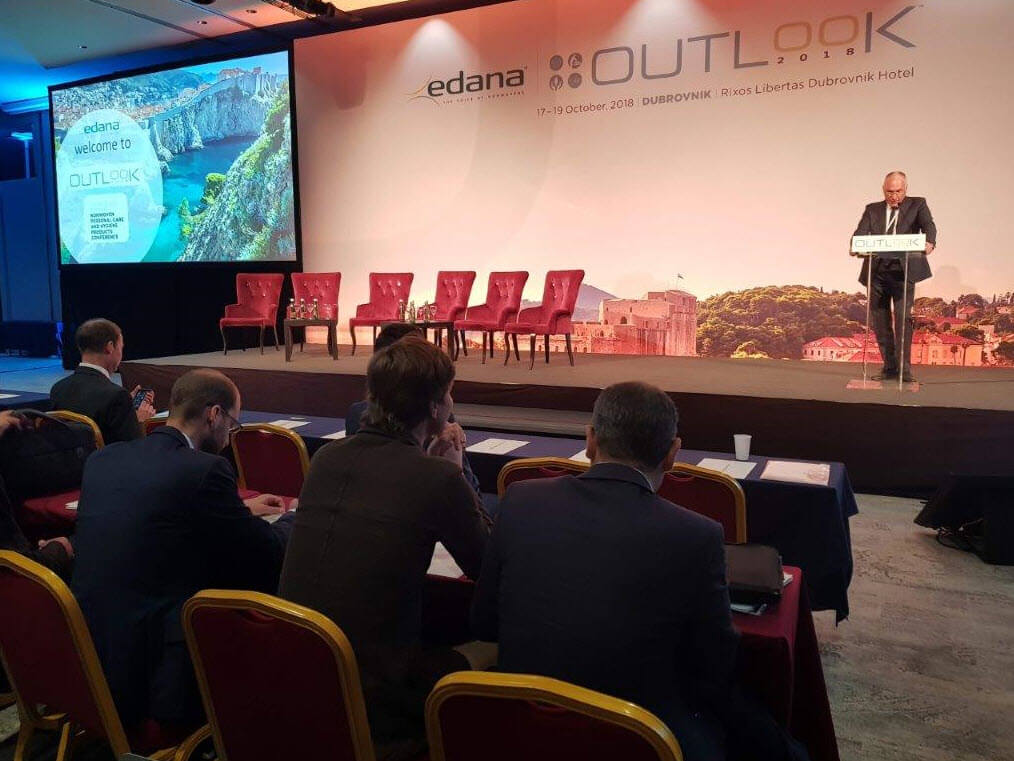
EDANA Outlook welcomed around 500 delegates to Dubrovnik, Croatia
According to the organisers, 510 delegates attended the conference, which also explored new product developments, market trends, performance and safety testing and sustainability initiatives in its opening two days. The third and final day, meanwhile, featured an interactive workshop focusing on building stakeholder trust in absorbent hygiene products.
Insightful programme
This year’s conference programme saw presentations delivered by experts from key nonwovens players including Procter & Gamble, Essity and Nice-Pak International on a range or prevalent issues. The opening keynote was given by Werner Bosmans, coordination plastics strategy, DG Environment, European Commission, who detailed EU circular economy and plastics strategies and their impact on the absorbent hygiene products industry.
In recent times, more emphasis has been placed on turning the nonwovens manufacturing industry into a circular economy, particularly in terms of single-use plastics and disposable wipes.
Similarly, Susan Iliefski, Janols, VP product sustainability, Essity Group Function Sustainability, explained how the company s inspired by the United Nations sustainable development goals. The UN has set 17 Sustainability Development Goals, while it has also created a 2030 agenda, while Essity itself has created a plan which it hopes will align the company with these goals.
The afternoon of the opening day was dedicated to the vast wipes market. According to research group Smithers Pira, the global nonwovens wipes market is valued at US$16.6bn in 2018 with 1.2 million tonnes expected to be consumed. By 2023, the market value is expected to rise to US$21.8bn with 1.6 million tonnes consumed.
However, many warn that the issue of wipes flushability needs to be addressed. Dr Stefanie Schlager, project manager R&D, Lenzing, discussed how enhanced flushability can be achieved by using fabrics created with Lyocell fibres. Wipes with a high level of plastic fibres do not breakdown in the wastewater system and can contribute to blockages known as fatbergs.
This new demand for renewable, eco-friendly wipes is proving to be a big opportunity for innovators within the industry. Jonathan Bourget, managing director, APIS REX, explained in his speech that new technologies, regulations and standards are creating new opportunities in this high-growth market, but that at present, the market is oversupplied.
The event’s second keynote was delivered by Professor Samuele Furfari, professor of Geopolitics of Energy, Free university of Brussels – Polytechnic School, who discussed the changing world of energy and petrochemical feedstocks.
His speech opened a second day which saw the wide-ranging nonwovens market explored in detail. Danijela Alilovi, R&D, Violeta, analysed the status of the absorbent hygiene market in southeast Europe, looking at regional differences and consumer purchasing power.
The nonwovens industry is said to be one of the most rapidly developing segments in the textiles industry, largely due to their increasing popularity and growing demand. Due to this, advances in the area are coming thick and fast, with many of these relating to the industry’s sustainable future.
Tyler Tibbits, VP sales and marketing, TETHIS, stated that the demand for sustainable products in on the rise, and that to successfully steer the market towards carbon neutrality, sustainability is required at all stages of the supply chain. This, he stated in his presentation, must include in the sourcing, manufacturing and afterlife stages.
Meanwhile, owing to tighter regulations being introduced in the industry, product testing is growing in importance. Alan Cottenden, emeritus professor of Incontinence Technology, University College London, explored laboratory test methods for predicting the in-use leakage performance of incontinence pads in nursing homes.
The event’s final session saw the nonwovens manufacturing process examined, with speakers including Ingo Mählmann, vice president, Oerlikon Nonwoven, discussing innovative nonwoven solutions for the competitive hygiene and medical nonwovens industry.
The event also featured a number of networking opportunities in the city, allowing delegates to discuss the industry’s latest trends and share ideas with fellow professionals.
The next edition of EDANA Outlook will take place in Athens, Greece, on 9-11 October 2019.