Today, a variety of coatings and treatments are available to provide protection for different substrates and, in the case of textiles, several products are available depending on the nature of the fibre, production method or requirements of the end product. The emerging coating technologies for protective applications highlight trends towards sustainable options within fire-retardant coatings, as well as nanotechnology advances for both protection against toxic gases and stab-resistant applications.
Fire retardance
The application of flame retardants to the finished textile constitutes the oldest method of making FR fabrics. There are two methods for treating a fabric surface for this type of application: using a finish agent via fabric impregnation with the selected chemical or using a coating that is applied to the fabric as an additional layer. It has been reported that “the use of phosphates, polyphosphates, phosphorous amides, phosphonium derivates, borax and boric acid or halogenated FRs” is common in finishes, while a variety of rubbers and synthetic polymers are used as coatings with the addition of phosphates and phosphonates. Additionally, decabromodiphenyl oxide (DBDPO) and hexabromocyclododecane (HBCD) have been used as coatings.
The pad-dry method is frequently used to produce non-durable finishes, while semi-durable finishes can be obtained if the fabric is cured. Back-coating is utilised when the aesthetic properties of the fabric face want to be preserved, hence a bonding resin is applied to the back side. In the latter, flame retardants must be able to confer protection also to the fabric face, therefore they often use compounds that act in the vapour-phase (eg antimony and halogenated chemicals) [1].
Incorporating milk proteins for FR protection
The ability of organophosphate esters to act as flame retardants, forming phosphate groups and charring when ignited, is at the basis of a study on caseins conducted at the Polytechnic University of Turin [2]. Caseins are found in whey, a by-product of cheese production, and they attracted the researchers’ attention due to the high content of phosphate groups. Cotton, polyester, a blend of the two fibres were protein-coated applying an aqueous suspension of casein powder in distilled water. When tested for flame retardancy, the results were certainly encouraging, with cotton and polyester fabrics becoming resistant to the flame application (residual material 86% and 77% in weight, respectively) [3].
Further tests must be carried out to assess the durability of the casein coating, however many finishing treatments on the market are not permanent and this is a good start. Also, it is known that products deriving from caseins often emit a strong smell [4] and this can discourage companies from investing and potential users from buying. Hopefully, new research in this field will focus on these issues and provide positive and informative solutions.
Incorporating graphene for FR protection
Graphene research is in continuous expansion and new applications for this formidable material are developed every day. The Hohenstein Institute for Textile Innovation is working with graphene layers as thin as an atomic diameter, producing coatings that have heat and gas protective properties. Researchers involved in the project aimed at applying graphene dispersions to a variety of fabrics to make lightweight protective equipment [5].
In another research, the combustion properties of cotton treated with phosphorus- and nitrogen-doped graphene oxides were studied. Phosphorus-doped graphene oxide and nitrogen-doped graphene oxides were tested and the results demonstrated that the former oxide can be used as a flame retardant. The presence of this compound was found to reduce burning and heat release rate as well as minimising smoke release [6].
Protection against toxic gases
Chemical warfare agents made from highly-toxic chemicals, and biological weapons that use harmful living organisms such as bacteria, are intended to kill or harm [7]. Moreover, it has recently become common for workers of some fields to work in an environment which requires enhanced protection against a range of threats, such as water-based chemical liquid splashes, asbestos, pharmaceutical and radioactive particulates or biological hazards [8].
For protection from these harmful substances, the body must be protected from poisoning by contact, inhalation or ingestion. This is accomplished by using respirators and protective clothing co-operatively. Some substances may remain harmful for a considerable amount of time, while a variety of dangerous substances are rapidly absorbed. It is for these reasons that protective equipment must be comfortable and practical to wear for long periods, while also being easy to put on following a warning of chemical contamination [8]. Although providing excellent protection, traditional PPE commonly gave rise to physiological distress that limited the time that the wearer could efficiently perform a specific role. In extreme conditions, traditional PPE can even threaten workers’ health and safety [9].
Traditional protective apparel has previously been based on two core functional elements: adsorbent protection, based on activated carbon or charcoal materials; and barrier protection, based on impermeable membranes. Activated carbon or charcoal is a small particle which can be used to adsorb hazardous particles from the air [9]. This unique property can be attributed to a large interparticulate surface area, made up of a tortuous network of micropores (diameter less than 2nm), mesopores (diameter between 2 and 50 nm) and macropores (diameter more than 50nm) [10].
Incorporating metal-organic frameworks for protection against toxic gases
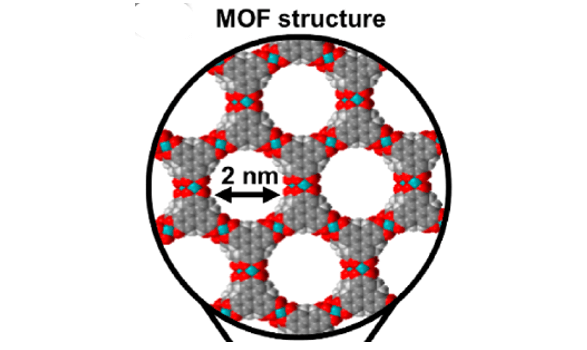
Here we report on a recently-developed coating method for protection against toxic gases, developed by the researchers at Dartmouth College, US. Who have developed a new smart fabric sensor named SOFT, which stands for Self-Organised Framework on Textiles [11]. The SOFT device features materials known as metal-organic frameworks (MOFs) and is a conductive, porous, material sensor integrated into soft textile fabrics. For this novel development, the researchers formulated a one-step fabrication method for novel, functional, conductive, flexible sensor material, designed to give electronic signals for the detection of chemicals such as nitric oxide (NO) and vehicle exhaust pollution (H2S), by coating both cotton and polyester fibres with two different conductive MOFs (Ni3HHTP2 and Ni3HITP2). In addition to sensing the chemicals, the SOFT device is also able to capture and filter the harmful toxins.
This smart fabric sensor can widely benefit wearers of hazardous material clothing by offering advanced protection against toxic chemicals. The smart fabric sensor can detect gas in real time while simultaneously capturing, pre-concentrating and filtering gases, offering great potential in applications such as haz-mat clothing. This new development can enable advanced protection for the haz-mat suit wearer, alerting the wearer if there is any tear or defect in the fabric, or if the suit is not giving the wearer full protection in any way, in comparison to passive protection that is seen in current products available on the market.
Approach for the incorporation of metal-organic frameworks to protect against toxic gases
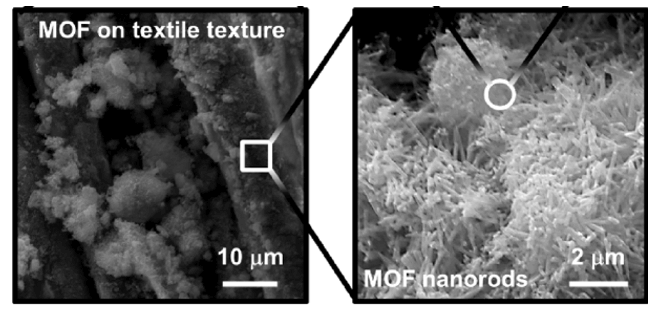
The researchers at Dartmouth College developed a method for the fabrication of flexible chemiresistive sensors supported by a textile substrate from a one-step simple approach, employing conductive metal-organic frameworks (MOFs), through the direct solution phase self-assembly of monomers; 2,3,6,7,10,11-hexahydroxytriphenylene (HHTP) and 2,3,6,7,10,11-hexaaminotriphenylene (HATP) organic ligands with metallic nickel (II) nodes onto natural woven cotton fabric and polyester nonwoven batting material. The aim was to produce Ni3HHTP2 and Ni3HITP2 coated textiles that are conformally coated with conductive MOF crystallites at the fibre level. Integration of conductive materials at the fibre level facilitates continuous conductivity while maintaining the functional integrity of the textile platform.
The uniformity and successful integration of the MOFs into the textile substrates was examined by comparing the MOF-incorporated textiles and bulk MOF that had been isolated from the SOFT device reaction solution. Moreover, the sensing properties of the SOFT devices were characterised in the composition of a chemiresistor against chemicals H2S and NO as common toxic gases emitted from human industry.
The researchers demonstrated the multifunctional utility of the SOFT devices in the context of chemiresistive sensing of toxic gases, as well as capture, filtration and preconcentration of gaseous analytes.
Results for protection against toxic gases after the incorporation of metal-organic frameworks
Chemiresistive sensors on a flexible textile substrate were fabricated by integrating conductive metal−organic frameworks (MOFs) onto a textile surface to form functional materials. Direct self-assembly of monomers produced durable large-scale electronic textiles. The conformal coatings of conductive material at the fibre level fabricated a novel SOFT device that is quick and simple to produce without any need for specially-designed equipment.
According to the researchers, the SOFT devices featuring MOFs can detect and differentiate toxic gaseous analytes of NO and H2S at 25pp and 10ppm levels respectively and maintain their chemiresistive function in the presence of humidity (5000 ppm, 18% RH). Moreover, they display reliable conductivity; results showed that both the SOFT natural cotton fabric and the SOFT polyester nonwoven material had a comparable level of conductivity performance. However, results also found that the SOFT devices failed to display conductivity if the MOF was not uniformly distributed. In addition, the results suggested that crystallisation of the conformal MOF coatings is imperative for the electrical and chemiresistive performances of the fabricated SOFT devices.
The SOFT devices were found to have stability to washing, while also maintaining the flexible properties of the original material after coating. These smart fabric sensors were able to be bent, twisted and wrapped around curved surfaces without any loss of conductivity. Findings also displayed the SOFT devices to be stable in heat, have good shelf lives and retain a full range of utility under humid conditions.
Protection against stab resistance
Textile materials with a highly-specific tensile strength and modulus are the common choice for the manufacture of protective body armour. With gun control legislation becoming increasingly strict, sharp objects have become accessible weapons, and injuries arising from stabbings are now much more common. Conventional body armour has traditionally been bulky, stiff, uncomfortable and challenging to disguise under clothing. Therefore, there is a greater requirement for flexible and wearable stab-resistant materials.
Aramid materials are well known for providing high-ballistic protection, however, these materials commonly have low puncture resistance. Recently advanced strategies have been incorporated into the development of stab-resistant materials to improve performance. This includes techniques such as treating the materials with resin or coating the material with hard and refractory particles to improve the flexibility of the material as well as its resistance to sharp objects.
Adding SiC particles to enhance stab resistance
Here, WTiN reports on a research outcome from Shandong Non-Metallic Materials Institute, China, detailing the development of a novel stab-resistant material that incorporates vinyl ester resin–aramid composites coated with silica (SiC) particles for the development of a cost-effective, high-performance and flexible stab-resistant material for use in body armour to provide increased performance [12]. The researchers verified that incorporation of SiC particles into thermoset resin/aramid composites greatly enhances the stab resistance of the material when compared with conventional woven Kevlar material, indicating that SiC particles are favourable for the development of high-performance stab-resistant textile composites.
Approach for the incorporation of SiC particles to enhance stab resistance
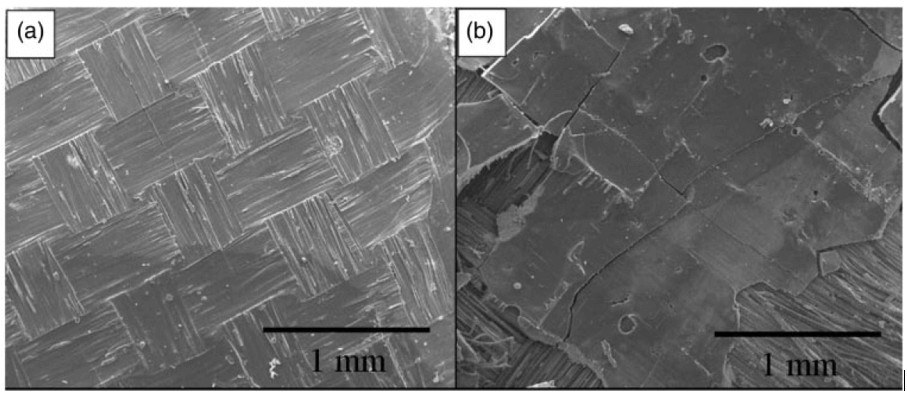
For the manufacture of this novel flexible body armour, the researchers saturated aramid fabrics with thermoset vinyl ester resin. The thermoset-aramid composites were subsequently coated with hard and resilient SiC particles. The researchers used Kevlar with a weight of 410 g/sqm and a thickness of 0.4 mm, with a plain weave structure as the base material, demonstrated in Figure 1a. Thereafter, the Kevlar material was coated with a controlled amount of SiC particles via the solution spray application on a single side of the Kevlar material, seen in Figure 1b. After the water from the SiC spray suspension evaporated from the fabric, vinyl ester resin was applied to the SiC-coated Kevlar via hand lay-up technology. After curing the fabricated material at room temperature, the samples were cut and prepared into multi-layered samples.
Results for the protection against stab resistance by incorporation of SiC particles
The researchers experimentally demonstrated that when SiC particles are incorporated into thermoset resin and Kevlar composites, resistance against knife penetration to the material is greatly increased. Incorporation of SiC particles was found to improve the fibre-to-fibre friction and blunt the sharp metal blades via abrasion, therefore improving stab resistance of the fabricated material.
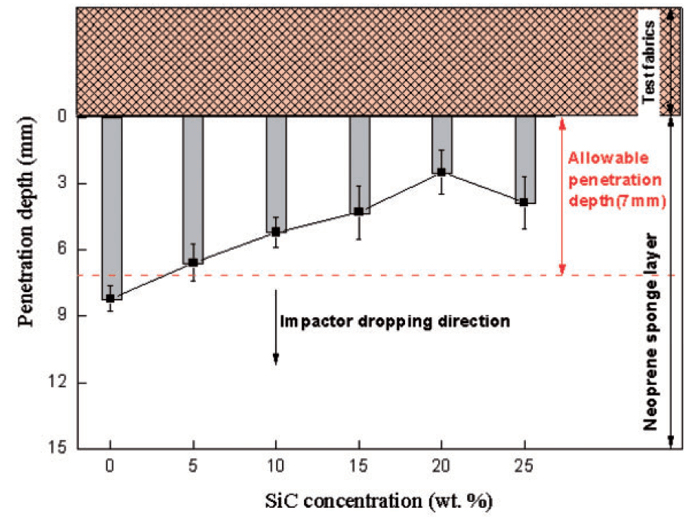
Additionally, it was discovered that 20 wt.% was the optimum concentration for the leading stab resistance against knife penetration, illustrated in Figure 2. Results found that, with an increase in the concentration of SiC from 5 wt.% to 20 wt.%, the stab resistance was dramatically improved. However, when the SiC concentration was raised above 20 wt.%, results demonstrated that stab resistance was reduced; researchers attributed this to a lower resin rate brought about by the increased SiC concentration, therefore reducing adhesion between the material interfaces.
Moreover, the dispersant PVP was found to provide the leading dispersion stability for the SiC particle suspension, in comparison to alternative dispersants chosen for testing such as PEG and TMAH. Additionally, the researchers characterised the stab resistance of a variety of samples, each with a different number of material layers. The experiment found that a higher areal density (nine layers of fabric with an areal density of 6.75 kg/sqm) gave increased stab-resistant performance. Additionally, the researchers demonstrated that, when coating the Kevlar surface with the SiC particles, energy efficiency of the fabricated stab-resistant material was improved by 11.25%, while the weight of the anti-stab material was reduced by 10 wt.%.
The researchers measured the tear force of the material because this strongly correlates to the tensile breaking strength and is therefore important to understanding the puncture failure of the fibres. It was experimentally shown that the tear force of the material was found to be marginally lower when coated with SiC particles. The researchers concluded that the lower tear performance was likely to be attributed to the decrease in resin rate, which was reduced accordingly with an increase in SiC particles. Moreover, the irregular shapes of the SiC particles may have been destructive to the fibres when the material was stretched, reducing the tear properties of the material.
Item 1
- N. R. C. Subcommittee on Flame-Retardant Chemicals, Committee on Toxicology, Board on Environmental Studies and Toxicology, Toxicological Risks of Selected Flame-Retardant Chemicals. 2015.
- A. Hellemans, “Milk Proteins Protect Fabrics From Fire.” [Online]. Available: https://cen.acs.org/articles/92/web/2014/03/Milk-Proteins-Protect-Fabrics-Fire.html. [Accessed: 19-Mar-2019].
- F. Carosio, A. Di Blasio, F. Cuttica, J. Alongi, and G. Malucelli, “Flame Retardancy of Polyester and Polyester–Cotton Blends Treated with Caseins,” Ind. Eng. Chem. Res., vol. 53, no. 10, pp. 3917–3923, Mar. 2014.
- “Sustainable and Recycled Fibres for Sportswear 2017.”
- “Projectdetails • Forschungskuratorium Textil.” [Online]. Available: https://www.textilforschung.de/en/project?id=10. [Accessed: 19-Mar-2019].
- H. Liu, Y. Du, G. Yang, G. Zhu, Y. Gao, and W. Ding, “Flame retardance of modified graphene to pure cotton fabric,” Orig. Artic. J. Fire Sci., vol. 36, no. 2, pp. 111–128, 2018.
- Q. Wei, Functional Nanofibers and Their Applications. Woodhead Publishing, 2012.
- “DuPontTM Tyvek® 500 Xpert | DuPont | DuPont United Kingdom.” [Online]. Available: http://www.dupont.co.uk/products-and-services/personal-protective-equipment/chemical-protective-garments-accessories/brands/tyvek-protective-apparel/products/tyvek-classic-xpert-chf5-coveralls.html. [Accessed: 20-Sep-2018].
- “Nanofibre Potential - HSI Magazine.” [Online]. Available: https://www.hsimagazine.com/article/nanofibre-potential-795. [Accessed: 20-Sep-2018].
- von Bicher et al., “Filter sheet material and method of making same,” US4,455,187, Aug. 1982.
- M. K. Smith and K. A. Mirica, “Self-Organized Frameworks on Textiles (SOFT): Conductive Fabrics for Simultaneous Sensing, Capture, and Filtration of Gases,” J. Am. Chem. Soc., vol. 139, no. 46, pp. 16759–16767, 2017.
- W. Rubin et al., “Enhancing stab resistance of thermoset-aramid composite fabrics by coating with SiC particles,” vol. 48, no. 7, pp. 1228–1241, 2019.