The Australian wool market bounced back this week after falling downwards during the previous three weeks.
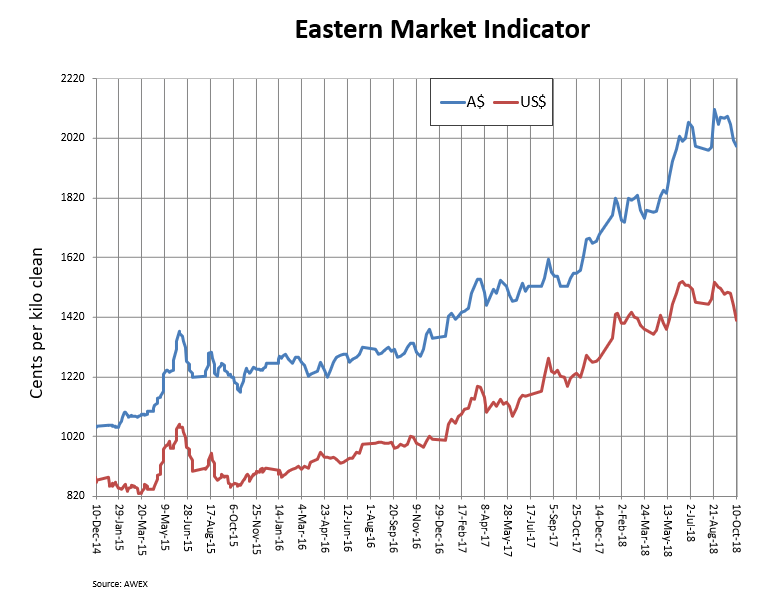
The Australian Wool Exchange (AWEX) Eastern Market Indicator (EMI) rose for the first time in a month, gaining 31 cents (1.6%) for the week to close on 2,023 cents per kilo clean on Thursday 11 October. In US dollar terms, the EMI was up by 20 cents (1.4%) to finish on 1,430 US cents.
The Australian dollar against the US dollar was reasonably stable during the week, before finishing 0.13 cents (0.2%) lower, to close at 70.72 cents on Thursday.
Analysts noted that with the rise in the EMI reversing three weeks of falls, it was repeating a mini-cycle that has been seen a number of times since the market started on its continuous upward path at the beginning of 2017.
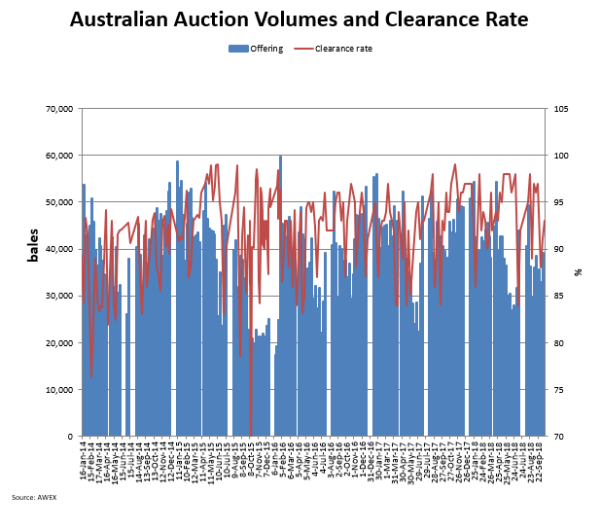
The total national offering this week was 32,072 bales, compared with 39,261 bales last week, resulting in a clearance rate of 93%.
Sales were held at all three selling centres on Wednesday 10 October and Thursday 11 October. On Wednesday, the EMI rose by 24 cents to 2,016 cents and in US dollar terms gained 25 cents to finish on 1,435 US cents. On Thursday the EMI was up by 7 cents to 2,023 cents and in US dollar terms fell by 5 cents to 1,430 US cents.
AWEX reported that although the Merino sector recorded overall losses last week, there were positive signs towards the end of the week, especially in the Western region, which recorded healthy increases on the final day. This positive tone was evident from the beginning of this
week. As buyer confidence increased, so too did the prices.
The strongest demand was for a limited supply of wool 20 microns and coarser, pushing these types up by 20 to 95 cents, with the largest increases seen in Melbourne.
AWEX said that although overall the Merinos recorded increases, a large national selection of fine tender wool struggled to attract sufficient demand. The better style and spec wools sold at similar levels to the previous week. However, the losses felt in the tenders resulted in the average AWEX Micron Price Guides (MPGs) for 17.5 microns and finer generally losing ground.
Analysts said that the greater demand for medium and broader Merinos reflects their relative shortage in the market. The closing average AWEX MPGs for these types were again very close, with only 28 cents covering the closing MPGs for 20, 21 and 22 microns.
The MPG for 16.5 microns fell by 7 cents (0.2%); 17 microns was down by 5 cents (0.2%); 17.5 microns declined by 1 cent; 18 microns increased by 15 cents (0.6%); 18.5 microns rose by 15 cents (0.6%); 19 microns was up by 37 cents (1.6%); 19.5 microns gained 47 cents (2.1%); 20 microns increased by 51 cents (2.3%); 21 microns climbed by 65 cents (3%); 22 microns rose by 96 cents (4.4%); 23 microns lifted by 56 cents (2.6%); and 24 microns declined by 22 cents (1.1%).
AWEX said that concerns about an oversupply of fine skirtings due to harsh growing conditions helped to push the broader types by up to 100 cents, with the higher vegetable matter types enjoying the largest gains, as buyers attempted to secure meaningful quantity of a limited selection.
The crossbreds had an overall positive sale, with most types and descriptions posting
gains. Only 28 microns failed to record increases for the week. Among the national AWEX average MPGs for the crossbred types, 25 microns fell by 8 cents (0.5%); 26 microns lost 20 cents (1.4%); 28 microns declined by 9 cents (1%); 30 microns increased by 25 cents (3.5%); and 32 microns rose by 7 cents (1.4%).
The oddment sector was again the poorest performer this sale. Despite having different results in each centre, overall the three carding indicators fell by 6 cents.
AWEX reported that the total value of the wool sold this week was AU$68.7m (AU$2,312 per bale), taking the season total to AU$978.7m (AU$2,379 per bale). Buyers for China were dominant, with support from buyers for Europe and India.
The offerings for the next three weeks are expected to be 16.5% less than in the same period last year. The forecast for next week (Week 16) is 37,664 bales, followed by Week 17 with 36,801 bales and Week 18 37,571 bales.