Independent consultant to the nonwovens industry David Jackson, offers his expert take on the flushable wet wipes debate and shares some insights from his former role at Kimberly-Clark.
The flushable wet wipes debate dominated the nonwovens industry last year, heightened by a recent study from consultancy firm WRC which found that all wet wipes sold as ‘flushable’ in the UK have so far failed the water industry’s disintegration tests, causing blockages that are highly expensive to put right.
 David Jackson
Responding to the findings, a statement from Water UK said: ‘No matter what it says on the packaging, most of our personal healthcare and beauty products must never be disposed of down the toilet’.
So, where are manufacturers going wrong when it comes to flushable wet wipes, and what materials should they be using to determine a successful outcome?
We put this question to David Jackson, an independent consultant at Materials / Process Connexxions in Atlanta, Georgia, and a retired technical leader at Kimberly-Clark. Jackson was one of the inventors of the original Kimberly-Clark flushable wet wipe.
“Firstly, you’ve got to deal with short fibres. Conventional carded nonwovens can’t be flushed no matter how you stick them together. The fibres are just too long and will simply rope up in the sewers creating blockages. Wood pulp of course works well,” says Jackson.
The team at Kimberly-Clark used airlaid wood pulp and 8 mm Tencel fibre to develop its flushable wipe, which Jackson says was very effective, but the development issue, he adds, came from the adhesive used. “The adhesive was specially formulated so that in a small amount of water it was relatively solid. The adhesive was designed to ‘salt out’ in a low concentration salt solution, which was part of the wipe lotion. Put it in fresh water and it disintegrated.”
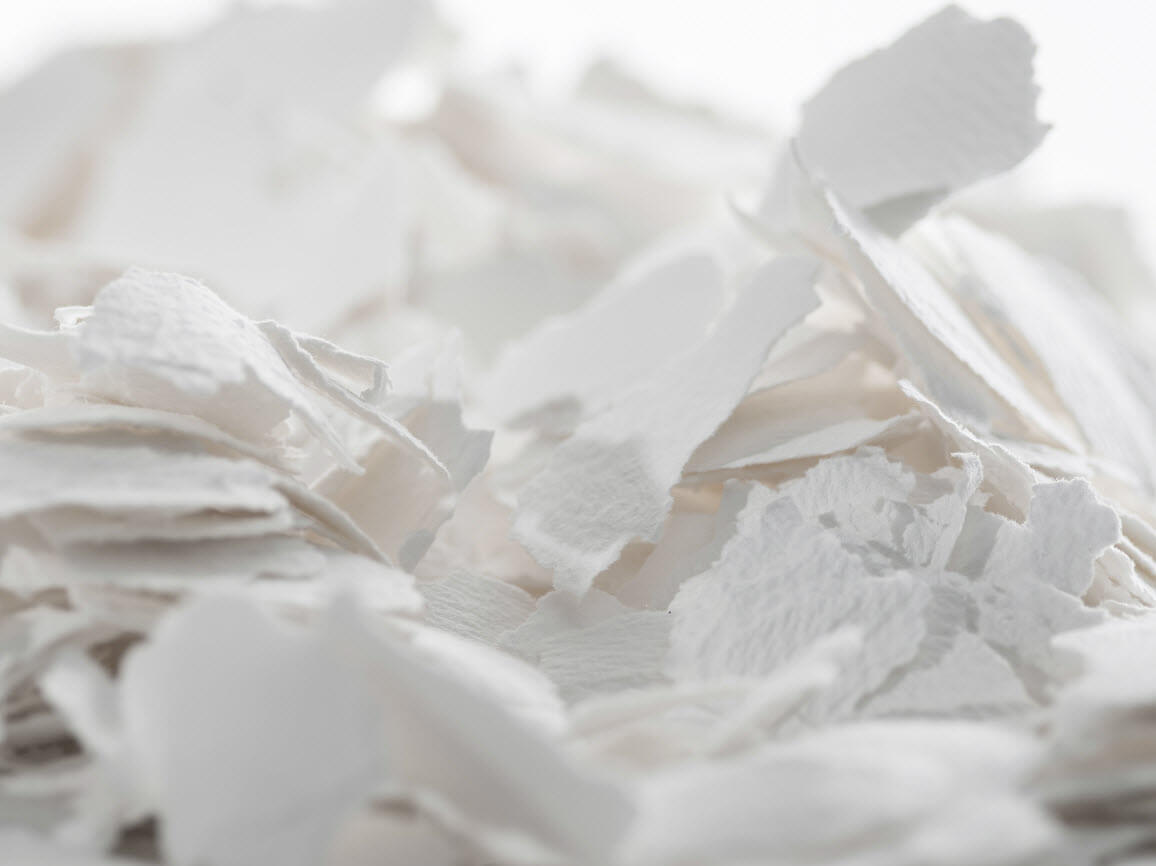 Wood pulp, such as that used by Lenzing, is considered an effective material for flushable wipes
Expanding on the correct fibre length or particle size to use, he says: “If it is less than 15 mm, almost everything will flow through the sewer pipes etc and get to the sewer plant so that it can end the congestion. The key is having something that has sufficient strength in use but will disintegrate in excess water. The sheet should have a tensile strength of about 75-100 grams per inch wet [three times its weight in liquid] that will survive in use and generally break up in excess water. That’s the rule of thumb that I’ve used for a while.”
Non-flushable wet wipes commonly contain polypropylene or polyester fibres which don’t easily break down in the sewage process, if at all. The incorrect disposal of such products by consumers has led to the development of new industry guidelines which state that non-flushable wipes packaging must display the Do Not Flush symbol.
Several manufacturers have explored alternative materials that are deemed flushable, but problems still exist – prompting one to ask why?
Part of the issue, says Jackson, stems from the ‘slosh box’ method commonly used to test the dispersibility of wet wipes, whereby a wipe is placed into an oscillating water-filled container. As Jackson found during his own test procedures, the quality of the water used can have a significant impact on dispersibility. That’s because the ‘harder’ the water is, the more difficult it is to disperse the adhesive bonded substrate, which is as it was designed. Additionally, the slosh box doesn’t indicate roping issues; a flow pipe with a projection simulates a typical house-to-street sewer pipe well, adds Jackson.
According to waterresearch.net, as water moves through soil and rock it dissolves very small amounts of minerals and holds them in solution. Calcium and magnesium dissolved in water are the two most common minerals that make water hard; and the hardness of water varies depending on where you live. If you live in an area where the rock is limestone, for instance, the tap water will be hard. As a result, Jackson says the slosh box method is ‘misleading’ if used with local tap water. “What’s important is making sure the product breaks up in lift pumps.”
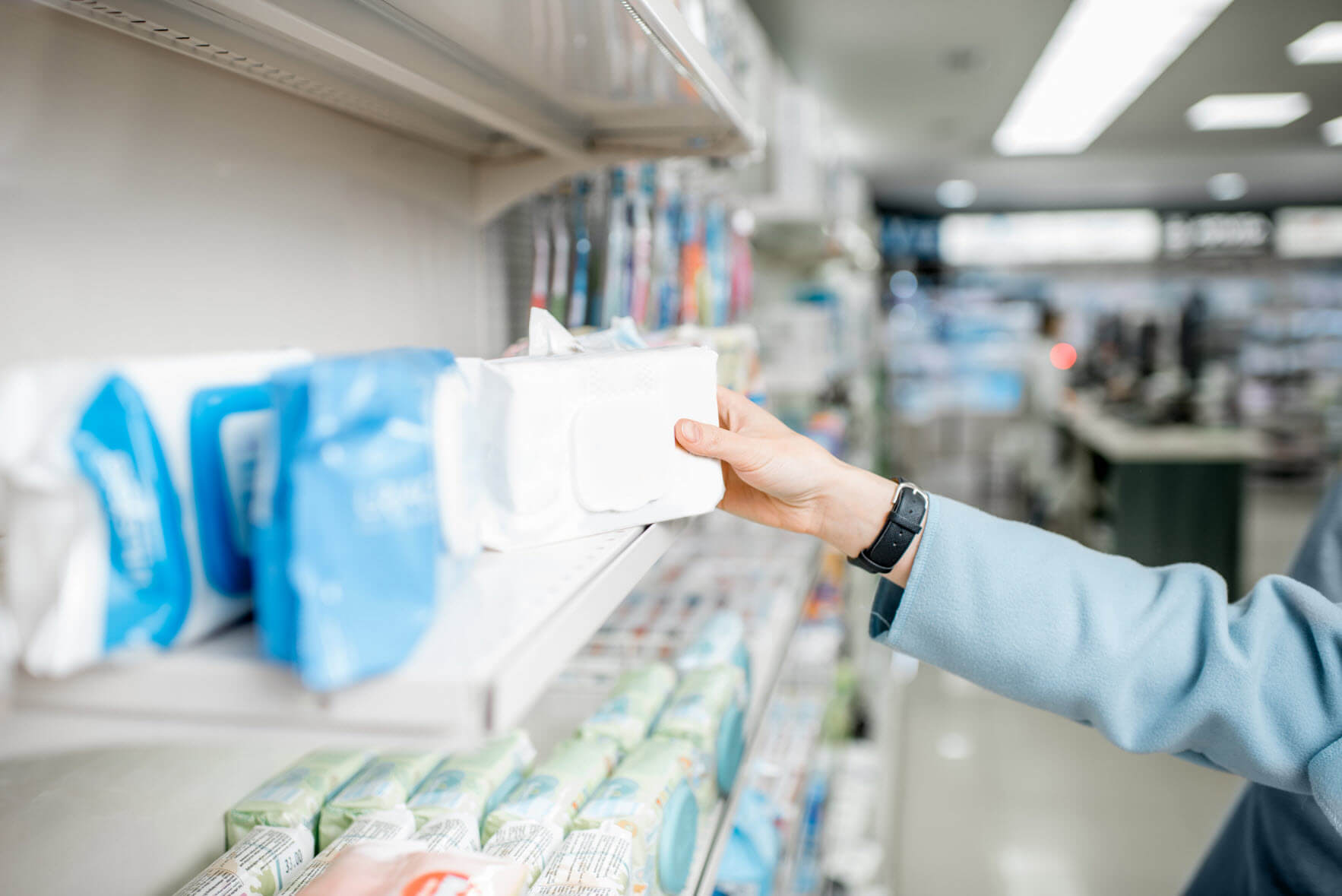 Wet wipes should be designed with shelf life in mind, says Jackson
Another issue that has hindered the wipes industry – particularly regards to transparency and education, says Jackson, is the lack of ingredient information currently available on wet wipes packaging. The Regulation (EU) No 1007/2011 of the European Parliament and of the Council regarding textile fibre names and related labelling and marking of the fibre composition of textile products, states:
“The indication of textile fibre names or fibre composition on the labels and markings of textile products listed in Annex V is not required.”
Instead, the only ingredients legally required on wet wipes packaging are lotions and other cosmetic add-ons. There is therefore no way of knowing what the wipes substrates are made of.
Additionally, Jackson points out that manufacturers need to consider the fact that these wipes must be able to survive a two-year shelf life, particularly as “you typically have raw materials that have a tendency to want to degrade in wet storage”.
Listing some appropriate fibres to use in flushable wipes, Jackson says: “Anything you make should contain viscose/rayon, Lyocell/rayon, PLA, cotton or wood pulp. And anything else you put in there needs to be made from water soluble polymers etc.”
Contrary to many media reports, Jackson stresses that rayon and cotton are no longer considered dirty processes. “There is 50-year old data about how polluting cotton and rayon are – but not anymore. It has changed dramatically because the industry realised it had to change dramatically and address the ‘greenness’ issue in fibre production.”
Sustainable solutions
Jackson’s main research interest is alternative disposal methods for disposable absorbent products and wipes. Much of this initial research was conducted during his 39 years spent at Kimberly-Clark. He also played a key role in developing an in-line alcohol treatment process for Kimberly-Clark Kimguard and Spunguard medical fabrics, supported the company’s Elastics programme through commercialisation of waist elastics and side panels, and championed the development of airlaid materials for use in feminine care thin pads and personal care wipers (Cottonelle Moist), to name just a few of his achievements.
 Jackson has spent time researching disposable hygiene products that can be composted
“In the late 1990s we looked at turning Kimberly-Clark’s products into either compostable items or those that could legitimately be flushed and degraded in active sludge,” he says.
The team based its flushable wipe, mentioned earlier, on the technology of a flushable diaper it investigated previously. The ability to one day be able to flush a whole diaper would certainly be deemed a significant breakthrough but, according to Jackson, “the hardest part of a flushable diaper is turning off the super absorbents, as currently they would suck up all the water in a commode”.
He continues: “It’s all doable but there are too many components. The barrier films have got to break up and the adhesives have got to be water soluble to a point. We tried to do a compostable diaper instead of a flushable one, but one of the problems was the elastics – they’re typically crosslinked polymers.
“Standard super absorbents are not degradable, but there are products that are based on protein chemistry among other things. The degradable side is workable, but the flushable side is very difficult; the product is too big.”
As part of his consultancy work, Jackson is encouraging companies to ‘do innovative stuff with new polymers’ including composting; something he also rallied for at Kimberly-Clark. But one of the setbacks he’s faced is the potential impact this could have on traditional nonwovens. He explains: “Part of the problem was the threat it posed to the current business, typically based on polypropylene and polyester. But you look at these solutions and yes, they are a little more expensive, but they’re probably no more than 30% more expensive when you get it scaled up, and closer to parity as oil prices increase. I’m very happy that Lenzing, for instance, has finally built a machine for Lyocell spunbond because I already had uses for it at Kimberly-Clark, but we couldn’t get it through. So, now I’m retired I’m trying to promote these ideas with other companies.”
One idea Jackson is particularly keen on is compostable wipes – something that would certainly ease the burden on sewage plants. There are parts of the US where municipal composting is beginning to be used as a disposal alternative. He refers to the Green Sports Alliance that began in the Pacific Northwest which has brought together a number of US sports teams committed to reducing landfill waste. By producing food service items from PLA for instance, the alliance was able to compost much of its waste – taking the overall waste from 85% to 15%. According to Jackson, the chair of the Green Sports Alliance, Scott Jenkins, revealed that its next step is food service wipes. “The great thing is that you can make a food service wipe out of all pulp-based (including rayon) or pulp and PLA mixture materials that can go through the composting system. A somewhat durable wiper is much better in use than paper towels, from a number used perspective. But the trouble with that is that I’ve not seen it happen yet. I’ve been trying to convince people to make it happen.”
Jackson says he has similar ideas for the medical industry, with the aim of producing dressings, wipes and lightweight absorbents that can be composted or shredded and flushed.
Alternative disposal methods to landfill are easier to achieve in Europe than the US and Asia as the infrastructure is currently there, since there is more history, says Jackson, who is working with a couple of startups towards workable solutions. “We’ve got to find the right product specs and production partners to make it happen; all those things are out there.”
For more information on David Jackson’s work and research background, visit http://nwconnexx.com/