‘Compliance and Technology – key factors for industry and retail’ was the focus of the International Apparel Federation (IAF) Conference, which made its Brazil debut in October, reports Marcia Mariano.
Recent research by CR Glasgow – Caledonian University Fair Fashion Centre, presented during the IAF Convention 2017, reveals that the fashion industry generates about US$2.5tn each year. One in six people in the world work in this sector, which employs around one million workers; 80% of which are women. Worryingly, however, it is also the second-highest user of water and the second-highest polluter – 85% of textiles are sent to landfills, responsible for 10% of global carbon emissions.
 The IAF Convention 2017 unites retailers and suppliers in Rio de Janeiro
Despite this concerning scenario, the 33rd annual World Fashion Convention, held for the first time in Brazil on 16-18 October, in Rio de Janeiro, surpassed the expectations of its organisers. The IAF is an international business platform with members in nearly 60 countries.
For three days, debates and lectures on issues such as technology, sustainability, social responsibility, demanding consumers and increasingly transparent production caught the attention of 350 participants. They left the event convinced that disruption is coming to the textile and clothing industry and that Brazil needs to move quickly to keep track of the New Age journey. Organised by the IAF, the International Apparel Federation, in partnership with Abit, the Brazilian Association of the Textile and Apparel Industry, the conference urged entrepreneurs, stylists, executives and retailers to rethink their business models. After all, as robotics increase in factories and smart clothes, the future has come, and it is here now.
At breakneck speed, disruption has destabilised companies through technological innovations that have broken the traditional way of production and created new products and new consumer markets, changing the value chain around the world. In some countries in Europe, Asia and the US, this is already a reality.
Robots are coming
At the inaugural lecture about Robotics, Automation and Industry 4.0 in The Age of Disruption, Mike Fralix, CEO of [TC]², a leading manufacturer specialised in 3D body scanners for the fashion, fitness and medical industries, invited participants to reflect on the transition from conventional production to the automated industry. He said: “Get ready! The robots have come out of the labs and are heading to the garment factories”, pointing to Sewbots System launched by SoftWear Automation in the US, a fully functional sewing robot that can make pillows, pants, mattresses and towels. But, despite praising the technology, Fralix stressed the importance of humans in determining the proper functioning of automated devices. “Jobs will not end, they will change,” he says.
Even the apparel industry, which so far has appeared immune to robotisation’s advances, was haunted by the invention of Sewbo, a start-up based in Seattle, US, which has created a process where a robot arm is able to sew a T-shirt from start to finish, without human intervention. Its inventor, 30-year-old engineer Jonathan Zornow was one of the conference stars. In the panel discussion, The Challenges of Moving Towards an Industry 4.0 Model, he explains that its goal is to achieve complete automation for apparel production.
 Jonathan Zornow predicts a complete automation for apparel production
As an industrial robot still hasn’t the perfect skills of the human hand, essential to holding sewing tools, Zornow developed an innovative process to temporarily stiffen fabric with a water-soluble polymer, making it rigid enough for a robot to handle. Once made, the piece needs to be washed to return to its normal condition. Zornow says his next challenge will be to perfect the method that makes this process sustainable, since washing generates residues.
Some concerns
How do we implant Industry 4.0 where computers talk directly to machines, without leading to the unemployment of millions of people? And, how do we meet the requirements of sustainability and the growing demand of intelligent and transparent production, in socially and economically different countries? Is it possible? “Not yet,” say most executives in response to the research of McKinsey & Company global management consulting. The survey is conducted every two years.
Saskia Hedrich, senior expert, Apparel, Fashion & Luxury of McKinsey & Company presented the exclusive inside research topic General View of the Textile and Apparel Industry in the Global Market. The research was attended by 63 executives of the supply chain from Europe, the US and Asia. None of the respondents pointed out suppliers from Latin America including Brazil, although this is one of the world’s biggest apparel and textile markets in terms of production and consumption.

Saskia Hedrich
The first step of McKinsey & Company’s research was to verify the automation potential, the technical and economic viability, and the rate of adoption of companies to this new reality. The predictive analysis is the use of data, statistical algorithms and machine learning techniques to identify the probability of future results based on historical data.
To the question: ‘How do you rate the digitalisation maturity of your suppliers?' 57% of executives ranked their suppliers’ current digitalisation as very low, although they see CMT automation as slightly more mature. Only 16% rated their efforts as very high, and the remaining percentage chose medium. The use of Condition Monitoring Technologies (CMT) allows maintenance to be scheduled and also actions to be taken to prevent failure and avoid its consequences. It is a major component of predictive maintenance.
Regarding track and trace technology use in production, including upstream supply, 52% of respondents said their use was very low, 22% said medium, 16% responded with very high, and 10% did not respond at all.
The next question asked: ‘By when will automation in manufacturing reach a significant enough level and become the major driver for sourcing decisions instead of labour cost?’ Only 6% of respondents say that this will happen in 2020, while the majority (56%) say they will find it viable in 2025, and 27% bet in 2030. The remaining 3% of executives believe that it will not be possible even by 2050.
Among countries with the best performers in terms of sourcing digitalisation maturity, China is the clear leader according to 81% of executive respondents, followed by Turkey with 33% and Bangladesh with 30%. From Europe, only Germany appears, claiming 8% of the response.
Given the trend towards automation, the next question asked, ‘To what extent do you believe manufacturing will return to the US or Europe within the next five years?’ 43% of respondents are pessimists against 38% of optimists which means that, in this regard, expectations are more balanced.
According to McKinsey & Company’s research, automation of garment manufacturing in China could achieve an adoption rate of up to 50% by 2030. The step changes will be fast. In 2010, the rate of China was zero, but until 2025 it will reach 13%, reveals the consultancy’s research. On the other hand, it points out that the pace of automation adoption in the US garment industry could be quicker, reaching 63% by 2025 and 75% by 2030.
Looking to the future, the top-of-mind issues for sourcing executives are speed, transparency and flexibility. The structural changes expected by executives by 2030 provide a clear roadmap for the transformation.
At the end of the lecture, Hedrich says that companies must first improve their internal processes before going digital. “Executives believe that supply must be integrated into the value chain. Research shows that there are some players who are moving forward in the digitalisation of supplies, but in terms of structural change, I think they will have to invest heavily in technology and find talents with a new mentality, different to the old model.”
Hedrich also suggests a focus on decisions: “If you want to work with fewer factories and major reliability, you should improve efficiency from start to finish. Most respondents point towards connecting and partnering with strategic suppliers to build up a competitive eco-system. I think they should experiment with new collaboration models involving new supplier start-ups and fashion schools to optimise the end-to-end process for supply chain flexibility.”
Main challenges
One of the most discussed panels of the IAF Convention was ‘The Role of Governments and Institutions in International Compliance Demands to the Apparel Industry’, whose moderator was the president of Abit, Fernando Pimentel.

Fernando Pimentel, president of Abit
Peter Poschen, Brazilian director of the International Labour Organization (ILO), emphasises the need to discuss the technological evolution and its impacts on labour and environmental activity, aiming at finding a balance. “Many industries, pressured by global brands that want low-cost fashion apparel and fast delivery, seek underdeveloped countries for greater productivity and competitiveness,” he says.
Poschen cites Ethiopia, one of Africa’s poorest nations, which is becoming the world’s new apparel base. “It is necessary to establish responsibilities on the part of the companies and create a culture of respect for human rights and legislation in the countries where it maintains its factories,” he says. “There is an urgent need to reduce dull overtime and combat slave labour, while raising incomes and improving working conditions must also be a priority for organisations of the new millennium along with technology.”
Pimentel clarifies that Brazil is one of the 48 countries that approved the Due Diligence Guidance for Responsible Supply Chains in the Garment and Footwear Sector, launched by the Organization for Economic Co-operation and Development (OECD) in 2015. “Compliance and relationships with suppliers should be a two-way street. In Brazil, we have a heavy tax burden and rigid labour laws for formal companies, while on the other hand, there is low government efficiency against illegal domestic trade and unfair competition from imported products.”
 Peter Poschen, Brazilian director of ILO
The Brazilian Textile and Apparel Industry Association (Abit) is one of the most important entities among the Brazilian economic sector. It represents a production force of 30,000 companies located throughout the national territory; companies of all sizes that employ over 1.6 million workers and together generate an annual revenue of US$36.2bn (according to 2015 data). Brazil produces 5.5 billion garments per year, including beachwear, jeanswear and homeware.
Pimentel concludes: “The IAF Convention has motivated our imagination, mainly regarding new technologies that are improving the productivity of the industry. However, if innovation is a keyword, creativity is also very important. We are developing an advanced manufacturing project with Senai (textile education institute) aimed at providing a new perspective. Brazil will not be a platform for standard low-cost products, but an emerging creative player in the global fashion market.”
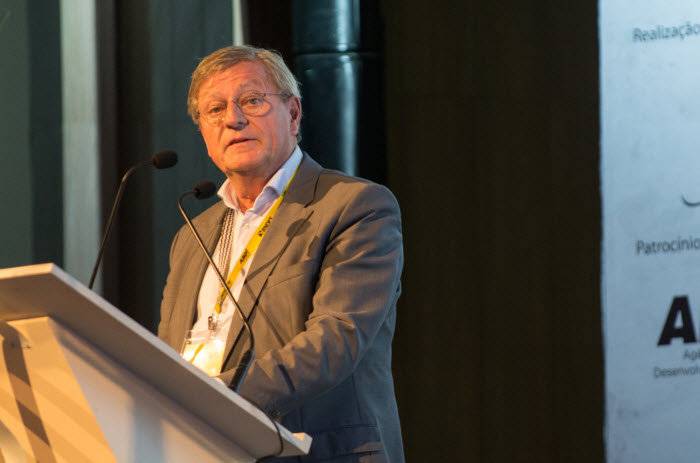
Han Bekke, president of IAF
Han Bekke, president of IAF, adds: “The first convention in Brazil was a success. Abit’s organisation, qualified audience and renowned speakers were also excellent. Besides, Rio de Janeiro is a beautiful city and the people are very welcoming.”
The next IAF Convention 2018 will take place in Maastricht, Netherlands. For more information, visit www.iafnet.eu.
Have your say. Tweet and follow us @WTiNcomment