
Whilst working on an alpaca garment finishing project in the Centro de Innovacion Tecnologica Textil (CITE Textil) of the Instituto Peruano de la Alpaca y Camelidos (IPAC) in Arequipa several years ago, Erika Muñoz was curious to see if it was possible to felt alpaca fibre and produce different and interesting qualities of finished cloths and garments.
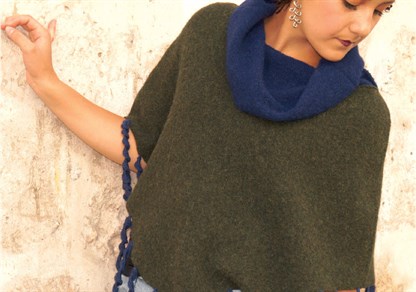 |
| A ladies' felted alpaca poncho from Brisan’s collection |
Her colleagues advised her that it was not practical due to the small scale count, when compared to wool, on alpaca fibres but, nevertheless, it was a thought that would nag her until 2009 when she formed her own company, Brisan E.I.R.L., and commenced to produce a range of knitted garments and accessories in alpaca.
Once her knitwear range was established, she turned her attention to woven fabrics and, in particular, the finishing techniques that could enhance them. Being only a small-sized business - the company has a staff of eight employees - the challenge to mount a research and development programme to investigate how best alpaca could be felted was a daunting one, and Muñoz decided to consult local alpaca finishing expert Andres Manrique.
Manrique, with almost 30 years experience of applying various finishing applications to alpaca garments, was keen to get involved. “Alpaca is renowned for its softness of handle and excellent drape in tailoring,” he explained. “Garments that have been felted are very much in fashion and command higher price levels, especially in export markets.
“Our approach was to focus on techniques that could be applied on a small scale, allowing Brisan to offer bespoke and unique products rather than anything on a larger basis, and without losing the characteristics that define and identify alpaca to the final consumer.”
 In 2012, Muñoz and Manrique applied to the Peruvian government’s Innovate-Peru scheme for small business development, and were awarded funds by its Fondo de Investigacion y Desarrollo para la Competitividad (FIDECOM) based on their proposal to felt alpaca fabrics and garments in regular cylindrical drum washing machines (in Brisan’s case a machine made in Spain).
Muñoz and Manrique contacted the main suppliers of textile finishing chemicals and enzymes in Peru and laid out a programme of experimental conditions to encourage alpaca to felt using their specialised products.
The parameters that they defined as a priority were to control the variables associated with the water used in the machine, namely temperature, pH, and the relationship between immersion in an aqueous solution and the application of steam.
Then, the mechanics of the machine process were governed with regard to the process’s time-cycle and drum speed (rpm). Here the amount of time the garment is in the machine and the speed with which the agitation process is carried out at are seen as critical in achieving the balance sought between felting and retaining fibre properties.
The measurement of the success of the experiments was determined by the retention of alpaca’s smooth handle, overall appearance, drape, elasticity, dimensional stability and comfort factor.
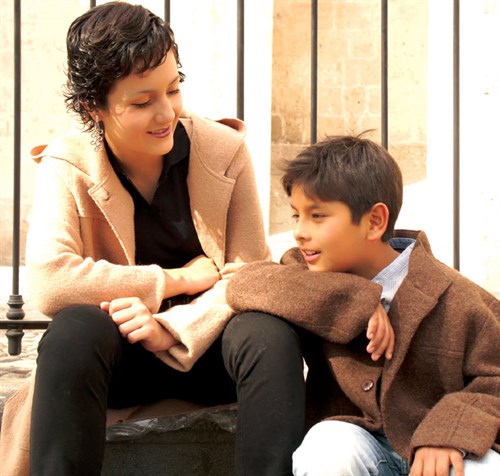 |
| Ladies' and children's felted alpaca coats from Brisan’s collection |
Muñoz recalled: “Once we received the funding, our work commenced in earnest and, two years down the track, we now have a range of felted products such as coats, jackets and tops for both ladies and children in a range of different weights which we sell in our domestic market and, following contacts made during Alpaca Fiesta [held on November 10-15, 2014] in Arequipa, we have commenced to trial and sample abroad.”
Brisan’s full felted range is comprised of 100% baby alpaca; 70% baby alpaca / 30% wool; and 60% superfine alpaca / 40% wool. The company has also successfully felted a blend of 70% baby alpaca / 30% silk, which has a surprisingly agreeable handle, though, as Muñoz points out, its commercial viability and value is yet to be established.
The successful commercialisation of a range of felted alpaca garments has helped Muñoz define a new strategy for the business and open up new avenues of opportunity.
“Whilst the knitted garments that we have produced since 2009 are a key aspect of our place in the world of fashion, it has to be said that the market for small alpaca knitwear manufacturers in Peru is increasingly competitive,” she explained.
“Our development of felted woven garments has taken us into a new market niche, but equally important has been our focus and specialising on felting as just one of various textile finishing processes now available to us.”
 |
|
One of Brisan’s medium-felted ladies alpaca coats |
Brisan has been able to branch out and offer commission services for other small manufacturers that require their knitted panels and fabrics to be washed prior to final packaging. The company is currently contracting its services to local manufacturers of garments and fabrics in cotton, wool, alpaca and blends.
This service has recently been stepped up to include laundering and care services for hotels and corporations, where bedding materials, towels, furnishings, tableware and uniforms are laundered with Brisan’s trademark of retaining the items’ original tactile characteristics. The range of processing includes laundering (both wet and dry), stain removal, steaming, ironing, making buttonholes, and sewing on buttons and labels.
A nagging curiosity and the will to conduct an investigation into the prospect of felting alpaca has resulted in a success story for Erika Muñoz and Brisan. The business model that Muñoz has created enables small orders for felted alpaca products to be realised using standard, affordable machinery in Arequipa’s small business textile sector, which increasingly operates in a way similar to that in Prato, Italy, where individual companies offer their services to both allies and competitors alike.
It is a good example where, instead of pursuing a large scale production path, an entrepreneur has shown that the added value of a final product can offset its lack of production volume.
From the alpaca industry’s viewpoint the fact that alpaca and blends can be felted successfully helps keep it in contention with other natural fibres in a fashion world that is evermore competitive.
Looking to the future, Muñoz said: “Felted alpaca gives the fibre a new texture and different property and is one way of overcoming some of the limitations that have excluded it from certain fashion applications. Brisan has had a useful learning experience in the possibilities offered by finishing techniques in general. I believe that we can build on this and explore new techniques to improve and enhance the fibre’s natural characteristics for the benefit and pleasure of the final consumer.”