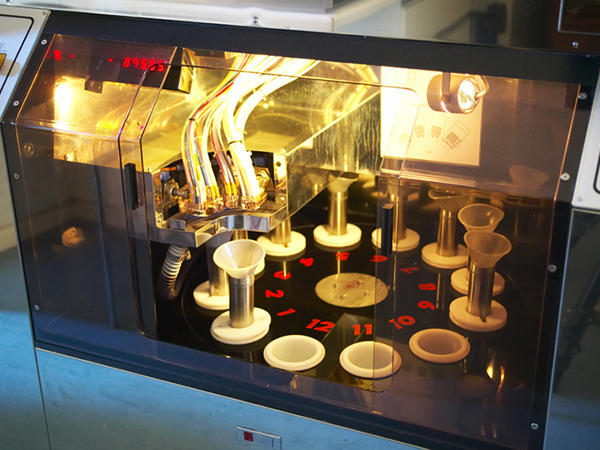
DP Dyers, in collaboration with Future Fashion Factory, will develop a digital recipe prediction system that will cut waste and lead times in piece dyeing. Otis Robinson reports.
“Working with wool is part art and part science,” says Paul Johnson, managing director at WT Johnsons, a UK-based textile dyeing and finishing company, “because wool is a natural fibre that doesn’t always behave in either the way you think it will or the way that you want it to.”
Such is the reason the company will collaborate with Future Fashion Factory, a UK-based, GB£5.4m (US$7.4m) research and development (R&D) programme, to develop a digital recipe prediction system that will help simplify the dyeing process at its dyehouse, DP Dyers.
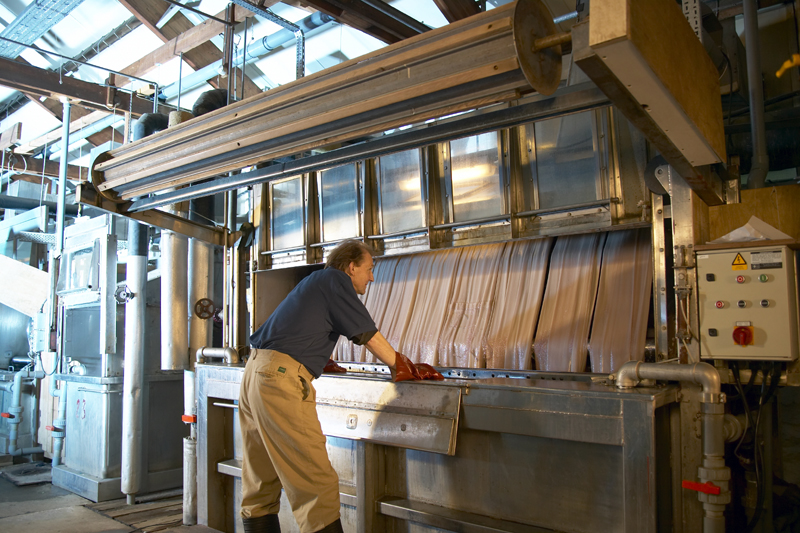
Recipe prediction system
DP Dyers is an independent dyehouse and wholly owned subsidiary of WT Johnson. The company provides piece dyeing services for a range of textile applications including home furnishings, fashion and apparel companies – notably for use in the high-value, luxury wool fashion segments, which Johnson notes is a necessity within the UK market, which cannot compete with the low-cost production of fast fashion in territories like China and Bangladesh. The dyehouse also caters to a wide range of run requirements, from “A4 sample size, through three metres, up to 800 and 1000 metres”.
Johnson acknowledges that fabric dyeing – a method of dyeing that occurs in the late stage of textile manufacturing, and the facility’s own dyeing method of choice – is not necessarily a hugely popular option for buyers. Rather, many opt for other dye processes that occur earlier in the supply chain.
“[Fabric manufacturers] tend to dye textiles earlier in the supply chain (for example, yarn dyeing). This costs more money, but they can be a little more certain they are going to get what they want.
“Historically, what’s been stopping buyers [from choosing piece dyeing] has been the accuracy of colour matching, because the later in the chain you colour the textile, the more variables become involved.”
This includes hurdles like dye uptake. The managing director explains that if the fabric is not scoured or cleaned in a uniform or repeatable process, dye uptake may waver and lead to a different shade than expected. Other variables may relate to the substrate itself – yarn type, misjudged counts, and more.
Ultimately, according to the managing director, the aim of the project is to develop a digitalised recipe prediction system that will help refine this dyeing process, reduce inconsistencies and strengthen its offering in the market. Such an ambitious goal requires two courses of action. Firstly, the team at the University of Leeds will scrape data from DP Dyers’ historical dye library.
“We have a largely manual recipe history. They are going to digitalise that library so we can access [this information easily] on a computer. Having captured all of that data from countless recipes on countless fabrics, going back many years, [the University of Leeds team] will create a recipe prediction system that accesses this recipe and colour library.
“If they can put years and years of our history in dyeing shades on different types of fabrics into a [digital format] and then extract that information so we can predict colour recipes for various substrates, that sounds pretty handy to me.”
Secondly, the team will identify the aforementioned variables that can be “knowingly or unknowingly introduced when you are trying to dye fabric”, says Johnson, to ensure the utmost dye accuracy every single time. For the University of Leeds team, this will mean examining both the dye process at DP Dyers and fabric preparation beforehand with a fine-toothed comb to track all variables within the facility.
Johnson and Dolley explain that digitalising and predicting the dye recipe process will improve the speed and accuracy of dyehouse operations, while doubly offer productivity improvements and reduce energy use.
“We have a manual system that goes back many years, and it takes a bit of effort,” Johnson confesses. “If, when we look at [a dyed fabric], something’s not quite right, we have to make additions of dyestuff until it’s right.”
Or even worse still, Johnson says, there are rare occasions where the dyed fabric is rejected by a customer.
“You have to put the fabric back in the machine, and that’s an absolute disaster, because now you’re dyeing it twice and only getting paid once.
“[But] if the digital prediction system can be more accurate [than our manual system], then we’re looking at an increase in quality, correct first-time dyeing, reduced reworks, reduced lead times, increased productivity, more business, increased profits.”
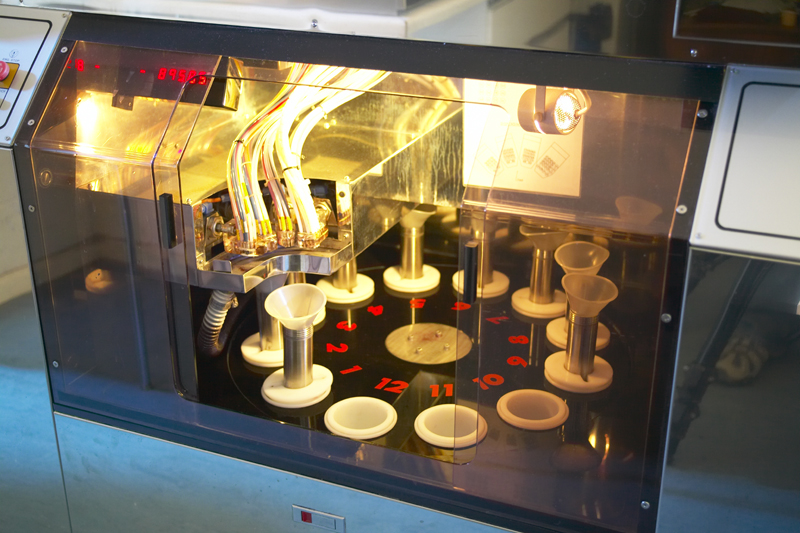
Digitalisation
The collaboration marks WT Johnson’s third funding round from Future Fashion Factory. Another digitalisation project intends to develop a system to rapidly detect weft misalignment in the fabric finishing process using an intelligent sensory system. These partnerships mark an essential move for the company and its subsidiaries towards digitalisation.
“[The move to digital tools is essential because of its] speed and accuracy,” says Johnson. “We hope that the recipe system in particular will be more accurate than the [manual] one we have at the moment.
“[By digitalising our process], we’ll be able to do the job that we do at the moment more accurately, quicker and with less resources.”
Dolley remarks that the project offers a unique opportunity to improve the reliability of the company’s piece dyeing offering using future-focused tools. As industry increasingly digitalises, B2B customers are on the lookout for companies that embrace digitalisation as a solution to longstanding industry issues.
“Our customers want us to deliver the right shade every time,” Johnson explains. “What we want to deliver is the right shade every time, without any damages and within a reasonable amount of time. That’s the simple [goal] of the business.”

Johnson says he is a supporter of the Future Fashion Factory concept, whose collaborations have forged essential bonds between industry and academia.
“This is an opportunity to work closely on useful industrial projects. This is good for the university; it is good for industry; and Future Fashion Factory is a great example of the way that industry would like to see universities and industry collaborating. It’s a real breath of fresh air.”
“The company has a long history of [pushing innovation],” adds Alan Dolley, technical director at WT Johnson. “While [the University of Leeds are experts on] digital technologies, DP Dyers knows a bit about shaking things up and getting into new, opportune areas to improve our product.”
Johnson concludes: “Having said that, working with wool is part art and part science.
“We want this project to move as close to the science bit as we can.”