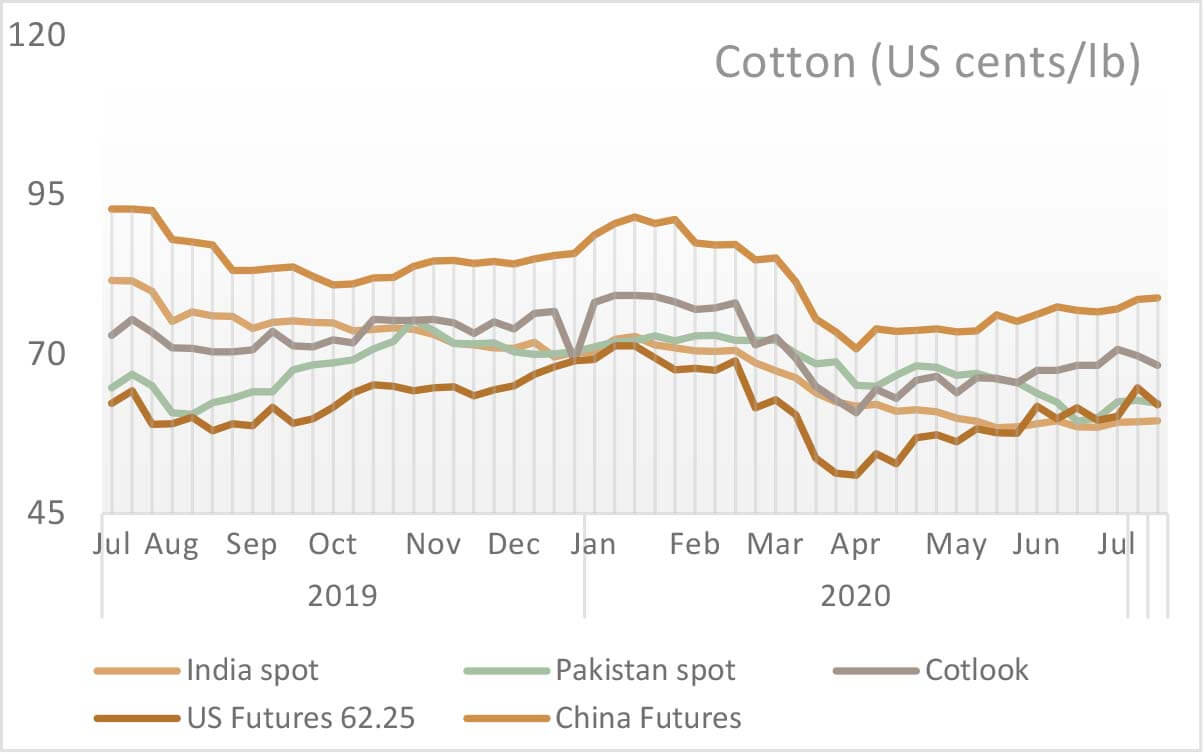
US cotton futures moved lower on the week due to weak demand for US cotton, despite a worsening drought situation and soaring temperatures across West Texas. Weak demand was evident in the latest round of USDA weekly export data. Net export sales and shipments were off significantly against the previous sales period. Some showers occurred across the Mid-south and the Southeastern states over the past week, but little precipitation was recorded across West Texas as temperatures soared. The latest crop progress report suggested slightly worsening conditions of this season’s crop. New crop forward contracting was deep into doldrums. Current levels offered no premium over likely prices at harvest, effectively eliminating any incentive to commit. Meanwhile, the US and China continued to trade barbs. The Phase Two trade negotiations with China have been set aside now.
Contract for October lost US cents 2.70 or 4% on the week, at US cents 62.01 per pound. December contract also gave back US cent 2.37 or 3.7% at US cents 61.94 per pound.
Global spot benchmark, the Cotlook A also eased US cents 1.50 or 2% to US cents 68.20 per pound. It had opened the week high at US cents 70.15 per pound but continued to fall later only to end the week with a small gain.
In China, spot cotton markets were range-bound amid thin liquidity this week. Offers for Xinjiang-origin mechanically-picked grade-3128 in were flat week on week at 12.30-12.40 Yuan a kg (US cents 79.68-80.32 per pound). Logistac were partially affected by restriction in Xinjiang due to pandemic. The China Cotton Index inched up 32 Yuan on the week to close at 12,163 Yuan a ton (US cents 78.79 a pound, up US cents 0.25 on the week). Imported cotton values eased on the week. Offers for US-origin EMOT SM July/September loading were at 14.14 Yuan a kg (US cents 91.60 per pound) on sliding scale duty, and at 12.67 Yuan a kg (US cents 82.08 per pound) under 1% in-quota tariff. Cotton markets are likely to extend weakness on sluggish demand.
In Pakistan, the official spot of Karachi Cotton Association was lifted and lowered midweek by PakRs100 to stand stable on the week at PakRs8,575 per maund ex-Karachi. According to reports, cotton sowing during the current 2020-21 season was down 1.3% compared to last year. Cotton was cultivated over 2.457 million hectares against the target of 2.663 million hectares. Thus, 92% of the target was achieved. Area in Punjab was down 2.5% while it was up 2.7% in Sindh. Reports also stated that southern Punjab, including Multan, cotton production may affect due to White fly the attack on cotton crop. Meanwhile, textiles and clothing exports posted a decline of 6% in fiscal 2019-20. According to the official data, readymade garments exports dipped 3.8% in value and 10% in quantity during July-June fiscal year, while those of knitwear dropped 4% in value and 10% in quantity.
In India, cotton price movement remained mixed in spot market this week. Some varieties were cheaper by INR300 per candy and some up INR100-200 a candy. Benchmark Gujarat Shankar-6 was traded unchanged at INR35,000 a candy (US cents 59.53 per pound). Cotton sowing was completed over 11.3 million hectares compared to 9.63 million hectares last year same period. About 10.79 million hectares were under BT cotton. Higher acreage was reported in Telangana, Maharashtra, Andhra and Karnataka this season. Meanwhile, cotton export shipment in June was at 480 thousand bales worth INR829 crore or US$111m. This takes the total export to 46 lakh bales in the first nine months of 2019-20 marketing season. Bangladesh was the largest market during June, followed by China and Vietnam. Export price realisation averaged INR101 a kg or US cents 61.50 per pound during June. This was lower compared to Cotlook A index, and higher than domestic spot price for benchmark Gujarat Shankar-6.