

The International Textile Manufacturers Federation (ITMF) has revealed findings from its second survey and urges governments to support their respective textile industry.
Between 28 March and 6 April 2020, ITMF conducted a second survey among ITMF members and affiliated companies and associations about the impact the Covid-19 pandemic on the global textile value chain, especially on current orders and expected turnover in 2020. In total, 700 companies from around the world participated.
The results
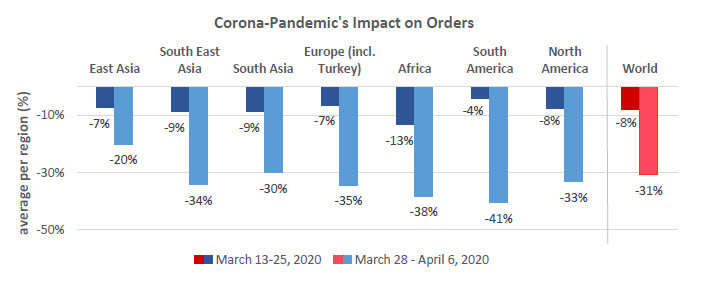
The results show that companies in all regions of the world suffered significant numbers of cancellations and/or postponements of orders. Globally, current orders dropped by 31% on average. The severity of the decrease ranges from 20% in East Asia to 41% in South America.
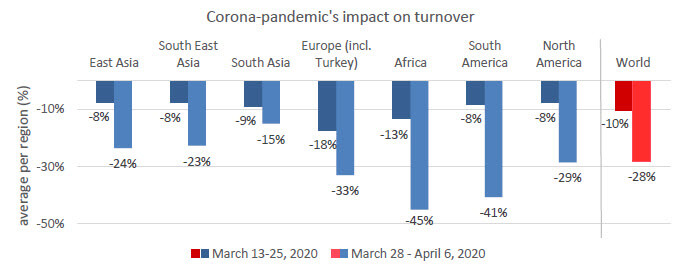
The results show that companies in all regions of the world are expecting their turnovers in 2020 to be significantly lower than in 2019. On world average, the turnover in 2020 is expected to be 28% lower than in 2019. While in South Asia the expected turnover will fall by 15%, and companies in Africa are expecting a drop of 45%.
Only three weeks ago, some regions were not fully affected by the coronavirus. The new numbers on orders and turnover reveal the dramatic extent this demand shock has had on the textile industry around the world.
The uncertainty about the duration of the crisis weighs heavily on the industry. Companies around the world said that challenges include the lack of current demand and/or fear that future demand will drop significantly, in addition to the lack of liquidity. On the flip side, companies producing fibres, yarns, fabrics and end products with healthcare and protection functions will see new opportunities.
The results of the third ITMF survey about the impact of the pandemic on the global textile industry will be released on 23 April 2020.
ITMF urges governments to support their respective textile industry
Against the backdrop of the Covid-19 outbreak, which has spread across the entire globe, the ITMF is urging governments to increase support for their textile and apparel industries to overcome this period of unprecedented demand and supply shock.
Kihak Sung, president at ITMF, says: “Textile and apparel companies around the world are struggling along with millions of workers and employees. In such times, both the public and the private sectors must work closely together to avoid an economic and social meltdown.”
Some industrialised countries have sophisticated instruments such as short-time work. To avoid laying off workers, companies are reducing their working hours and wages, with the government making up some of the employees’ lost income. Most governments in developing countries do not have the necessary mechanisms in place and are lacking the resources. “Therefore, it is important to find creative solutions between governments, international institutions and the private sector, that can be implemented quickly,” Sung adds.
Covid-19 has forced governments around the world to introduce lockdowns and all sorts of exit restrictions, leading to a sudden closure of all sorts of ‘offline’ business for textiles and apparel. Within a few days, shops and stores of any kind selling ‘non-essential’ products have had to close, cutting off global demand of textiles and apparel.
In the past three weeks, ITMF has conducted two surveys among textile companies around the world. The first survey in the second half of March indicated already the dire consequences of this demand and supply shock: orders were down by an average of around 8% globally and turnover in 2020 is expected to be down on average by 10.5% compared to 2019.
The second survey conducted at the end of March and beginning of April highlights the devastating impact the pandemic has on the global textile industry. Across all continents, orders dropped on average by dramatic 32%. On average, companies around the world expect their turnover to plunge by 29% compared to 2019.
Furthermore, the survey reveals that companies are struggling with many issues. The two most important and pressing issues are, first, to keep the workforce safe, and second, to have enough liquidity to cover all the running expenses. Both issues are essential for the survival of each company.
In the short-term, the safety and health of everyone working in a company is indispensable. In the medium-term, the availability of liquidity is crucial. In such a situation it is important that governments step in, if possible, with the support of international financial institutions like the International Monetary Fund or the World Bank to provide fibre, textile and apparel companies with financial assistance.
Sung says: “The ITMF is asking governments to provide banks with additional credit facilities backed by guarantees of states and/or international institutions, to suspend any taxes or any other forms of social levies and contributions etc with the objective to provide companies with enough liquidity to overcome this critical period.”
At the same time the ITMF is asking all stakeholders in the supply chain to work closely together. Above all, ITMF is asking retailers and brands to refrain from making use of any ‘force majeure clauses’ in their contracts with suppliers. These would lead to a cascade of cancellations of orders that are ready for shipment or in the process of completion. Instead, brands and retailers as well as all other stakeholders in the supply chain should have dialogues and look for creative solutions that allow partners to survive this unprecedented period together.
While the supply chain is certainly disrupted dramatically, all stakeholders should do their part not to destroy it, ITMF says. If otherwise healthy companies go under because of insufficient numbers of orders and/or a lack of liquidity, the supply chain will not be capable to produce the necessary number of products with the necessary quality and speed once demand is returning.


