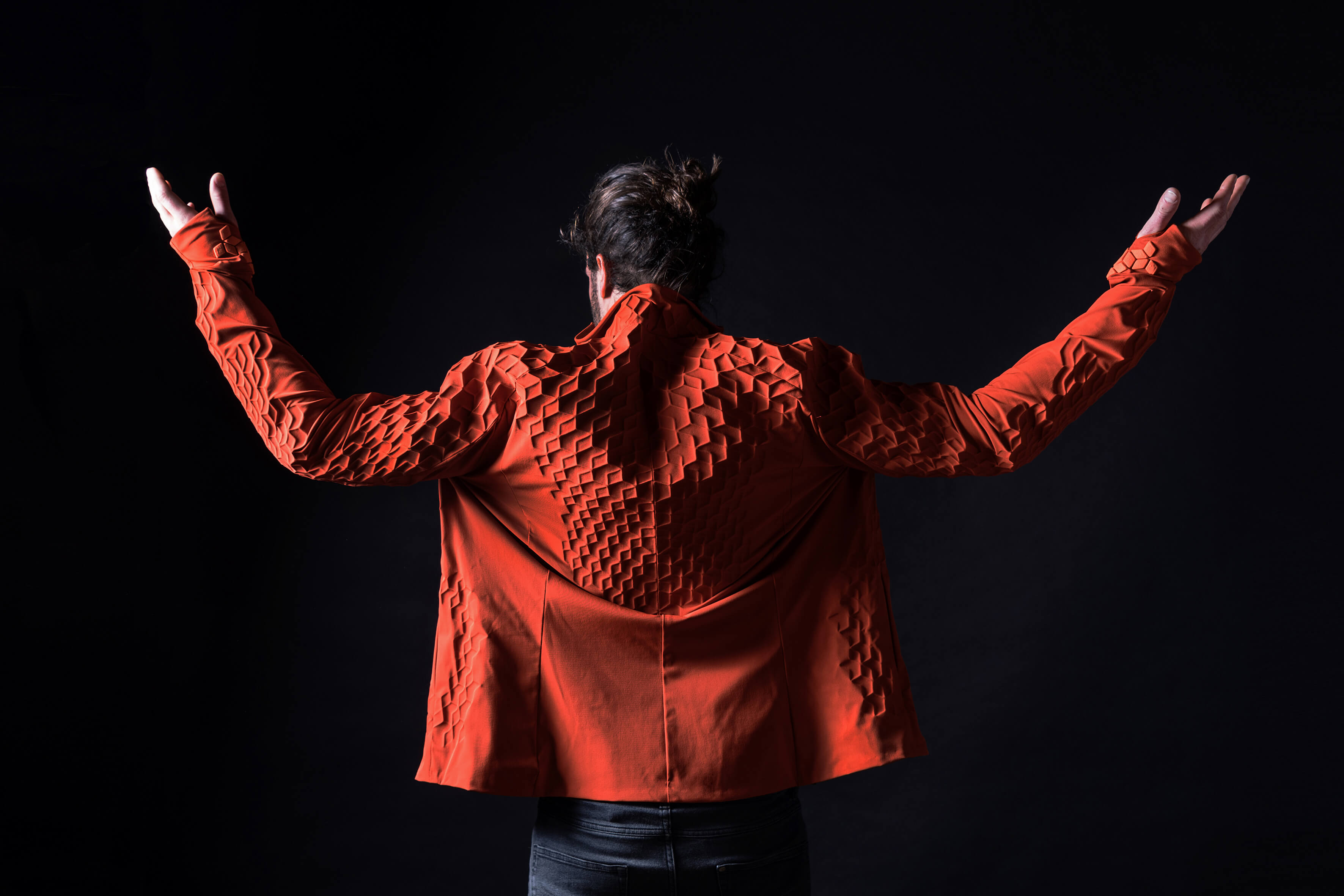
At Innovate Textile & Apparel, the German company is exhibiting its three-dimensional textile printing technology.
The last time WTiN spoke to GRDXKN, the company had just exhibited at ISPO and it was receiving quite a lot of interest from players in the sportswear and protective garment industries. However, like most other companies, Covid-19 hit a short while later and negatively affected the company’s plans.
“Of course, the pandemic impacted us,” says Bastian Mueller, founder, GRDXKN.
“All of the fairs got cancelled and some of my clients stopped their development programmes. But we then started a small mask project and that has been successful.”
After a couple of months, Mueller says that business started to resume as normal and now he is able to come back to the core work of GRDXKN. While the company lost some work, at the same time it has gained some new clients from different product areas. However, with physical events still not taking place, he still needed a platform to showcase his company.
“At a time where our understanding of a fair is changing, it is a pleasure to be a part of Innovate Textile & Apparel as a new format for showing our work,” he says.
“We all need a window to show new developments. And being a start-up company, visibility is very important to GRDXKN.”
This is the first time that the company has participated in a virtual event and Mueller says that he thinks these types of show will continue even after the Covid-19 pandemic. He says: “This is just the starting point for a new format of exhibitions.”
GRDXKN started out as a project for Mueller’s diploma as an industrial designer at Burg Giebichenstein University of Art and Design. What he has created is a textile printing technology that enables a two-dimensional textile to become three-dimensional, while adding lightweight, sturdy, flexible and abrasion-resistant characteristics.
Essentially, what he has made is a fluid mixture that is printable on almost any type of textile. Similar to screen printing, the mixture is applied to the fabric and dried in an oven, which is where the 3D effect takes shape. As the water is evaporated, the colour fixes and the growing component within the mixture creates a foam and binds itself to the textile.