Dmitry Sarbaev, managing director of Fluxmall DTG – a Vietnamese direct-to-garment (DTG) machinery distributor since 2014 – assesses the challenges facing DTG print service providers in the Vietnamese economy.
The direct-to-garment (DTG) printing industry in Vietnam continues to evolve. If we take a step back and compare where the industry was three years ago, and its development since, it is hard to underestimate the progress it has made.
The DTG market in Vietnam suffered from supply-chain issues and consisted largely of garage-sized print service providers operating repurposed machines. But the Vietnamese DTG market is now growing at a steady pace courtesy of a strong local fashion industry and an acceleration in the implementation of branded DTG machinery. But to continue this upward curve, sustained foreign investment is required from international businesses.
And despite an upturn in fortune, the DTG market in Vietnam is still trailing its regional rivals which includes Malaysia, Indonesia and China. For the industry in Vietnam to mature, there are certain obstacles it must overcome.
Playing safe
Following dialogue with experienced screen printers in Vietnam, it can be concluded that many do not have a clear vision of the future. Evidence suggests inkjet technology is going to continue to grow its share of the textile printing market post-Covid-19 and companies in Vietnam need to have a plan in place to capitalise on this shift. It is important that textile print service providers, whether they consider inkjet technology a worthy investment or not, have a development plan in place so they have a clear structured strategy for the future.
However, there are several reasons why development plans are lacking. A language barrier might sound like an outdated problem thanks to tools like Google Translate, but because of this many business owners don’t have a profound understanding of the DTG printing market in western economies.
Similarly, their knowledge of new business models like on-demand manufacturing and the power of ecommerce appears to be lacking.
Moreover, the middle-aged businessman is quite often more conservative than a millennial counterpart and is therefore more likely to base their decisions on culturally established ways of developing a business. The assumptions they make are regularly based on price points, but they lack the understanding that outpricing doesn’t work because labour costs are higher in traditional garment printing compared to digital DTG printing.
Some business leaders in Vietnam also lack the knowledge that DTG printing involves the use of high-tech machinery and software, premium consumables and a skilled workforce. Therefore, digital DTG printing requires an entirely different approach to that of traditional analogue printing. Because of this, there is a degree of scepticism among traditional textile printers in Vietnam around new business avenues, pricing, investment costs, and new printing applications.
In contrast, young entrepreneurs are well informed about the global DTG market, have experience with many online fulfilment platforms and can easily adopt the most up-to-date business trends into their strategies. Helping these teams to grow with their DTG ventures is a long-term target, but it also builds the foundation for the future landscape of the market in Vietnam.
Branching out
Geographically, the vast majority of DTG printshops and factories are located in or around Hanoi and Ho Chi Minh City.
Ho Chi Minh City has a population of nine million people and is also home to the highest concentration of digital DTG print service providers. Hanoi is less crowded but being the capital, it contains more printshops working for fashion brands. The remainder of Vietnam carries a lot of potential for the DTG market, particularly in the cities with populations of over one million, but there remains a distinct lack of DTG decorators.
Overall, compared to Europe and other well-developed markets, Vietnam has a very weak domestic infrastructure which means spare parts and consumables are hard to locate. Print service providers in Vietnam are forced to order spare parts from abroad which increases machine downtime, compromises product quality, lengthens turnaround times and challenges the effectiveness and profitability of digital DTG operations in Vietnam. The country is the third largest exporter of textiles and garments in the world, but its domestic market has been neglected.
But the tide is slowly turning, and there is reason for optimism. There has recently been a shift among OEMs who are beginning to take the DTG industry in Vietnam more seriously. This has been reflected in their decision to appoint authorised and qualified distributors to maintain enough stock across the country to satisfy the needs of end-users. Nevertheless, more still needs to be done.
Copyright measures
Another major drawback which prevents international companies from actively investing in Vietnam’s fashion decoration market is the lack of functioning regulations and policies for copyright protection. As much as you see citizens on the streets of Ho Chi Minh City or Hanoi wearing the familiar designs of premium western brands, social media fan pages of local printing companies are flooded with fake photos of their production setups taken from other places in the world, and of artworks they have never printed in reality. The setups are either poor or non-existent, meaning in some cases the production is outsourced. Moreover, artwork is also easily copied, distributed, and printed without the owner’s permission. This makes the business climate suspicious and inhibits the development of many companies. A true highlight of the market are the companies who sensitively approach this matter by respecting people’s labour and rights, and who enter business negotiations with relevant NDAs and license agreements that protect the intellectual property of the buyers.
Educational incentives
The DTG market in Vietnam will move in a positive direction once legitimate efforts have been made to nurture the next generation of fashion designers, equipment operators, service technicians and production managers.
By doing this, new marketplaces will emerge as more people become passionate about DTG printing and garment decoration. Subsequently, entrepreneurs are expected to enter the market and leverage their skills to the advantage of their newly established enterprise and the DTG industry more broadly.
Educational establishments should be the foundation for this, but many pupils do not have access to the equipment and tools required to develop the necessary skills for a career in the DTG printing industry. Direct communication with industry professionals is also lacking, so pupils are starved of industry-related knowledge.
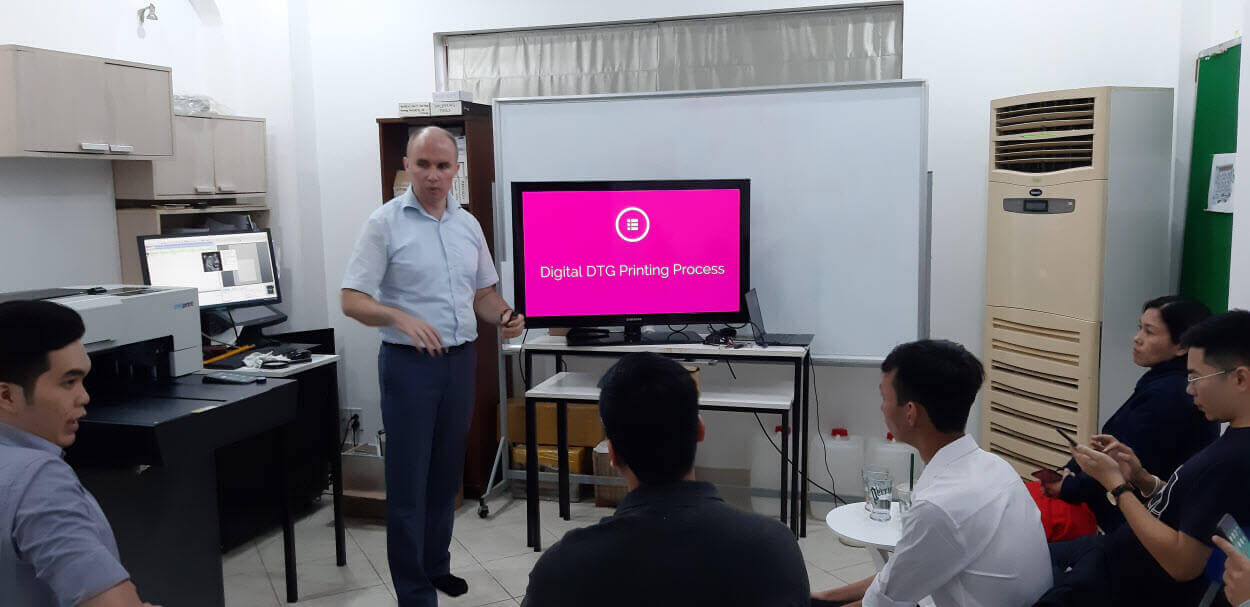
FLUXMALL DTG has fronted several incentives to educate young talent in Vietnam and build awareness of DTG technology nationwide through equipment demonstrations in organised workshops, equipping university labs and helping students to accomplish their fashion projects with digital prints in the most creative way.
Covid-19
The Covid-19 pandemic has also exposed a lack of hard cash in the hands of those who would like to keep investing in new technologies, namely DTG. Vietnam’s financial market has never looked favourably upon financing deals for compact semi-industrial solutions like DTG printers. The system has always preferred to support large, heavy machinery investments such as analogue screen printers. But even existing consumer financing has slowed down which has piled more fiscal responsibility onto the shoulders of the buyer. Consequently, decision makers have been forced to rethink pre-planned investments.
An evolving business
Evidence suggests the challenges facing garment decorators in Vietnam are easing. The country is receiving more machines built from the ground up as opposed to modified DIY solutions. Traditionally, Japanese brands enjoy a high share of the Vietnamese machinery market: buyers in Vietnam are enticed by the machinery’s fast speed and seemingly easy operation.
More responsible buyers do their homework by analysing ownership expenses, including operational outgoings like the cost of idle time and spare parts. Their purchases are arguably more rational, giving preference to some of the European or Australian equipment manufacturers. Choosing the right DTG machine, and the team that comes alongside to support and service it, has a substantial impact on further business operations. But it is the business model that truly defines which DTG machine is to be acquired.
The number of DTG printshops both in Hanoi and Ho Chi Minh City shows steady growth, and though it has slowed down during the pandemic, not all investments have been halted. The vast majority of these printshops provide DTG printing services starting from the promotional market to local fashion brands. Most of them have already got some basic experience with either silkscreen, vinyl or dye-sublimation printing, and would seek opportunities to target the niche of cotton-based garments with full-colour prints.
Some, being more focused on unique and creative designs, purchased a DTG printer to expand their product portfolio and start selling shirts, jeans, or other garments under their own brand name. They feel quite confident to own and operate entry-level DTG machines that are easy to use and keep running costs low. Thus, they can control their profit margins and keep production in-house.
Local brands and sustainability
A highlight for the digital DTG printing industry and the driver of its growth across the country is the expansion of local fashion brands specialising in streetwear and casualwear. From tiny teams of a few people to professional offices with foreign investment encompassing dozens of bilingual young, energetic, creative fashion designers and digital marketeers, these brands dominate the landscape of online fashion for the Vietnamese-speaking audience of TikTok, Instagram and Facebook. Their fast fashion concepts generate a constant demand for digital prints, therefore creating more printing jobs for garment decorators. It is a competitive niche which also requires high quality standards, hence not many DTG contractors are able to provide a relevant premium-type printing service.
FLUXMALL DTG has been privileged to partner with some of the key leading local brands on the most complex artwork in DTG printing. This has enabled brands to deliver the best quality to their audience and price their garments at a premium.
Furthermore, consumers are becoming increasingly concerned about their environmental footprint, so much so that purchasing decisions are being influenced. DTG printing is a more sustainable printing method when compared to other analogue and digital textile printing processes, not least because of its compatibility with water-based pigment inks. Consumer awareness is sending a strong signal to the fashion and textile market in Vietnam, and local garment decorators, to hasten the adoption of digital DTG printing technologies.
Online trends and mass customisation
Unsurprisingly, the mass customisation business model is yet to be fulfilled in Vietnam, partly because owners lack access to existing webshop solutions. Moreover, customising hundreds if not thousands of items per day requires a more in-depth approach to the workflow and necessitates continuous efforts to raise the effectiveness of the DTG production process. Print service providers in Vietnam also need to get a better understanding of how to build a successful and profitable ecommerce platform, which has been integral to the ongoing resilience of DTG print service providers around the world during the pandemic.
There is no doubt that print service providers who follow such online business models in Vietnam should fully absorb the digital mindset of consumers nowadays. The rise in online shopping in South-East Asia, and worldwide, amid the pandemic has resulted in the growth of many existing DTG print service providers. Fashion remains the number one purchasing category in Vietnam and this will enable a clear path for these companies to succeed.
Industrial DTG sector
In the past few years, there has been no positive development in Vietnam’s industrial DTG printing sector. Along with the abovementioned challenges that print service providers faced, investments were made solely on equipment. There is a fear that many of the businesses, because of a lack of education and support concerning DTG printing across Vietnam, are not able to utilise their investments.
Vietnam is yet to make steps towards establishing fully digital, high-volume factories or build the appropriate infrastructure to support manufacturing. Some of these efforts will require support from the government and the creation of hundreds, if not thousands, of marketplaces. Agreements like EAEU-Vietnam FTA, and the recently ratified EVFTA will, however, help expand the exports of DTG-printed products in a post-pandemic world.
For more information on Fluxmall DTG and the company’s operations in Vietnam click here.