Thermotherapy is a common approach for the pain alleviation of muscle spasms, stiffness and joint injuries. However, conventional heating pads are stiff and unable to provide even heat treatment, particularly during movement or physical activity. The same mechanism applied to thermotherapy could potentially provide increased thermal conductivity and insulation in wearable applications. The human body produces a large amount of heat, even during sleep. However, more than 50% of body heat produced is lost and wasted through dissipation to the air. Although outdoor clothing designed for the cold weather is often made from thermally insulating materials, there is a further requirement for cold weather clothing to provide increased warmth. Metallic nanowires have great potential for application in conductive wearables due to their exceptional conductivity, in particular when pulled and stretched. Moreover, due to the one-dimensional microstructure, nanowires have an increased electrical conductivity when compared to nanoflakes or nanoparticles. Efforts have been made by scientists to coat metallic nanowires onto textiles and, in this case, heat is produced via a small battery. However, when cloth coated in extremely electrically conductive, electrically charged nanowires comes into direct contact with human skin it is likely to be unsafe and become damaged via abrasion during application. Additionally, the thermal insulation of nanowires reduces when coming into direct contact with the skin. Therefore, further development is still required to fabricate a material that is safe, inexpensive, durable and flexible for increased thermal conductivity and insulation.
In this product innovation profile, WTiN reports on a research outcome from the Department of Mechanical Engineering of Ulsan National Institute of Science and Technology, the Republic of Korea, aimed at the incorporation of metallic nanowires into the high strength, aramid-based, bulletproof material Kevlar, to develop smart wearable heated body armour that can conduct and retain heat for police and military personnel in cold climates, as well as for thermotherapy application.
| Purpose |
|
To develop a novel flexible material that can adapt to body movement, worn as body armour, whilst also providing thermotherapy and personal thermal management for the wearer in cold regions. The smart device will prohibit heat from being lost from the body via the mechanism of reflecting IR radiation back in the direction of the body. The aim is to warm the body via harvesting body energy and enabling the required body temperature to be maintained, without wasting energy by heating the surrounding environment and without any compromise to wearability. |
| Approach |
|
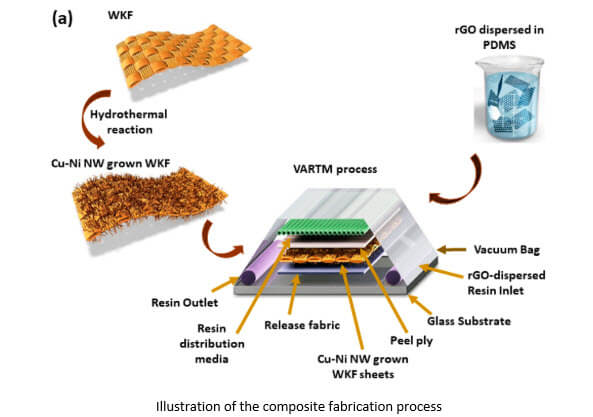
For fabrication of a woven Kevlar-based personal thermal management protection device, researchers grew vertical copper-nickel nanowires from the fabric surface into the middle of the two Kevlar sheets, via a hydrothermal approach. The voids amid the nanowires were subsequently filled using the vacuum-assisted resin transfer moulding method, with 0.5% reduced graphene oxide dispersed in polydimethylsiloxane resin to produce a composite, so that heat is generated uniformly. The copper-nickel nanowires were synthesised with an adaptable nickel sheath over the copper core in order to improve the copper sheath oxidation resistance.
|
|
Results |
| Researchers found the fabricated material to be strong, flexible, breathable and resistant to washing, while also maintaining the same mechanical properties of the Kevlar substrate. When a low voltage of 1.5 volts was applied to the fabricated composite, this incurred a quick and uniform rise in surface temperature, up to 70°C; this temperature is generally considered a high setting in traditional heating pads. The researchers also experimentally showed that the fabricated material could also act as a thermal insulator. In the experiment, the composite material reflected infrared radiation that was emanated from a hot plate imitating the temperature of the human body. When comparing the composite material containing nanowires to the same composite material without nanowires, the inclusion of nanowires was found to play a key role in increasing the thermal insulation and IR reflectance by 43%. The composite with the copper-nickel nanowires was also found to withstand a higher absorbed impact energy and provide an increased tensile strength. The fabricated composite containing nanowires with higher nickel content resulted in increased mechanical properties, while the composite fabricated with nanowires containing a higher copper content resulted in increased thermal conductivity and IR reflectivity. |
| Impact |
|
The high flexibility, electric heating performance and thermal stability during human movement, as well as the high mechanical strength, breathability and durability of the fabricated composite materials make the material a perfect applicant for cold weather body armour and thermotherapy applications. The localised heating outcome attributed to the nanowires in the composite material has the potential to reduce the amount of power required and lessen the Earth’s dependence on fossil fuels for widespread application of eco-friendly and low cost personal thermal management systems. |