For decades, huge amounts of research and development have been devoted to improving pressure sensitivity to realise industrial-grade sensing devices. And until now, the challenge has been working out how to effectively apply force touch sensors to flexible applications, as often the sensing performance degrades when subject to mechanical stress and deformation when the device is bent.
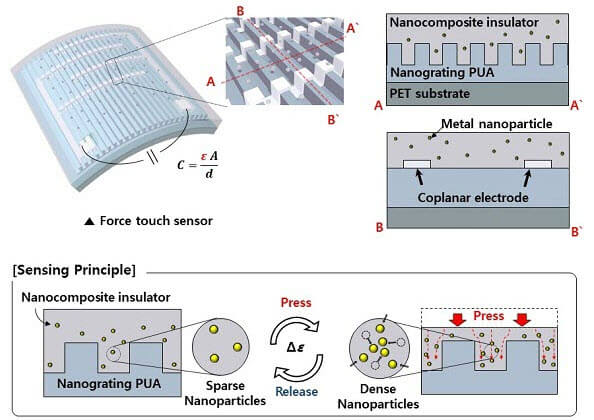
A seven-inch large-area sensor could be integrated into a commercial smartphone too
But now, the research team, which consists of professor Jun-Bo Yoon, PhD student Jae-Young Yoo, and Dr Min-Ho Seo from the School of Engineering at KAIST, has developed a touch sensor by developing a thin, flexible and transparent hierarchical nanocomposite (HNC) film.
“We successfully developed an industrial-grade force touch sensor by using a simple structure and fabrication process,” says Yoo, who led the research. “We expect it to be widely used in user touch interfaces and wearable devices.”
The team says the sensor simultaneously features all the necessary characters for industrial-grade application – high sensitivity, transparency, bending insensitivity and manufacturability.
Non-air gap technology
To overcome the issue of bending sensitivity, the research team focused on the development of non-air gap sensors to break away from the conventional technology where force touch sensors need to have air gaps between electrodes for high sensitivity and flexibility.
The proposed non-air-gap force touch sensor is based on a transparent nanocomposite insulator containing metal nanoparticles which can maximise the capacitance change in dielectrics according to the pressure, and a nanograting substrate which can increase transparency as well as sensitivity by concentrating pressure.
As a result, the team succeeded in fabricating a highly sensitive, transparent, flexible force touch sensor that is mechanically stable against repetitive pressure.
Furthermore, by placing the sensing electrodes on the same plane as the neutral plane, the force touch sensor can operate, even when bending to the radius of the ballpoint pen, without changes in performance levels.
Manufacturability and application
The proposed force touch has also satisfied commercial considerations in mass production such as large-area uniformity, production reproducibility, and reliability according to temperature and long-term use.
Finally, the research team applied the developed sensor to a pulse-monitoring capable healthcare wearable device and detected a real-time human pulse.
Additionally, the research team confirmed with solution provider company, HiDeep Inc, that a seven-inch large-area sensor can be integrated into a commercial smartphone, too.
This research was supported by the Basic Research Program through the National Research Foundation of Korea funded by the Ministry of Science and ICT, and also supported by the Open Innovation Lab Cooperation Project funded by the National Nano Fab Centre.