1. Introduction 
In recent years there has been an increase in the adoption of inkjet printing techniques within the textile printing industry. As a result, we will be looking at why digital textile printing is so disruptive to conventional textile printing methods and its impact on industry competition, using Porter's Five Forces Model of Industry Competition.
Porter's Five Forces analysis is an industry framework developed in 1979 by Michael E Porter of Harvard Business School as a simple tool for assessing and evaluating the competitive strength and position of a business organisation [1]. The intensity of competition in an industry is neither a matter of coincidence nor bad luck. It all boils down to underlying economic structure and goes well beyond the behaviours of current competitors. The state of competition in an industry depends on five primary components, according to Porter. In this report, we will be using the framework of these five components to analyse long-term market attractiveness of the textile inkjet printing industry.
Porter's Five Forces framework helps players within any given industry to look at the balance of power in a market between different companies and to analyse the attractiveness as well as the potential profitability of an industry sector. As such, a company should be capable of applying its core competencies, business model, or channel network to gain a competitive advantage in its industry.
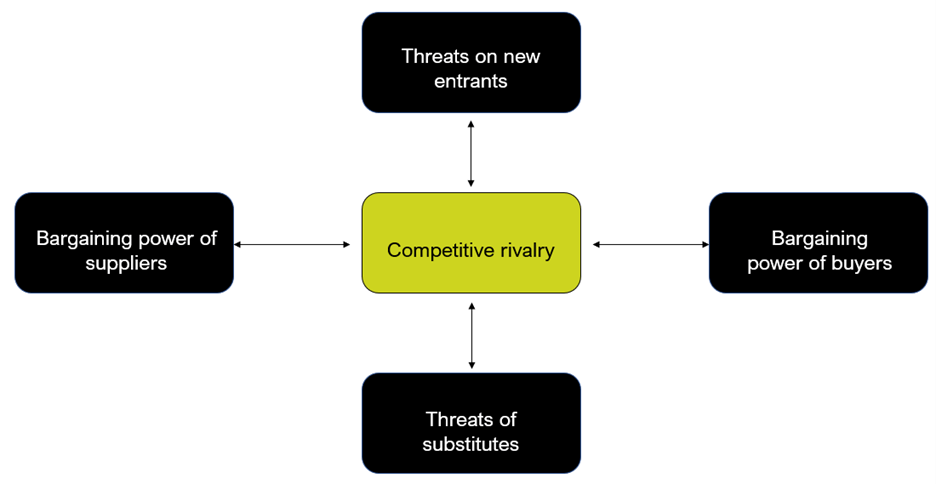
Let's take a look at the five forces individually...
1.1. The threat of new entrants
The inkjet printing market is a reasonably new market within the broader textile printing industry. According to WTiN Intelligence: Digital Textiles, the penetration of digital textile printing into the wider textile printing industry has seen some increase, although it is still small at 6.9% of total printed fabric [2]. One of the selling points for digital textile printing is that it is a greener, more flexible option as most consider it to have a less negative impact on the environment. However, at present, there are very few studies to justify these assumptions [3]. Although the environmental effects have been reduced through the evolution of textile printing technologies – both conventional and digital textile printing methods still involve processes that by necessity require energy, water, chemicals, etc. Nonetheless, digital textile techniques have become more attractive.
As digital textile printing only currently accounts for 6.9% the current printed textiles market, it is still an attractive market for new entrants because of the potential for growth – such a vast area of the market remains ‘untapped’. New companies are entering the market all the time. For example, HP recently launched its HP Stitch technology for the dye-sublimation market (both direct-to-textile and transfer textile printing) [4]. It is evident to see that new technologies are continuously being brought into the market. However, there is also an increasing awareness of innovative sustainable technologies within the wider textile industry. For instance, ITMA 2019 featured many interesting new product launches and innovative technologies, including those that leverage the Internet of Things (IoT) and sustainable strategies. All this indicates that there is great potential in the market and that is attractive to new market entrants.
In any given industry, new entrants increase the level of competition as existing players try to defend their market share against them. Also, the higher the threat of new entrants, the lower the attractiveness of an industry. Highly profitable markets tend to attract many new players as seen with the increase in adoption of digital textile printing technologies. However, for new entrants to an industry where established players are taking advantage of economies of scale and high product differentiation, several additional obstacles make entering the industry unattractive, including high upfront investment requirements and the time and cost of establishing distribution channels.
1.1.1 Barriers
The threat of new entrants correlates with the barriers to entry. In this context, barriers refer to the existence of high costs or obstacles that can deter new competitors from entering the industry. Some of the barriers to entry within the inkjet textile printing market include brand loyalty, capital requirements, access to suppliers and distribution channels as well as government regulations.
Firstly, textile inkjet printing has a high upfront investment requirement as the industrial printing machines are usually more expensive in comparison to conventional printers. This can make print houses hesitant to make the transition to digital, especially when they still have costs relating to their traditional printing equipment.
In terms of inkjet, there are two different kinds of printing techniques available: multi-pass scanning printing and single-pass printing. The latter is a newer printing technique that enables faster printing at a high quality. However, this comes at an extra cost, as more print heads are needed to allow for faster printing. Thus, single-pass printing is more expensive than multi-pass printing and only makes sense when printing very large orders. Print heads are costly components of the printing process. As a result, the more print heads there are incorporated into the printer, the more expensive the machine will be.
The cost of ink is another factor to consider as textile inkjet printing inks are much more expensive than conventional dyes. The more expensive inks are the production cost obviously increases and this needs to be mitigated for. Consequently, new entrants are faced with the dilemma of which printing techniques to invest in as that will determine their success within a competitive market such as the textile inkjet printing market.
It is fair to deduce that the textile inkjet printing market has a low threat of new entrants. This is because incumbent OEMs and brands are well-known and have a well-established rapport with consumers. Hence there is high brand loyalty within the industry. Also, proprietary technology is required to be successful and high initial capital investment is needed. With the high initial capital investment, most of the top machines last a long time. Therefore, print houses may just need to update their existing machines for maintenance purposes. Moreover, if they do not like the machines they are using, investing in a new machine is an expensive process and can mean a long set up and testing period. It is also worth mentioning that this could mean unnecessary downtime if they do not keep their other machines running and testing can also be costly. A low threat of new entrants makes the textile inkjet printing market attractive due to the high barriers to entry. Therefore, existing companies can enjoy increased profit potential.
High barriers to entry = Low threat of new entrants = Increased profit potential
1.2. Threats of substitute
In an industry where close substitute products or services exist in a market, the likelihood of the consumers switching to alternatives in response to price inflation is increased. In terms of inkjet textile printing, this can come from a purely digital substitute or a hybrid substitute. As previously mentioned, the move to digital from conventional textile printing is slowly taking its course (although conventional printing will always have its place). However, there is also a need to differentiate products within the digital sector further, hence the hybrid substitutes. For instance, OEMs such as Mimaki, provide a hybrid digital textile printer, the Tx300P-1800 MkII. According to Mimaki, the printer is aimed at helping textile and garment manufacturers achieve flexibility and enhanced application opportunities [5]. The ability of the Mimaki Tx300P-1800 MkII to switch between direct-to-textile and transfer printing is enabled by its interchangeable platens. Other OEMs such as HP, and DGI amongst others, also offer hybrid solutions. Japanese OEM Ichinose offers a different type of hybrid solution: one that encompasses conventional screen printing and inkjet technology to provide the detail and flexibility of digital but the block colours and effects (such as metallics), of screen printing.
At the same time, products (in this case, digital textile printing machines) from the EU can be similar to those in Asia and can equally substitute one another. However, differentiation within the industry has been made possible via the difference in product costs, quality and services provided, which impacts the selection of substitutes.
The threat of substitutes is high in many industries where switching costs are low and buyer propensity to substitute is high. However, in the case of the digital textile printing market, the tendency to switch from conventional textile printing is not necessarily high – as previously stated, only 6.9% of printed textiles is done so digitally. The penetration of digital textile printing techniques is still small in comparison to the former and this could be due to a lack of education surrounding the benefits of switching to digital. Also, factors such as high capital requirements result in a low buyer willingness to convert, and consequently, little threat of substitute. Therefore, we can deduce that the threat of substitutes within the inkjet textile printing market is low.
1.3. Bargaining power of buyers
The bargaining power of buyers or consumers is an assessment of how easy it is for consumers to drive prices down. In general, consumers demand high product quality, low costs, quick turnaround times and personalisation, amongst other things. Consequently, the demand stirs up the competition as players within the market attempt to satisfy these demands. Of course, the consumers, in return, use the competition to obtain the best value. However, this is not always the case. Various factors can reduce the bargaining power of consumers including the high cost of switching to another supplier; a low number of suppliers and a lack of substitute products. If a company has just a few influential consumers, they are often able to dictate terms.
The global digital textile printing market is dynamic and continues to grow with its annual printing capacity reaching 3.08 billion sqm in 2019, double of what it was three years ago [2]. China, Italy, India, Turkey and the US continue to dominate the market. Contributing factors to growth include the sale of more machinery and developments in smaller niche segments such as soft signage and pigment printing. These have helped drive new demand in markets that previously had been underperforming – and there is still much untapped potential in these niche markets.
Although China is the of choice for many when it comes to raw materials, fabrics, printed textiles and machinery, other low-cost producers like India and Pakistan would also benefit from the growing trend of overseas importers diversifying their supplier options with the intention of mitigating the risk of sourcing from only one country.
Thus, we can deduce that the bargaining power of customers is secure. For that reason, producers of textile & apparel need to prioritise differentiating their products or production so that they are not solely reliant on price as their only means to compete.
1.4. Bargaining power of suppliers
The bargaining power of suppliers affects the intensity of competition within an industry. This competition increases as new companies join the industry. The competition also escalates with the decreasing amount of raw materials, leading to inflation in their prices.
There are numerous players within the textile inkjet printing industry and they vary in terms of size and power. As mentioned in section 1.3, there has been an increase in digitally printed fabric globally. Our data also indicates that apart from the key countries aforementioned, Pakistan, Bangladesh and South Korea are becoming high growth markets. Additionally, Vietnam, Malaysia, the Philippines, Egypt and Central American countries – including Columbia, El Salvador and Guatemala – have potential in the long-term [2]. Although the printing capacity of these countries is still minimal compared to the five key markets mentioned, they should all be on the radar for OEMs.
Nonetheless, the inkjet textile printing market is highly dependent on chemicals from China – making China the largest supplier in the textile inkjet printing market. China enjoys a cost advantage in textile printing because of its abundant supply of locally produced chemicals and dyestuff as well as its cheap labour (although the cost of this is increasing hence the rise of neighbouring countries such as Vietnam and India).
Suppliers play an essential role within the supply chain and can impact the cost of production by changing the prices of intermediate goods or raw materials. In the inkjet textile printing industry, a significant increase in raw material prices can force smaller businesses or less profitable firms to exit the market. This is simply because they are not as well-positioned as their counterparts who tend to be larger, well established and more productive firms. As a result, these companies are not able to absorb drastic price changes within the market.
On the other hand, low bargaining power of suppliers can occur when there is the availability of low-cost substitutes, low cost of switching to another supplier and little threat of forward integration and a situation in which a supplier directly reaches out to the end customer with B2C business models rather than B2B.
A large number of available suppliers in high growth markets within the textile inkjet printing industry gives an initial indication of a weak bargaining position for the supplier group. Additionally, the supplier group lacks switching costs – unless they have brand loyalty or contract bound – and has a low level of product differentiation. As a result, manufacturers and brands can scout the supplier group for the best terms and prices for production. Besides this, they can contact different suppliers and play suppliers against each other. Consequently, such activities weaken the bargaining power of suppliers and as a result, prices are pushed down, making them similar among vendors.
1.5. Competitive Rivalry
This concept refers to the intensity of competition among existing firms in an industry. The inkjet textile printing industry consists of numerous OEMs which all vary in terms of size and power. It is a massive industry with thousands of operating within the supply chain. The apparent high growth rate of installed inkjet textile printing machines indicates the competitive rivalry amongst OEMs is high. For instance, the growth rate for sublimation technology is high: sublimation transfer remains one of the most important digital textile printing technologies used globally because of its easy process, low ink cost and the low-price of polyester that it prints on [2]. Also, the digitalisation of the industry and the mass customisation trend is catapulting the growth of dye sublimation printing. We are seeing more machines getting faster at printing and the strength of individualisation is also becoming more prominent. This results in healthy competitive rivalry amongst OEMs within the market and this level of competition varies from region to region. For instance, there are some OEMs such as EFI Reggiani which dominate the European markets, although Japanese and Chinese OEMs are finding ways to penetrate the region.
Industry rivalry usually takes the form of jostling for a position using various tactics like price competition, marketing or advertising battles online or at events, product launches etc. Even though it may be challenging to carry out product or service differentiation in the textile inkjet printing market, price competition and product introductions have remained essential strategic elements for competitors.
The intensity of rivalry tends to increase when companies either feel competitive pressure or are compelled to elevate to a new position within the market. Nonetheless, healthy competition within the industry will largely be determined by the continued growth of the existing global inkjet textile printing market. It will also partly depend on the stability of the global economy.
In any given industry, companies are mutually dependent: any slight change in the competition will have a domino effect in that reaction may harm all the companies and the industry. In most cases, one company's competitive move will have a noticeable impact on competition.
Additionally, as ink plays a vital role within the textile printing industry, ink manufacturers may risk cutting prices when demand slackens. For example, with the current Covid-19 pandemic, most factories were shut down in Q1 2020 with the complete disruption of the whole textile value chain and closures of malls and retail outlets. Ultimately this impacted on demand and productivity at manufacturing plants. If fewer orders are generated or manufactured, this has a direct impact on the printing required – and many orders were indeed cancelled. Thus, weakening the demand for inks. If ink manufacturers still want to make a profit there is a risk of cutting prices, but currently, there is no evidence to prove that this has been done. When there are recessions in the business cycle, commodity prices drop significantly due to a fall in demand.
The rivalry between manufacturers is high because there are several key players within the digital textile printing ink market, with a strong presence in various regions. A high degree of competition impacts industry profitability, thereby making the industry less attractive for potential new entrants because they fear they may find succeeding in the market a challenge.
However, the intensity of rivalry varies from region to region. Some factors can result in a low level of competition. For example, high fixed costs, high level of product differentiation, high customer conversion costs, and the existence of a monopoly, duopoly, or oligopoly.
In conclusion, several structural factors can affect industry rivalry and these include:
- Numerous or equally balanced competitors
- Slow industry growth
- Diverse competitors
- High fixed costs
- Lack of differentiation or switching costs
- High exit barriers
- Capacity increased in vast increments
Nonetheless, as the inkjet textile printing market continues to grow, Porter's Five Forces of competitive position will remain relevant to both the key players as well as those wanting to enter the market. However, variances may appear as each player in the industry works towards the development of more efficient technologies that consume less ink per sqm of fabric. Also, they are in pursuit of technologies that consume less energy. Moreover, in terms of sustainability, the development of machinery and processes that consume less energy are becoming more and more eminent as the market grows. Sustainability is also a developing consumer demand and is something that governments and NGOs are taking more seriously. Dye-sublimation and pigment printing are the most environmentally friendly forms of printing to date. In the future, we also hope to see faster printing machines as markets demand high productivity and flexibility when it comes to digital textile printing.
References
[1] M. E. Porter, COMPETITIVE STRATEGY Techniques for Analyzing Industries and Competitors. 1998.
[2] S. Masuwa, "2019 digital textile industry review," 2020. Accessed: Jun. 18, 2020. [Online]. Available: https://www.wtin.com/article/2020/march/090320/2019-digital-textile-industry-review/.
[3] D. J. Provost, "Digital textile printing and the sustainability promise," WTiN, 2016. https://www.wtin.com/article/?articleid=4295014252 (accessed Aug. 07, 2020).
[4] M. Thomas, "Thermal print heads on dye-sublimation and future opportunities," WTiN, 2020. https://www.wtin.com/article/2020/february/100220/thermal-print-heads-on-dye-sublimation-and-future-opportunities/ (accessed Aug. 26, 2020).
[5] T. Fall, "Hybrid textile printer from Mimaki to launch at ITMA," WTiN, 2019. https://www.wtin.com/article/?articleid=4295421780 (accessed Aug. 05, 2020).