
In the first of a series of articles outlining research on sustainability carried out by the Cotton Council International (CCI), Bruce Atherley, the CCI executive director, looks at the latest consumer trends driven by ecological concerns and what they mean for the textile and clothing industry.
A global focus on climate change is altering how consumers view the world
A growing body of scientific literature, supported by international policies and popular culture, including TV shows such as Blue Planet, has propelled environmental sustainability into the public consciousness. This is creating more informed consumers, who are increasingly seeking sustainably produced foods, renewable energy sources for their homes, and fuel-efficient transportation. However, do consumers have the same desire for sustainably grown products in their clothing, and how does this influence their purchasing decisions?
These are important questions as apparel brands and retailers begin to navigate the impact of sustainability in a market with a highly complex supply chain. How do consumers know whether the clothes they buy are from a sustainable source? Perhaps more importantly, do they care?
Sustainability has been defined by Gro Harlem Brundtland, chairperson of the World Commission on Environment and Development, as “the ability to meet the needs of the present without compromising the ability of future generations to meet their own needs.”
Brands and retailers around the world increasingly have taken an active role in the sustainability movement by providing the consumer with more information on their product sourcing. However, as brands and retailers cater to a more knowledgeable audience, it is important to better understand consumers’ thinking on sustainability.
Evidence suggests that consumers are putting more effort into finding clothing labelled as environmentally-friendly
Why consumers care about sustainability
Recent research conducted by Harris Insights & Analytics, on behalf of Cotton Council International, examined the views of more than 7,000 consumers in the US, UK, India, Germany, Italy, Mexico and China. Their investigation found that 86% of those surveyed were concerned about sustainability. In the UK, three-quarters of consumers agreed that concerns about environmental change and resource depletion are real and require a change in our day-to-day behaviour – with most motivated to take environmentally-friendly actions.
While consumers are most concerned about sustainability in their food, appliance and automobile purchases, globally 61% are concerned about sustainability when purchasing clothing, with two-thirds indicating they would put a lot of effort into finding clothing labelled as environmentally-friendly.
Consumers report that they care about sustainability because they want to (1) support companies which are doing things the right way (38%), and (2) take a stand against those which do not treat their employees fairly (35%), or do not employ sustainability practices during the manufacturing process (33%). Therefore, it is imperative that brands and retailers establish and maintain a strong image of sustainability.
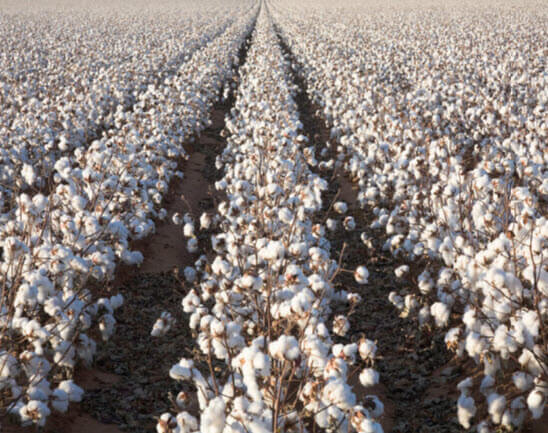
Cotton fields in the US
Man-made fibres are viewed as less safe and trustworthy
Consumers clearly have become far more aware of responsibly produced textiles’ importance. However, in general, consumers’ detailed knowledge of specific issues, such as the use of chemicals or pesticides, was found to be relatively low. This was particularly true for survey respondents in developed nations, including the UK.
Yet the issue consumers were most aware of was the environmental impact of man-made fibres – one consumer deemed a notable concern. For example, in the UK the two greatest environmental concerns for consumers were identified as microfibre waste in the oceans from synthetic fibres such as polyester (47%), and greenhouse gas emissions as a result of producing man-made fibres (24%). Rayon particularly was a fibre that consumers were keen to avoid. Half of UK consumers said they were likely to check the fibre content label before purchasing a clothing item, to specifically avoid clothing made from rayon.
Natural fibres were viewed as safer than their synthetic counterparts, with cotton considered as the safest. Specific natural fibres, such as US cotton, also were seen as more trustworthy and were associated with better quality products. In fact, natural fibres were identified as the main reason that consumers chose to spend more on textile items, demonstrating the direct impact of fibre origin on purchasing behaviour.
Location, location, location: where fibres are produced makes a difference
Consumers associated cotton with sustainability more so than other fabrics such as wool, silk, polyester, rayon or spandex, and 83% of consumers surveyed believed cotton was safe for the environment. Where cotton was produced also was an important factor. Regarding specific growths, the survey found that US cotton was rated as environmentally-safe (69%), more often than cotton from Australia (65%), India (64%), Better Cotton Initiative (BCI) (61%), Africa (60%), China (56%) or Uzbekistan (53%). Overall, US cotton was viewed as more sustainable (39%), responsibly-produced (40%) and higher quality (43%) than cotton grown in other parts of the world.
This awareness reflects the past successes of US cotton’s environmental stewardship but may also be based on the fact that the US cotton industry has set measurable national goals to improve its environmental impact. These include continual improvements in key areas of environmental stewardship, farm productivity and resource efficiency such as land, water, air, input and energy use. On the other hand, cotton from China was considered the most harmful for the environment, which could reflect that country’s recent environmental issues.
How can brands and retailers connect with consumers on sustainability?
With sustainability growing in importance for consumers, it is important for global brands and retailers to distinguish themselves as caring about sustainability and fair labour practices. How can this be accomplished? One answer, based on this research, may be a stronger alliance with natural fibres such as US cotton, which are viewed more positively than their synthetic counterparts.
In addition, transparency of supply chain and sourcing practices will be important as consumers continue to demand more information on the history of the products they purchase. What does seem clear from current consumer attitudes, though, is that, overall, consumers do prefer to purchase natural, sustainably produced products when possible. Thus, it stands to reason that brands and retailers should work to make these products more common, visible and accessible.


