Roger Wills, consulting editor, provides an insight into the complexities of choosing the right ink and fabric for your digital printing application, and how to get it right.
You’ve chosen a digital textile print for your new product; smart move, because digital printing offers the widest possible range of available fabrics, with no limitation on the number of colours or the size of repeat. However, choosing the right fabric for your application, and the ink type to go with it, can sometimes be a daunting prospect for a newcomer to the industry. It is even difficult for established print houses moving from analogue to digital printing as the chemistry and technology is quite different.
Questions abound. What does GSM (grams per sqm) stand for? What is the lightfastness? Will the colour rub off? How do I wash the fabric? Is it flame resistant? Is it organic? Will it shrink? And many more. But, don’t be baffled by the technical jargon. The first and most vital stage in any fabric selection is down to you the user.
Firstly, find the fabrics that most appeal to you for your application and employ the same tools as your eventual clients. At this stage, the relevant questions should include: What does it look like? How does it feel? Is it the right weight?
When you’ve chosen your fabric, maybe an airy chiffon for a scarf, perhaps a gabardine for your water-resistant bomber jacket or a flame-retardant twill for those contract chairs, you will now be able to assess the way your fabric will be digitally printed and what properties it will possess.
In terms of fabric construction, three methods of fabric formation are mainly used:
Warp knitting: Stable fabrics (when set) formed by looping yarns in vertical columns along the warp or lengthways in the direction of the fabric.
Characteristics include: Medium dimensional stability, run resistance, easy sewing, cheaper production than weaving. These staple fabrics are often used for soft signage, sportswear and display printing.
Weft knitting: Stretchy fabrics formed from one thread knitted across the width of the fabric.
Characteristics include: Ability to mould and fit to the contours of the body, low dimensional stability. These staple fabrics are often used in childrenswear, athleisurewear and dancewear printing.
Weaving: Stable fabrics formed using two distinct sets of yarns or threads which are interlaced at right angles to form a fabric or cloth. The longitudinal threads are called the warp and the lateral threads are called the weft.
Characteristics include: Robustness, wide variety of constructions, dimensional stability. These staple fabrics are often used in contract and domestic furnishing printing.
As far as digital printing is concerned, by enlarge, all fabrics produced using the above methods can be printed successfully for it is the fibre type used in the yarns that determines the breadth of the colour display and the performance characteristics of the fabric. That said, printing on knitted fabrics can pose ink penetration challenges that are easier to rectify in analogue printing. For example, printing of a block colour in large area can result in ‘grin-through’ or loss of saturation which shows when the fabric is stretched, exposing undyed fibres.
In addition to fabric construction, fibre composition determines the choice of ink, and the choice of ink determines the type of digital printing process that must be used, which in turn determines the resulting physical properties of your finished fabric.
Table 1 provides details of various fibre types and the ink and digital processes that are needed to inkjet print on them.
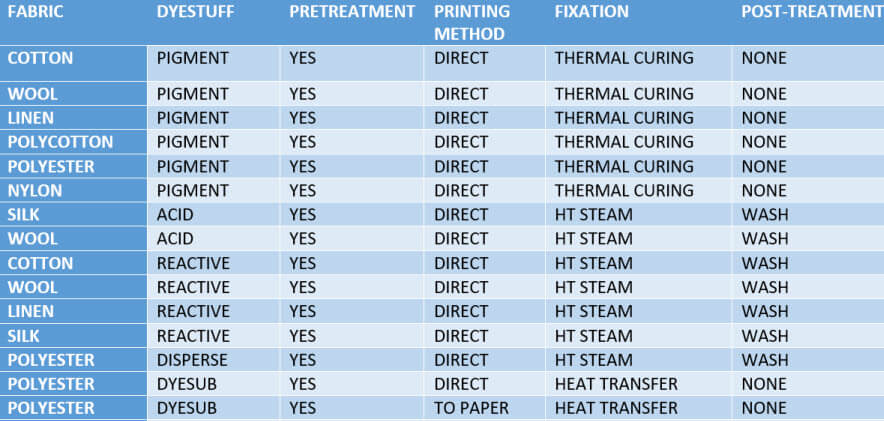
Table 1. Process for digitally printing on various fibres
As you can see in the table above, there are many types of fibres being used in fabric formation, each one of them has different cost and performance characteristics.
Cotton
Fabrics made using cotton are widely used in digital printing. They provide a ‘natural’ feel and organic texture and are generally water absorbent. However, these fabrics have to be pretreated before they can be printed, so the base fabric price is often high, between GB£3 and GB£5 per metre.
The two main ink types that are used for this fibre are pigment and reactive Inks. Each process has its pros and cons. Reactive printing is slower and costlier compared to the easy and fast pigment method. But, it has brilliantly bright colours, with good wash and rub fastness, however its light fastness is below average. The colour yield difference between reactive and pigment dyes is well known, with the former producing more vibrant prints, and although there have been substantial improvements in pigments recently it still cannot match the reactive alternative.
Pigment printing is achieved by depositing indissoluble solids on the surface of the fabric creating a physical bond, while reactive printing is done by dyeing the fabric and then creating a reaction with high temperature steaming and washing, a chemical bond. Due to the different ways the colour adheres to the fabric, there is a considerable variance in the performance characteristics of each process. The chemistry determines the eventual fabric properties when it is subjected to physical stress, such as abrasion, rubbing, or washing. The pigment particle can detach from the fabric causing it to lose performance, whereas once the reactive molecule is chemically fixed and post-washed, it is permanently fixed.
In terms of handle or drape, reactive printing provides the best outcome, because pigment printed fabric preparations can leave a slightly stiff and chunky hand feel. This is because of the number of solids in the pre-coat, and the fact that pigment inks themselves contain solids which are deposited on the fabric and are stiffened during the subsequent heat fixation process. Silicone and polyethylene softening surfactants have been used to counteract this but to date with limited effect against the inelastic mass of the current pigment pre-coat and ink formulations. Reactive printing on the other hand leaves a homogeneous handle, akin to the fabric having been dyed, not printed, and this has catalysed its use in fashion apparel.
While some challenges in the ink area are yet to be overcome, great strides are currently being overall, through a combination of advanced machinery, processing techniques and chemistry. This is to the extent that digital pigment printing now offers a viable commercial alternative to the marketplace for digitally printed cotton products. With cotton fabrics ever-popular in furnishings and apparel, as long as the printer is aware of the performance and colour gamut characteristics, you will never be disappointed with your choice.
Polyester
Fabrics made using polyester are also widely used in digital textile printing, currently the mainstay of the signage, sportswear and flag sectors. Polyester base-fabrics are priced between GB£1 and GB£3 per metre and come in a wide range of both knitted and woven constructions. They are notable for their faithful reproduction of colour, their shrink resistance, and their non-absorbance of water.
Knitted polyester fabrics encompass a broad range of varieties from rigid display fabric to stretch jerseys in a very wide range of weights. Woven polyester fabrics are generally heavier and display greater dimensional stability. Printing of either type of fabric construction, has broadly similar results. The substantivity of the colour yield and the register of the print are determined more by the types of yarns used than the method of fabric construction.
However, in the decorative and contract sectors, over the years, there has been considerable buyer resistance to using fabrics made from this fibre on the grounds of handle, drape and performance. Yet, with the availability of recycled polyester fabrics, the introduction of soft handle polyester fibres, and the need for regulated flame and abrasion resistance, polyester fabrics are enjoying increasingly widespread acceptance.
The inks used for polyester printing are based on the disperse dye set and are commonly known as dye-sub or transfer inks. The process involves the simultaneous transfer and fixation of the print under heat, from paper to fabric or direct printing to fabric.
Direct printing of polyester is an interesting choice when compared to paper transfer printing. There are several reasons for this choice, of which the most important is the cost. Direct dye-sub printing eliminates the use of transfer and protective paper which results in an approximate halving of the cost of direct materials used in printing. On the debit side, direct printing is less accurate in terms of print mark and register, so that when pure quality is required, paper transfer is often the ultimate choice.
Beyond that, the performance of digitally printed polyester fabrics are generally exceptional. In all of the most accepted technical standards of fabric performance, whether wash, light, or rub fastnesses, shrinkage, abrasion or tensile strength, polyester fabrics outperform most other fabric types.
Additionally, with some polyester fabrics having inherent flame resistance, they are a natural choice for the contract furnishing and upholstery markets. In general, the fabrics from this group are also good value for money.
Silk
The fabric texture and handle of silk fabrics is exceptional. It is no wonder that they rightly appeal to the luxury goods market where dresses, blouses and scarves made from silk carry a substantial retail premium. Base fabric prices range from GB£7 to GB£16 per metre so this premium comes at a cost and the digital printing of silk is a complicated and costly process.
The inks used are based on acid or reactive dyes, however the best colour results are obtained using acid inks. The process is convoluted and requires careful and accurate fabric steaming to develop the colours, and extensive post-print washing and weft control if the fabric is to be suitable for commercial use. The process involves heat fixation in saturated steam at 103oC followed by washing off of the unfixed colour in a series of continuous wash baths at varying temperatures of 16-90 degrees Celsius.
Silk is also a delicate fabric and has to be handled carefully by the consumer. It requires careful washing and is prone to distortion during cleaning. Moreover, while its lightweight quality sees it perfectly fitting the luxury market it also leaves it open to abrasion, to which it has a poor resistance.
It is possible to add chemicals to the digital silk printing process that improve aspects of the fabric performance, however it can be a risky process compromising colour vibrancy and handle. Using these steps some silks can be made machine washable, however, as any person with a silk item is concerned, a washing machine is the last place for their silk to be.
If you are attracted to a silk product, and love the look, the feel and the handle, just be aware of the downsides of cost and care that attend this fabric group.
Lycra
Lycra is a very popular sportswear and leisurewear fabric type. While Lycra is actually a brand name for a particular elastane composition, it has become synonymous with stretch fabrics that are elastic in either four or two ways. The fabrics produced are generally made using a combination of polyester or nylon and elastane yarns. Generally, these base fabrics can be bought for between GB£2.50 and GB£5 per metre.
Used extensively for leggings and body-hugging garments, this stretch fabric has many uses in the fashion, sportwear and athleisure sectors. The digital printing ink-set to be used is dye-sublimation, and the performance results are exceptional with one caveat, which is that during transfer under heat the fabric shrinks. Therefore, a specialised tacky or sticky transfer paper has to be used so that the paper and fabric stay together during any shrinkage, thereby giving a clear and sharp print.
Nylon
Fabrics made from nylon have widespread use in swimwear and leisurewear products. The base fabrics used, which are priced often as low as GB£0.60 per metre, are generally light weight and successfully repel water. Nylon can be digitally printed using either reactive, acid or dye-sublimation inks. The fastnesses obtained is generally robust, but a particular benefit is the propensity of the fabric to ‘drip dry’, which enhances its use in the swimwear market.
Viscose
Viscose fabrics are made from fibres created by processing of wood-pulp. Environmental initiatives have led to these fibres being obtained from mostly sustainable forestry initiatives.
Viscose fabrics can be printed with either reactive or pigment printing systems, and are considered to be a premium product, with base fabrics priced between GB£5 and GB£8 per metre. The fabrics are characterised by the nature of the fibre itself which, at its finest, is not dissimilar to silk or the finest cotton fibres.
In fact in many respects viscose fabrics have tried to imitate the handle and feel qualities of silk and fine cotton, but at a much lower price. Fabrics from this group are widely used in fashion and perform better physically than silk, although washing care is still required.
Linen
Linen is a luxury fabric for use in furnishings and lightweight fashion. Linen is relatively expensive, with base fabric prices ranging from GB£5 to GB£9 per metre, and although they perform well physically, care must be taken to ensure the finish is not too coarse in the end product, where excessive fabric weight can give a board like handle.
Linen fabrics can be digitally printed using pigment and reactive inks. Pigment printed linens give excellent visual results particularly in furnishings, where the colour palette is muted, however the physical performance characteristics of pigment printing have to be borne in mind during selection and a pretreatment to heighten rub fastness employed. Reactive printing of linens for fashion gives vibrant colour results, with soft handle, however, it is an expensive fabric and an expensive process.
Using linen fabrics can be very rewarding, particularly in the fashion sector, but be sure that you can cover costs in your product price and ensure that you have chosen the weight of fabric that is suits your product best.
Polyester-cotton blends
Finally, fabric made from a blend of polyester and cotton fibres probably has the widest fabric range available as well as being the most reasonably priced with base fabric prices ranging from GB£0.80 to GB£2 per metre.
Used for products from shirting to bedding and from fashion to home furnishings, polyester-cotton fabric performs well, doesn’t shrink, and has a decent colour yield in the end-product. However, these fabrics can only be printed with pigment inks. The reason for this is that pigment dyes are the only dyes that adhere to both fibre components. Reactive or dye-sub inks only fix to one of the two fibre components, and therefore, as a result, wash fastness, light fastness and abrasion resistance are all compromised.
The general performance of these fabrics when pigment printed is good, with colour vibrancy being excellent, however, as with cotton, particular care has to be taken when specifying washing instructions. However, if you select a fabric from this group, you will have an economical alternative to cotton, that is priced right and doesn’t shrink.
Conclusion
It’s worth mentioning that all prospective digital textile printers are entering a new and growing realm of textile production. Digital printing offers amazing benefits where limitations of scale, number of colours and production delays are a thing of the past, and with digital textile printing giving a true improvement to sustainability in textiles, it is definitely the technology of the future.
Further, although the contents of this article are not exhaustive, they do contain some hints and broad guidance for the newcomer to digital textile printing around fabric and ink choice.
Hopefully if you take these on board, you should be able to avoid some of the major pitfalls in print process specification, and also achieve your commercial aims with time and money to spare.