Cotton Futures rallied 4% in the thin nearby December, while the active March contract was up 1.7%. The USDA weekly report showed sales of all upland cotton 2018-19 down 46.3% from last week and 49.2% from last year. Overall, commodity markets remained extremely choppy to negative, as the US stock market retreated over the last several days, as all the euphoria created by the truce between US and China fizzled out quickly. For the bullish momentum to come back the levels will have to break the US cents 82 mark as the fundamentals are still bullish. The new front month active March gained US cents 1.32 or 1.7% week on week to close at US cents 80.23 per pound while May contract was up 1.5%. December 2019 inched up US cent 1 to close at US cents 78.03 per pound.
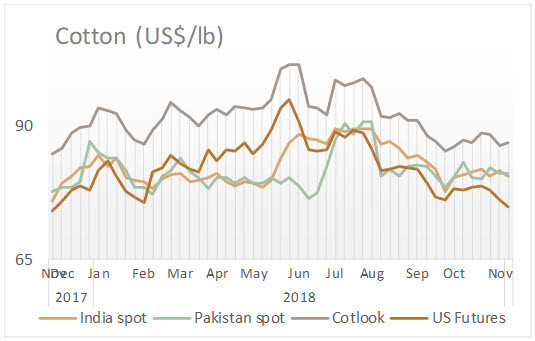
Global spot benchmark, the Cotlook A index, inched up US cent 0.70 week on week to close at US cents 87.25 per pound, having fallen US cents 1.95 on the weekend.
In China, buying prices of un-ginned cotton in Anhui province were at 6.70-6.82 Yuan a kg (US$0.98-0.99 a kg) and major selling price of lint cotton were between 14.70-15.10 Yuan a kg (US cents 97-100 per pound). Imported cotton offers for US-origin EMOT SM January-March loading inched up to 16.16 Yuan a kg (US cents 107 per pound) under sliding duties and at 15.38 Yuan a kg (US cents 102 per pound) under 1% in-quota tariff. The China Cotton Index continued to roll back this week by 21 Yuan, to close at 15,402 a ton (US cents 102 a pound). The spot market will continue to extend weakness due to lack of bullish factor in coming week.
In Pakistan, cotton prices moved higher on the first two days of the week amid increased demand from some leading textile mills as they replenished their stocks, fearing costly imports. Low cotton production figures released by the ginners association earlier also had some adverse impact on the market. According to the figures, the country has produced less cotton up to 9.37 million bales as against 10.13 million in last season. This implies that cotton crop is short by 0.77 million bales or 7.6% over the last year. Some private estimates pegged requirement at around 15 million bales, which means gap of 4-4.5 million bales which have to be imported. Later the market remained stalemated until the close of the week in the absence of buying interest. The Karachi Cotton Association spot rates were up PakRs150 on the week at PakRs8,960 per maund (US cents 77.93 per pound) ex-Karachi.
In India, spot cotton prices sobered this week as arrivals started to gain pace. However, prices of finer variety cotton such as S-6, MCU-5, Surabhi and DCH-23 continued to rise by INR100-500, implying demand for better quality crop. Benchmark Gujarat Shankar-6 was traded at INR44,300 per candy (US cents 80.10 per pound), up INR300 from last week. Meanwhile, reports emerged stating that cotton output may have dropped 12% to hit a nine-year low as scanty rains in the top two producing states adversely affected crop yields and has potentially reduced exports from the world’s top producer.
Cotton yarn
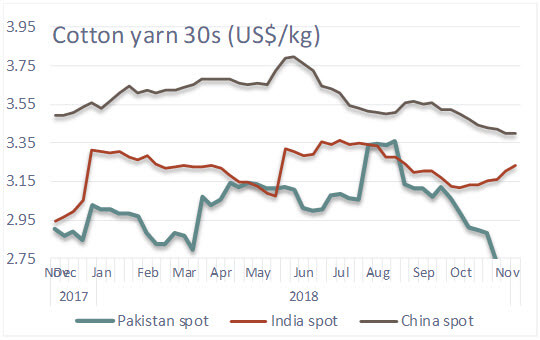
Cotton yarn markets in China were quiet and prices of some individual varieties were adjusted down amid stability. Demand for cotton yarn 32s and 40s was relatively better. With cotton prices moderating steadily in the domestic market, the cotton yarn market will continue to remain in correction, and prices softening in tandem. In Pakistan, cotton yarn prices were seen rising both in Karachi and Faisalabad yarn markets across count types reflecting the rise in cost in recent weeks. However, reports said that sluggish performance of cotton yarn market and uncertainty over government’s policies are affecting the textile industry which is currently burdened with huge unsold yarn stocks. However, slow offtake of cotton yarn in the domestic and world market is negatively impacting cotton trading in turn. In India, cotton prices were seen rolling back as arrivals picked up, prompting yarn makers to maintain their prices at the moment.
In China, 32s cotton yarn prices edged down to 23.40 Yuan a kg (US$3.41 a kg, up US cents 3, due to strong Yuan) while 40s fell to 24.00 Yuan a kg (US$3.57 a kg, up US cents 2). Coarser yarn prices of 16s also declined to 14.60 Yuan a kg (US$2.13 a kg, up US cents 1) while 21/2s moderated to 21.10 Yuan a kg (US$3.07 a kg, up US cents 2). In Pakistan, 30s carded prices in Karachi were raised PakRs2-3 to PakRs175-180 per pound (US$2.76-2.84 a kg, up US cents 1-3), while 32s cone in Faisalabad jumped to PakRs172-180 per pound (US$2.71-2.84, up US cents 17). In India, 30s carded cotton yarn for knitting rolled over at INR230 a kg (US$3.26 a kg, down US cents 4 due to weak INR) in Coimbatore while export offers were flat at US$2.90 a kg.