Despite the cancellation of industry events this year, ISPO persevered to keep the sport and outdoor sectors connected by introducing the digital event, ISPO Re.Start Days. Jessica Owen, Jessica Basey and Victoria Nickerson bring you the highlights
Embracing the new digital format that many of us have become accustomed to in this Covid-19 world, ISPO Re.Start Days, held from 30 June to 1 July, marked a fresh approach to collaboration, connection and discussion, as the industry looks to refocus and recover from the current crisis.
With an ambitious digital platform, ISPO Re.Start Days provided blocks of continuously streamed content spaced out by dedicated breaks for workshops and digital networking opportunities. The comprehensive agenda was split across two central themes: Experience Day, which reflected on the disruption to relevant markets and their current performance, before addressing the opportunities for growth which lay ahead; and Beyond the Status Quo Day, which focused on a more extensive view of the future, accommodating topics such as digitalisation, long-term operational sustainability and reinforcing the importance of sport and fitness in community health and wellbeing.
Opening the event, chairman and CEO of Messe München, Klaus Dittrich, said: “Covid-19 has changed everything. Never before have we experienced something like this pandemic.
“At the end of ISPO in January, we heard from the Chinese government that we couldn’t hold ISPO Beijing. And then in only a few weeks, Covid-19 came to Europe. What we already see very clearly is the enormous impact it is having on our business. Economically, for example, we had to cancel Outdoor by ISPO, and we have lost 50% of our revenues planned for this year: altogether €150m.
“ISPO Re.Start Days is here to provide a platform to exchange experiences, get hard facts about the market, create and share ideas and visions, and create new networks.”
He then opened the conference by conversing with Kristina Vogel, a two-time Olympic gold medallist in track cycling, and the extreme mountaineer, Jost Kobusch. The upshot of the conversation: the sports and outdoor industry should think like an athlete as it works to overcome the crisis. Vogel, a quadriplegic following a training accident, said: “We can’t change today. We can only change the future.”
The experience
Overall, ISPO Re.Start Days was a success. Yes, there was the odd technical difficulty, and some presentations had to be cancelled, but as with anything new, there will always be initial teething problems.
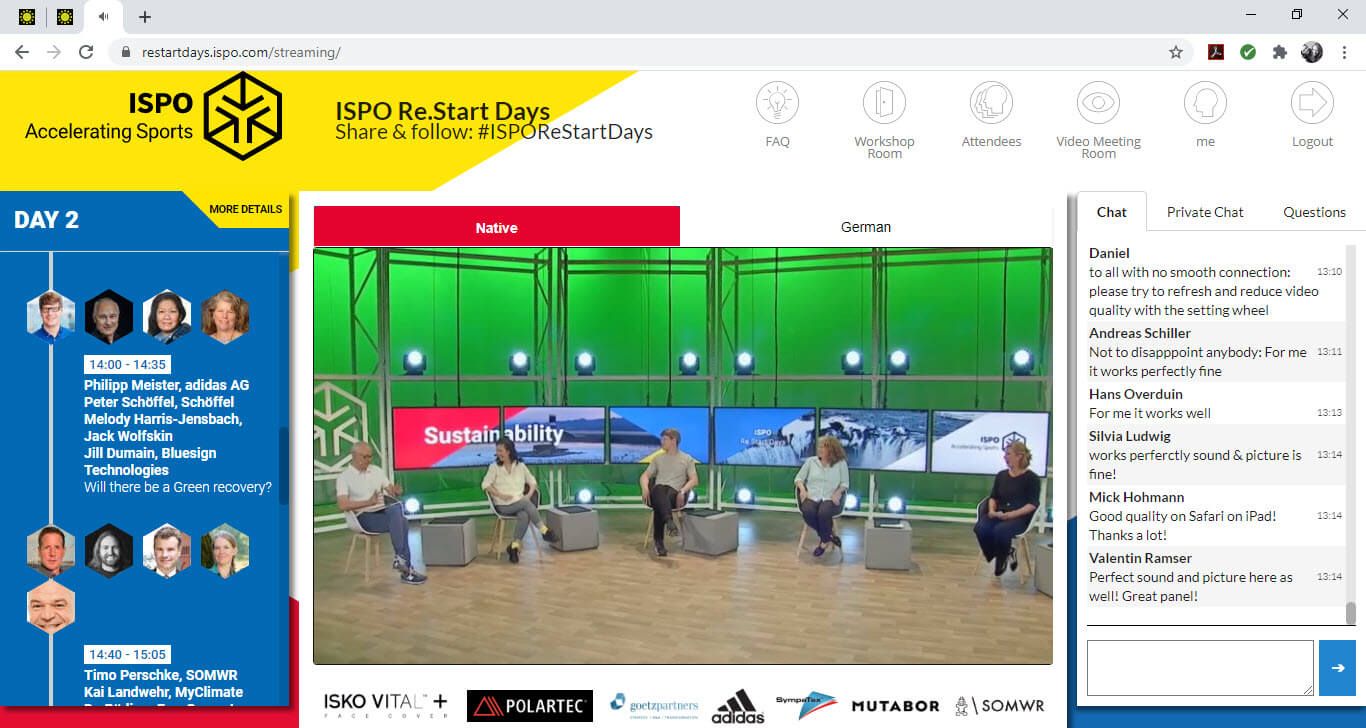
These few mishaps didn’t take away from the overall experience, though. For those of you reading this who didn’t get the chance to attend the show, let us explain how it all worked. Attendees logged onto the event website where they were greeted by a home screen comprising a live video stream in the centre, an event schedule on the left-hand side, and a live chat panel on the right. At the top of the screen there were also widgets for FAQs, a workshop room and a video meeting room.
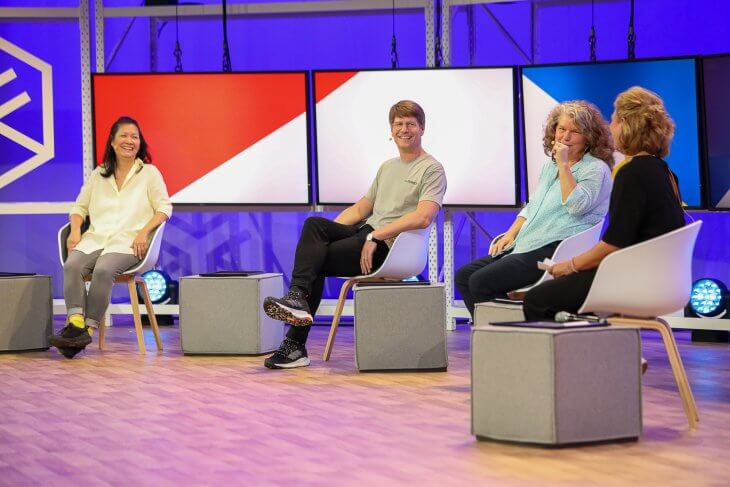
The main draw to the event were the panel discussions, which were streamed live from a hall at Messe München. Many speakers were able to be in Munich in person and so chairs were socially distanced in the style of a TV news show, and the two days were hosted by Annabelle Mandeng. The sessions kicked off in the morning and then a two-hour break was organised for midday – this gave attendees the chance to then head over to the workshop room for more specialised presentations and interactions with speakers. The programme continued after lunch until late afternoon.
While ISPO Re.Start Days proved that digital events can be successful and have a place in the industry’s calendar, it must be said that they still don’t quite live up to the experience that physical shows have to offer.

A green recovery?
Although we didn’t get to attend all of what was on offer (there were over 60 interactive sessions packed into the two days), there were three clear topics of interest highlighted: sustainability; digitalisation; and health. These three concepts have been trending for a few years now, but the onset of Covid-19 seems to have pushed the industry to act more quickly on them.
Since the start of the outbreak back in March, many players across all industries have commented on how much greener the world has become in such a short amount of time. Dolphins have returned to Venice, the air is cleaner than it has been in many years due to the reduction in transport, and national lockdowns have encouraged more people to connect and appreciate nature.
At ISPO Re.Start Days, there were several panels dedicated to exploring the topic of sustainability with regard to the sport and outdoor sector. Rüdiger Fox, CEO at Sympatex, gave a presentation on The Power of Distancing, one panel moderated by Kim Scholze discussed whether our economic activity will change sustainably due to the crisis, and Kai Landwehr from myclimate asked the question: ‘Is your company ready for the Paris Agreement?’
A common theme centred around the sustainably-driven nature of the sport and outdoor sector. Melody Harris-Jensbach, CEO at Jack Wolfskin, reiterated this point by explaining that “outdoor is slow fashion because it has a purpose and a relationship with the consumer”. This relationship is also helping to keep the sport and outdoor industry afloat during Covid-19 while others, such as fashion, struggle.
Peter Schöffel from the outdoor company Schöffel, said: “You can have a flirt with fast fashion, but not a friendship like with outdoor,” suggesting that the industry is much better placed to create a sustainable future.
Others, such as representatives from Adidas, Polartec and Bluesign, to name a few, described their sustainable initiatives and how the key to a sustainable recovery moving forward is partnership, knowledge sharing, and transparency.
Exploring digital opportunities
It’s fair to suggest that without digital platforms, Covid-19 would have had a very different impact on everyone across the world. Not only would we have had to find different ways of communicating with each other, but businesses would have had to cease operations altogether. Zoom, Microsoft Teams, eCommerce, and digital trade fairs just like ISPO Re.Start Days have been invaluable during this time, and now that many industries have proved that they can work differently, the question remains: how will digitalisation continue to play a part in a post-Covid-19 world?
This question was heavily explored at ISPO’s new virtual event. In fact, day two consisted of several panel discussions and presentations dedicated to this topic. For example, Hartmut König, CTO Central Europe at Adobe, spoke of customer satisfaction and how the digitalisation of brands can be monetised; Sophia Rödiger from Daimler Mobility looked at the digital transformation and how we should ‘never waste a crisis’; and Valerie Dichtl, founder of Authentic eCommerce, gave a workshop on digital marketplaces and the future of online sales.
Others spoke of how Covid-19 has almost been a blessing in disguise as it has accelerated the adoption of digital technologies. Christoph Engl, CEO at Oberalp Group, said: “Covid-19 has prompted us to think how we can reinvent the business. We have to go into evolution mode. Business models are dated and now we can recognise this and use coronavirus as an opportunity for positive change.”
Elsewhere, the topic of eSports was highlighted. This is still a fairly new concept, and it was only in 2018 when ISPO introduced eSports as part of its global sports network. But despite the sector only accounting for a small percentage of the sports industry itself, eSports is expected to reach US$31.1bn by 2024, according to Marc Roufeil, head of APAC & EMEA at Sports Tech World Series.
He continued: “Global lockdown initiatives have prompted consumers to take up sports and fitness activities from the comfort of their own home through the use of wearables and immersive VR technology.
“Current social trends include urbanisation, connectivity, automation, digitalisation, and working from home – all of which are contributing to our increasingly sedentary lifestyle. ESports are helping to tackle these trends by offering an alternative to conventional sports activities.”
There is much development going on in this space as eSports sits at the intersection of sports, technology, and entertainment, representing an opportunity for innovation from each sector. For instance, Roufeil also spoke of start-ups such as PICO and Minute.ly and how they are utilising technology to build a platform to encourage greater interaction between sports teams and their fan base. In addition, brands such as WSC Sports are utilising software tools to analyse gameplay in order to help sports teams improve performance. Other technologies to note in this space come from Icaros, Sphery and Ority.
The latter brand is targeted at ‘those who want to identify with the biggest phenomena of the 21st century and who want to show their passion and values to the outside word’. The idea behind Ority came from founding member Mathias Heinz – a passionate DOTA2 player who saw the need for a functional backpack to carry and protect all his equipment.
Several product samples and feedback surveys later, the team had developed the Ority One backpack – a ‘ready-to-go bundle’ with optional PC-inlays. Not only does it have an ergonomic carry-system, but it also features recycled materials made of plastic bottles, is water repellent and has a magnetic front-skin to individualise design. The sustainability aspect is pushed further by the fact that each bag is handmade, and that Ority carefully selects its suppliers and manufacturers to allow a high level of transparency.
Along with the backpack, the brand says that more products will follow which, ‘thanks to their individuality, functionality and quality, shall enhance the eSports experience of fans and athletes’.
The health and fitness boom
Understandably, health and fitness was also a focal point of ISPO Re.Start Days. Lockdown measures have resulted in the closure of gyms and cancellation of sports matches, and therefore people have had to look to alternative activities such as walking, cycling, running, hiking and even open water swimming. With this in mind, it is unsurprising that at the virtual event speakers spoke specifically about topics such as the next running boom, the state and future of the fitness industry, and how to motivate more exercise through digital solutions.
One of the speakers who addressed this topic was Marcel Beaufils, senior project manager of Rheingold Marktforschung. During his keynote address (From Brand Purpose to Industry Purpose), he described his hypothesis for the future: “Good health can also mean being crisis resistant. Sports play a key role here. People who were able to remain involved in sports during the crisis noticed that they still maintained control over their lives and the crisis itself. Sports have become their own type of crisis management system.”
One session that was particularly interesting reflected on cycling’s unique position within a restricted societal setting: specifically, the duality of the bike for the purpose of recreation and mobility. For instance, the speakers – including the CEO of Cycling Industries Europe and CEO Saalfelden Leogang Tourism – spoke of the opportunity lockdown procedures held for both new and established cyclists, as less traffic provided ample public space and participation adhered to social distancing recommendations, marking cycling as both a safe means of outdoor exercise and mode of transportation. Discussing the growing market potential, especially in direct-to-consumer retail, the panel advocated for greater flexibility and adaptability to market changes, especially in accommodating the sport’s growing newcomer base with affordable and accessible product options.
The future of ISPO and the industry
The many questions, discussions and personal examples the conference participants shared during the individual sessions showed one thing: networking and professional discussion will play a big part in the industry’s new start.
Reiner Gerstner, senior vice president of Marketing, Schöffel Sportbekleidung, said: “It is critically important for the industry to get together digitally, if not physically, and discuss things. This gives us a chance to see the things we have in common and the many opportunities that we now have in the sports and outdoor industry.
“I felt very good after the conference and realised that there are many positive aspects that will help the industry jointly move forward. After all, you can always achieve more if you work together.”
Now that ISPO Re.Start Days has come to an end, many are probably wondering whether this will now become an annual event for the organisation. To give more clarity on the situation, Jeanette Loos, global head of ISPO Group, said: “Some events are now allowed to go ahead again in Germany from September and so we are looking forward to ISPO Munich in January 2021. Our physical events will continue but now we will have some digital aspects.”
Providing his own take on the show as it drew to a close, Dittrich said it had been a ‘good start’ considering the ongoing pandemic. He continued: “This was our first digital conference and one of the positives of this horrible virus is how we can learn even more.
“We’ve had more than 100 CEOs and participants from over 45 countries for this event and I thank everyone who participated for motivating each other. Our message from ISPO is that we will come back stronger.”