Following its successful debut in Amsterdam in November 2018, Innovate Textile & Apparel (ITA) travelled across the pond to America on 1-3 May for its second edition – with NC State’s Wilson College of Textiles, Raleigh, playing host to the multi-track conference.
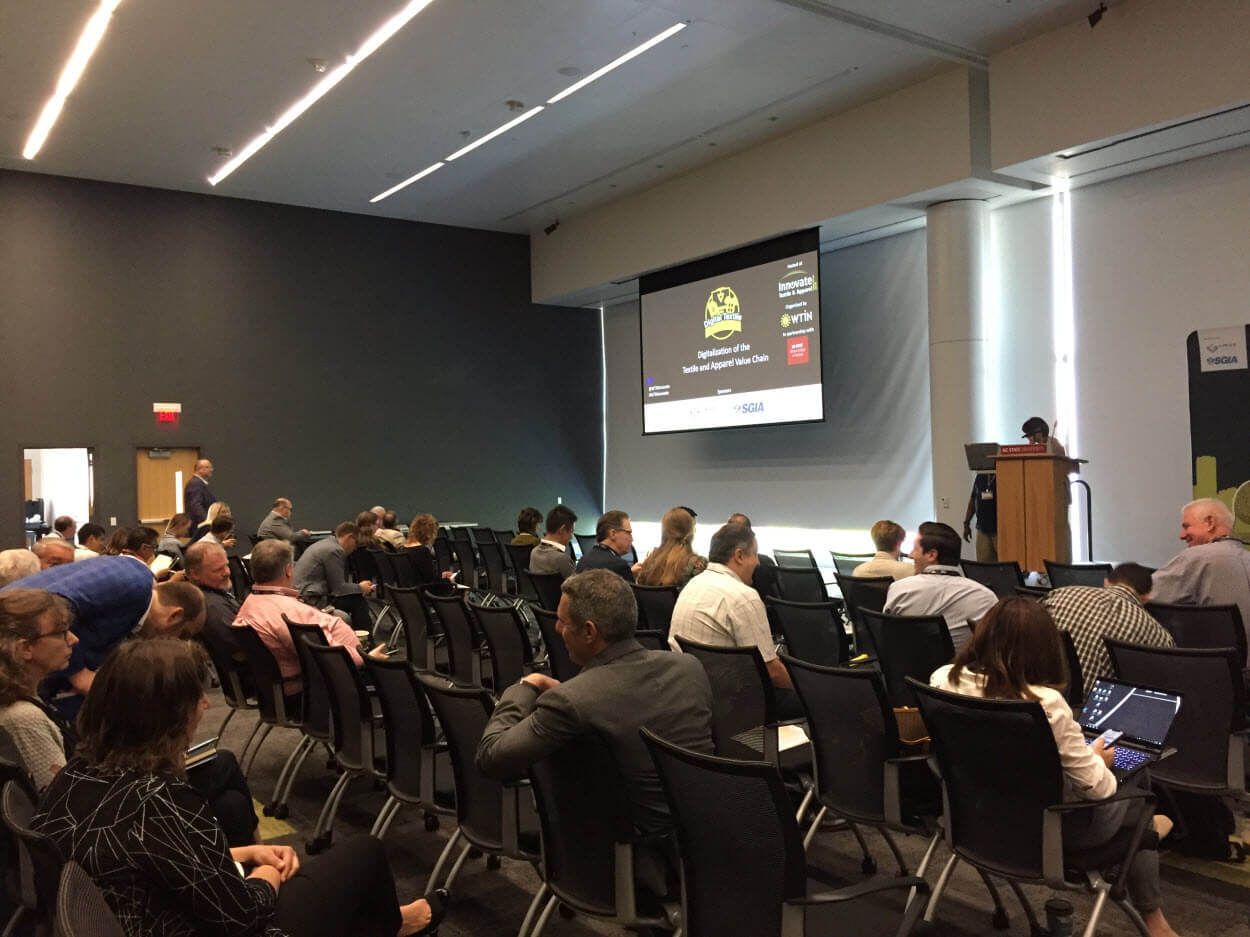
Organised by WTiN, ITA Americas emphasised the importance of digital transformation in the textile and apparel value chain, giving a nod to the information provider’s comprehensive survey of digitalisation in textiles and apparel, conducted in 2018, which confirmed a high level of awareness among business leaders, but revealed that the West is already trailing behind Asia when it comes to digital investments.
“If America is to fully exploit the potential of proximity sourcing and restore its domestic supply chain infrastructure, its manufacturers and entrepreneurs must redress this deficit and install super-lean systems with maximum automation and flexibility,” said WTiN’s managing director, Mark Jarvis.
“A customisation capability will be essential if traditional players are to compete with powerful outsiders such as Amazon who are already probing opportunities in the on-demand apparel marketplace,” he added.
ITA Americas 2019 encompassed the three core strands of digital innovation – technology, materials and business strategy – in three days of expert presentations and workshops that Jarvis said “will help business leaders and product developers identify the winning formula for their own enterprise.”
The event was supported by various industry sponsors and partners, including Datacolor, Lirico Group, SPGPrints, SGIA, Inedit, AATCC, Gherzi, NC State Wilson College of Textiles, Behind the Seams, ETextile Communications, and Fibre2Fashion; attracting 190 delegates. Participating companies comprised prominent brands, including Apple, Gap, Hanesbrands and Under Armour; key textile product manufacturers such as Liquid-X, Unifi, Suuchi and Texdel; technology providers, including APJeT and Shima Seiki; and R&D centres such as AFFOA, Lux Research, and Bureau Veritas.
Digital Textile Workshop
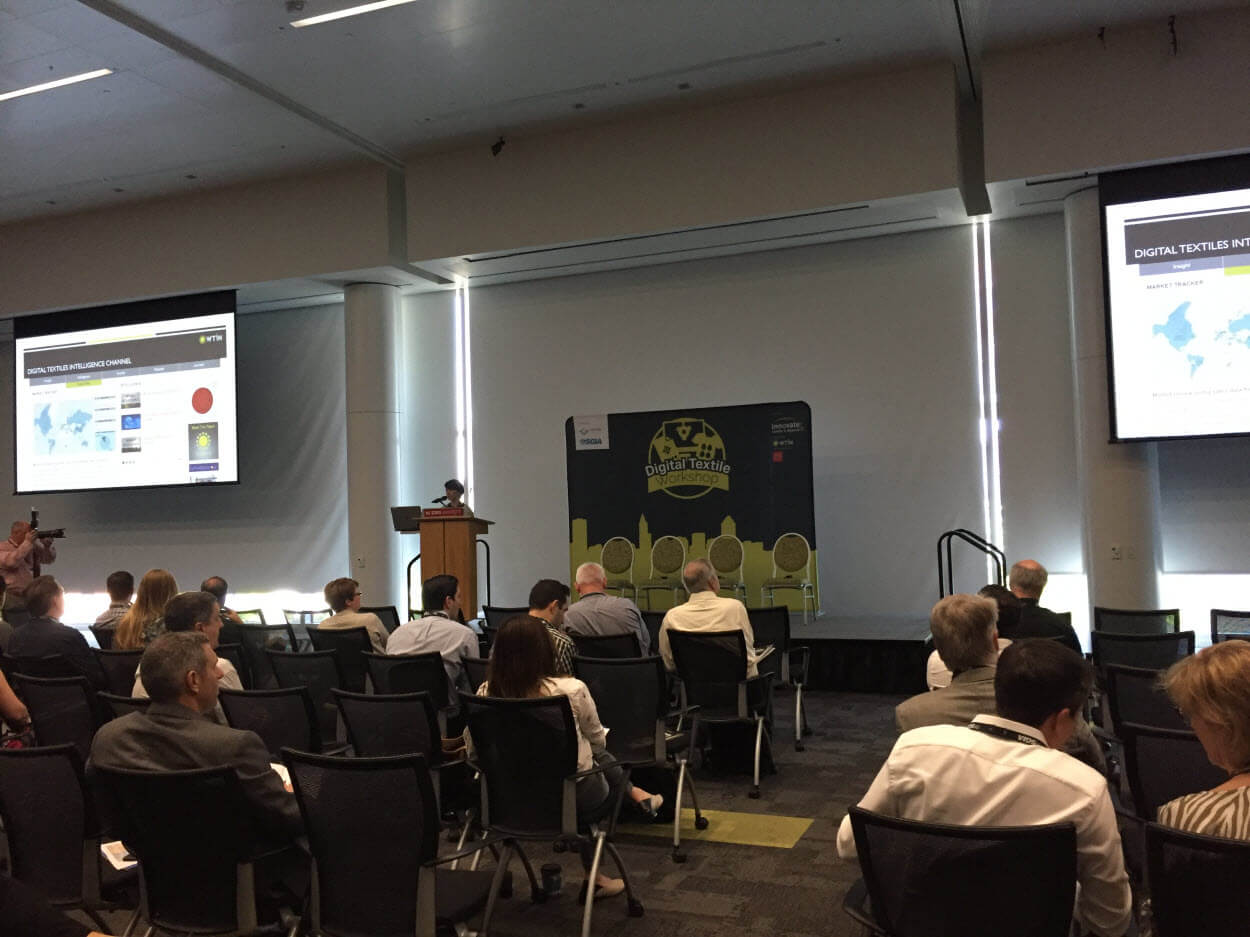
Building on the European edition, which featured three conference tracks – Textile 4.0, Re:Think Materials, and Textile Business Futures – this year’s programme introduced a new track in the form of the Digital Textile Workshop, held on the first day of the conference. Focusing on digital design, simulation and production, the workshop included lectures and demonstrations by industry experts on state-of-the-art technologies in the areas of digital archives, CAD, colour management, digital printing, and virtual prototyping.
Mutlu Chaouch Orozco, lead analyst – industry digitalisation, WTiN, kickstarted the session by analysing the 2018 digital textile printing market. She noted that the ‘dynamic’ market showed continual growth, with machinery sales helping to push the global market to 2.57 billion sqm of digital printed fabric.
Assessing how digital businesses should grow in the traditional market, Chaouch Orozco outlined several steps: 1. Scale your operations gradually – enabling businesses to take on a larger workload without losing revenue; 2. Develop integral relationships with customers – to understand their requirements; 3. Become a micro factory for brands – specifically at the distribution point to achieve personalisation; and 4. Invest in complementing digital technologies – to help businesses maintain competition in the industry.
The Digital Textile Workshop also provided a platform for some breaking news, courtesy of US software giant Adobe. During his presentation, Design for Textiles – An Adobe Perspective, Mike Scrutton, director of print technology and strategy, Adobe, revealed that the company is launching the Adobe Textile Designer plugin for its Photoshop programme, which went live on 6 May. Speaking to WTiN, Scrutton said that the aim of the new plugin is to ‘reduce the number of steps that someone would need to produce a design that they’d created by hand’.
“What we’ve added with the Adobe Textile Designer plugin for Adobe Photoshop is the ability to see how the colours would look on screen in repeat, with the motifs, with exactly the same colours that [designers] are going to get in manufacturing,” said Scrutton.
Other presentations focused on speed to market, with Flint Davis, president of WeaveUp explaining how software is breaking down barriers and creating opportunities using on-demand digital textile printing, and Kerry King, senior vice president of Research & Development, Spoonflower, discussing the web-to-print business model. Using Spoonflower as an example, King explained how the company is exploring various digital printing technologies across multiple products, including 3D-rendering which enables consumers to view a design in several ways.
“The Spoonflower marketplace has hundreds of thousands of surface designs, and if you want to be able to sell that design on duvet covers, wallpaper, cushions and blankets etc, those renders need to be generated in milliseconds. So, we have a team that’s actively working on technology development in that space,” said King.
The afternoon session of the Digital Textile Workshop made way for various product demonstrations from leading companies such as X-Rite, Springs Creative, Lirico Group, and Shima Seiki. The latter, for instance, demonstrated how digitalisation can be streamlined with virtual sampling using its SDS-ONE APEX3 design system. Samantha Burdett, senior product developer and sales, Shima Seiki, explained how, in a time where the textile industry faces the challenges of time and cost burdens, coupled with long lead times limiting forecasting precision, the system can be utilised to ‘reflect the latest trends more reliably, while improving forecasting accuracy of product demand’.
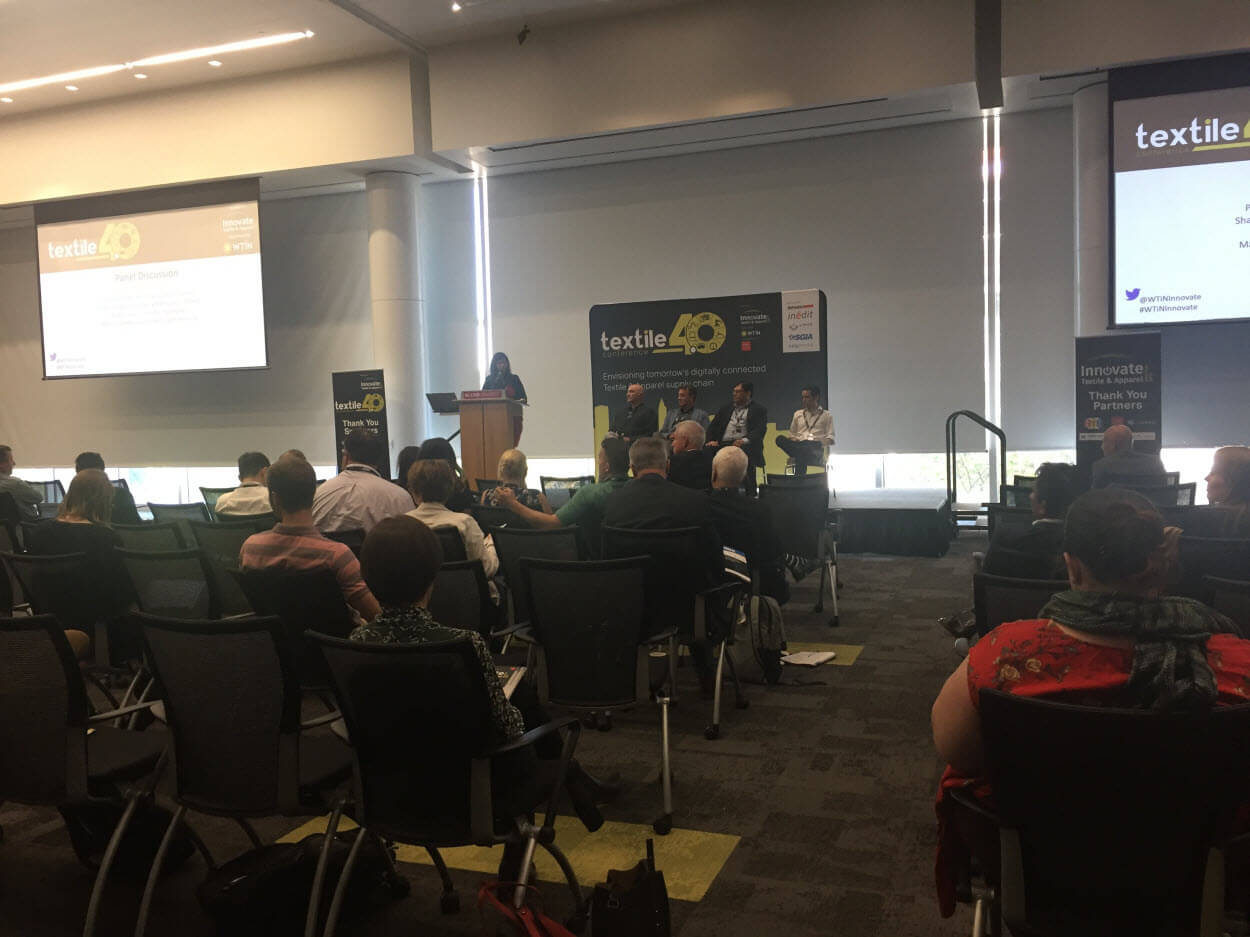
Day 2 of ITA Americas staged Textile 4.0 Conference, which focuses on the digitalisation of the textile and apparel sector. It provides a platform for hundreds of executives to share new projects, discuss opportunities, learn from the world’s leading players, and engage with the big questions: Where to start with digital strategy? What barriers are there to supply chain transformation? What are the benefits of investing in new digital technology when it comes to return on investment (ROI)? And more.
The keynote speech was delivered by Stefan Weisenberger, head of Mill Products Industries, SAP, who explained how textile companies can use IoT to deliver better outcomes and customer experiences, and to have more visibility, predictability and efficiency in factories. SAP calls this an ‘intelligent enterprise’, with various fashion and textile organisations running smart factories with the latest resource-efficient solutions.
“If you’re talking about an intelligent enterprise, you need to make sure that from order taking to planning to manufacturing to shipping and billing, this runs directly integrated. Then, in certain areas you add intelligence and you have something that helps you connect to this real world – by asking consumers or by connecting with sensors. This is where you have data management or sensor integration,” said Weisenberger. “The idea is to make it work as one, be able to automate. If you have 40 different databases and six different systems in different factories, this can be very tricky to pull off, but we’ve seen companies that are quite advanced in this field; it’s not just a vision, it’s actually already happening today.”
The topic of micro factories also topped the conference programme – a solution that is being championed to help combat many of the textile industry’s biggest challenges. For instance, micro factories promise to bring jobs back to local economies through reshoring initiatives and can also enable businesses to go from design to delivery faster than ever – resulting in a more streamlined and personalised process that prevents waste. Delivering some further insight into this was Bill Grier, CEO of AM4U. He advised that building a successful micro factory is ‘more than an exercise in buying equipment’.
“Whether your micro factory is a vertical supplier or third-party source, most of the key ingredients are the same,” said Grier. “Understanding your product groups, risk, demand-product profit lifecycle and factory production requirements are the key infrastructure decision factors in providing your client with the goal of: ‘never out of stock, never overstock’.”
This, he said, will require an understanding of data. “We have to deal with the real-time information of the internet; we haven’t learned how yet. We need to get to a point where we can handle that information. This will enable us make decisions based on huge amounts of data, and those decisions will be much more accurate than they are today.”
Another presentation that focused on the ‘factory of the future’ was by Suuchi Ramesh – CEO and founder of Suuchi Inc, who discussed data analytics for supply chain transparency and efficiency.
She described the traditional apparel supply chain as ‘old-fashioned’, saying that ‘it doesn’t give an opportunity for technology or skillsets to progress’. In response, the company built a digital supply chain system of its own – ‘one that tackled the old world and created a new world’. This, said Ramesh, is a digitised stack that provides real-time flow, with all the data in one place.
Using this model, Suuchi Inc has the capabilities to design a product, source fabric, cut and sew, and ship to over 200 brands and retailers across the US. It also provides the software and data to connect everything – a system that can be accessed by both brands, factories and end consumers.
“We’re all excited about the future of Big Data, but at Suuchi we believe that as far as digitalising the supply chain is concerned, it doesn’t have to be that complicated. A lot can be done with some simple data, but it starts by integrating everybody in the supply chain, especially the factory floor,” she concluded.
Mariano Amezcua, president of Dürkopp Adler Americas, also provided a ‘digital window into the factory floor’ by explaining the advantages of digitalising the sewing value chain.
Among these benefits were the ability to ‘hit the sweet spot’ of quality, productivity and sewing performance through various simulations and parameters. Plus, with all the rich data that can be captured by digitalised machines, best practice can be identified, and proactive measures can be implemented. Dürkopp Adler has contributed to this space with its latest innovation, Qondac networks, which is able to connect sewing machines via their network modules to control them remotely. According to Amezcua, Qondac networks knows the exact number of stitches and hours of operation for wear and tear parts in order to plan for predictive maintenance tasks and thus avoid unnecessary production stops.
The conference also covered the emergence of blockchain technology, with Paul Willerton and Shane Cooper from Defeet – producers of US-made cycling socks – stating that blockchain ‘changes the game at every level’ – from materials and manufacturing, to sale, marketing and even the way consumers interact with the product; adding that groundbreaking new technologies always lower costs and increase productivity.
Re:Think Materials
The third and final day of the conference presented Re:Think Materials, a forward-looking conference for innovation in materials, from fibres to the finished fabric. It sees beyond today’s state of the art to identify the big advances that are just over the horizon, in conductive, smart and novel textiles.
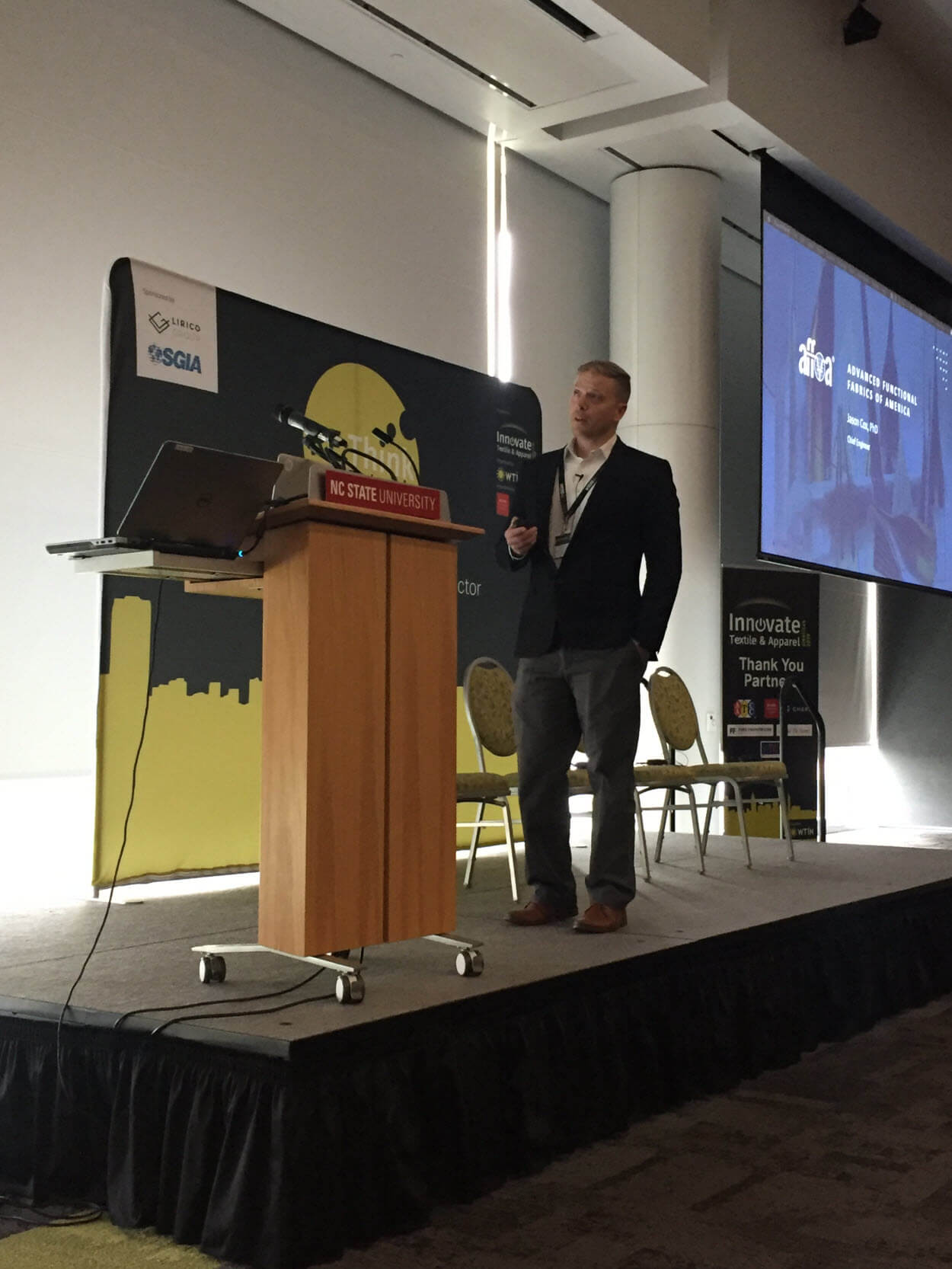
The keynote presentation by Jason Cox, director of Fiber Device Technology, AFFOA, proved a big hit with delegates, drawing several questions from those keen to find out more. AFFOA, which stands for Advanced Functional Fabrics of America, is a product-orientated manufacturing institute delivering fabric products that deliver value-added services to the user, or ‘Fabrics as a service’. These fabrics have the potential to see, hear, sense, communicate, store and convert energy, regulate temperature, monitor health, and change colour.
To achieve interesting functions, Cox said that three ingredients are required: insulators, conductors, and ‘the magic ingredient’ of semi-conductor materials. “You take these three ingredients, put them into very specific geometries and now you’re creating devices.”
AFFOA says this semi-conductor technology will enable wireless connectivity among advanced fabric products that are prototyped rapidly, amenable to both small-batch production and mass customisation to benefit the war fighter and consumers in global markets.
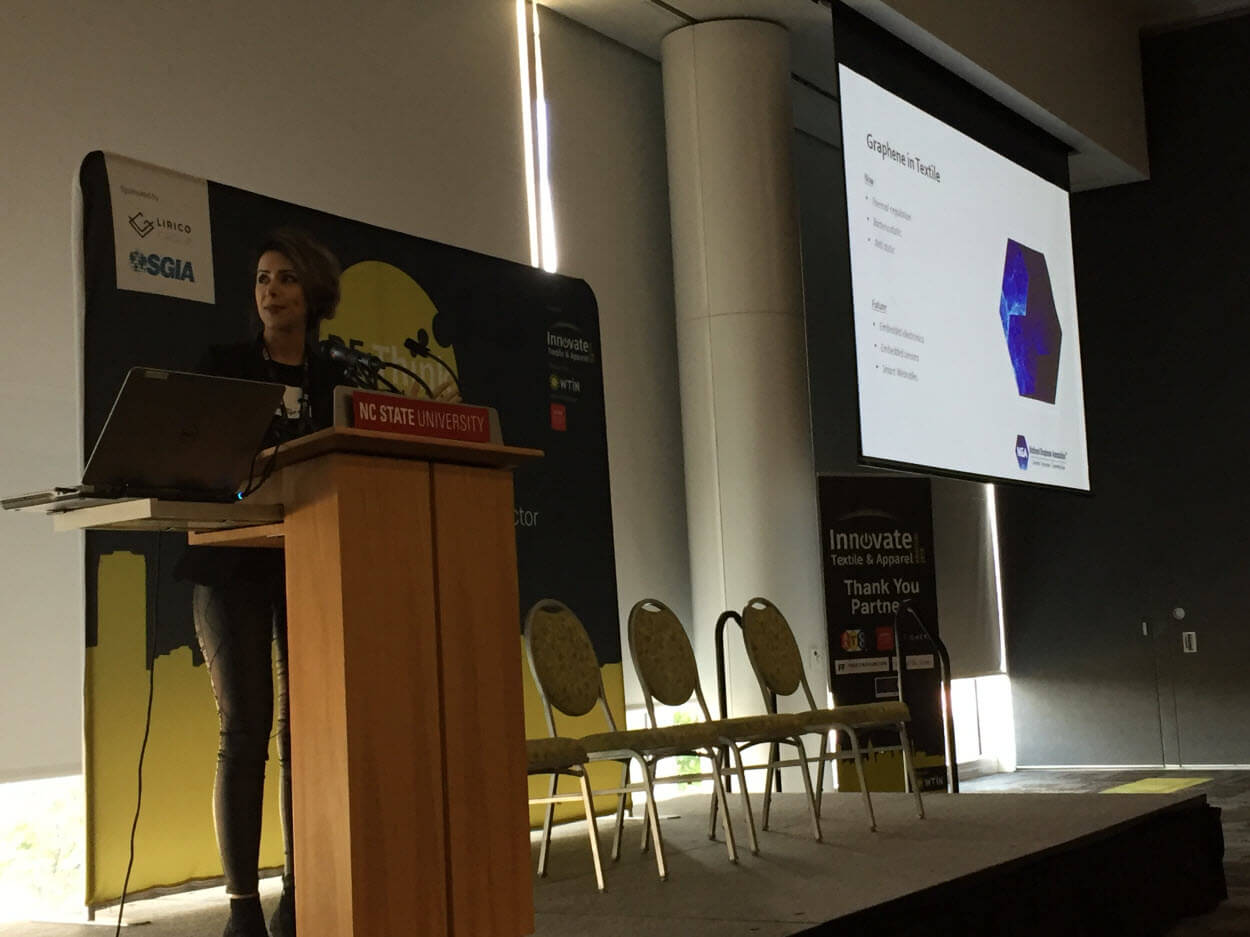
Re:Think Materials also focused on material innovations such as graphene-enhanced textiles, presented by Dr Zina Jarrahi Cinker, executive director of National Graphene Association.
Graphene is often dubbed the ‘wonder material of the 21st century’, but Jarrahi Cinker wanted to peel back its many layers, as it were, by focusing on the realistic expectations of its use in textiles. She started by addressing the two types of graphene that many people still aren’t aware of: film graphene (CVD) and graphene powder. According to Jarrahi Cinker, film graphene is a truly two-dimensional material that requires a substrate for stability – this won the Nobel Prize in 2010. Its applications include sensor components and photodetectors, to name just a few. Graphene powder, on the other hand, is often used in the reinforcement of composites, as an additive, and possesses many functional properties that are considerably different, and less superior, to those of film graphene. Powder tends to be the graphene of choice for the textile industry.
Addressing what is commercially scalable right now for graphene in textiles, Jarrahi Cinker listed advances in thermoregulation, bacteriostatic and anti-static properties. “What is going to be possible in the future is embedded electronics and sensors, smart wearables, and energy storage options that would be part of the fabric itself,” she said. The National Graphene Association works with several companies in the textile field, including Directa Plus – renowned for its Graphene Plus (G+) clothing range – which recently announced that it is going to launch graphene-enhanced firefighter uniforms in Italy, due to the material’s advanced flame-retardant properties.
The conference also highlighted the role textiles play in health and wellness, featuring talks on cooling fabric performance by Apurba Banerjee, chief scientist at Brrr, and drug-delivery textiles from Jordan Schindler, CEO of TexDel, which has developed the “world’s first and only wearable textile able to make pain relief claims”.
TexDel’s technology is said to allow for the controlled delivery of anything from creams and pills to transdermal patches – using an analysis tool called high-performance liquid chromatography (HPLC). Schindler describes it as a ‘next-level shift of textile technology’ called ‘active delivery fabrics’. Applying medication to something worn every day, said Schindler, is “how you simplify health and wellness for the consumer”.
Last year, the company received a US$1m award from the US Department of Defense, which has supported the manufacturing scale up of the technology. The company has since experimented with building a pain relief, blood-clotting or warming and cooling agent into military uniforms to create value for soldiers – which are currently being tested by the US Armed Forces. The company is also developing anti-fungal products, such as socks used to treat Athlete’s Foot, as well as an anti-cellulite ingredient to put into Spanx-type garments.
Smart textiles played a prominent role in the conference, particularly the afternoon session, which featured a market overview by Jerrold Wang of Lux Research, along with insights into textile computing by Milad Alizadeh-Meghrazi, director of R&D, Myant, and industry standards for e-textiles from Chris Jorgensen, director of Technology Transfer, IPC.
For the past two years, Jorgensen said that volunteers from the global e-textiles and printed electronics supply chain and user base have come together, through the IPC E-Textiles Committee, to find solutions to various issues associated with e-textiles – such as reliability, washability and production cost – through the development of industry standards.
“The committee is establishing classifications for materials – a way for users and suppliers of e-textiles to have some common definitions and standards into what is going into the construction of products,” said Jorgensen. “It will also include key characteristics that you need to test for, and durability requirements based on the end-use need. We’re also going to have quality assurance testing frequencies; according to the standard, it will say how often you should test so that we’re not repeating the same test over and over each time an order is placed.” This, he added, will reduce the amount of time it takes to get a product to market, as well as the manufacturing cost, meaning that a manufacturer can spend more time on innovation.
Someone who has plenty of knowledge in developing e-textile products is Madison Maxey, CEO of Loomia, a manufacturer of soft circuit systems, who discussed her experience in this space. “The biggest challenges are funding, finding the right team [which needs to be interdisciplinary] and product development,” she noted. “So, making these products is much more expensive than developing standard textile products.”
“On the product development side, you really need resources such as injection moulders, 3D printers or a screenprinting facility in order to make a prototype and get it into production.”
Maxey added that, when developing an e-textile product, it’s important to consider the problems that may be encountered. “With some e-textiles there are very difficult material science or electrical problems. Understanding where these problems lie helps form the team for the project.”
She concluded that an understanding of manufacturing complications should also be taken into account to ensure that something is going to be scaleable and reliable.
Dr Raj Bhakta, co-founder of start-up company Funxion, and Timothy Fahey, director and strategic advisor, ACI Materials, echoed this sentiment, stressing the importance of taking a realistic, down-to-earth view of e-textiles in order to turn an idea into reality. Fahey presented on high-performance conductive inks, while Bhakta identified methods of making textile-electronics.
Textile Business Futures
Day 3 of ITA Americas also hosted Textile Business Futures – an exclusive, avant-garde event for C-level delegates with one thing in common: the drive for innovation. Partnered by consultancy firm Gherzi, the forum covered topics such as new digital business models and impact projections for the next five years, as well as strategy, manufacturing flexibility, ROI and risk.
Eric Spackey, chief marketing officer of AFFOA, provided the keynote speech, sharing insight on the institute’s strategic approach to develop smart textile projects and on the importance of collaboration with the industry through its Fabric Innovation Network.
Building on Jason Cox’s talk, he explained that the foundations are there to create ‘fabric computers’ – a concept he believes can ‘change the world’. These are detailed in AFFOA’s Roadmap 1.0 which features components such as battery fibre, touch sensors for seating, and body-customising apparel that can change shape. “All these things are demonstrators – they’re not the product, we’re a long way out…decades,” Spackey said.
Meanwhile, Karim Shafei, international partner of Gherzi, addressed the disruption digitalisation is having on the conventional textile and apparel manufacturing business model.
Gherzi believes that there are three main factors changing the textile value chain today. One is the client – “the consumer is now becoming a major player in the textile chain; they can decide what they want to wear and how they want to wear it,” said Shafei. Brands and retailers are another driving force – “I’m not talking about the traditional ones such as Gap and Banana Republic; they’re the old model. We’re talking about Amazon and Apple, and how they’re being disruptive.” And, the third factor is the OEMs – “who are developing technologies that are linking the consumer directly into the chain.”
Shafei concluded that the industry is still in the infancy stage of digitalisation, but not a lot is required to start tapping into new business models. “It needs a change of mindset, and I don’t think the global textile and apparel industry has fully adopted this new mindset,” he noted. Up until 10 years ago, he added, the textile industry was traditional and lacking in dynamism, but it has now started attracting completely new companies from new sectors such as IT and chemicals etc.
The PwC network delivered a workshop later in the day on the smart factory. According to PwC, successful implementations start with the selection of specific use cases that address business problems, and with the development of solutions that embrace a human-centric approach. The workshop therefore guided participants through PwC’s methodology to identify, define and implement smart factory use cases that address challenges such as creating more capacity with existing assets, being able to react flexibly to demand changes, or being more resource efficient.
Another talk was given by Suresh Daniels, director of Coats Plc, who discussed the digital components for digitalisation. And Chinky Tyagi, head of business development, WTiN, concluded the session by offering some insight into perceptions of digital transformation in the textile and apparel industry, based on WTiN’s Digital Transformation Survey, conducted in 2018, which featured around 325 businesses. Using a language programming technique, based on the words used to describe digitalisation by the respondents, WTiN concluded that the sentiment of the industry right now is slightly positive. “There are some doubts on return on investment and around people understanding the technology. So, there is some ambiguity around how people can apply this technology that is available to them,” says Tyagi.
WTiN is currently planning its 2019 Digital Transformation Survey, which Tyagi said will be distributed to respondents in June. “We want to track this industry every year and show how this industry is changing gradually,” she concluded, adding that WTiN is seeking more partners to offer a better reflection of the industry.
The next edition of Innovate Textile & Apparel will take place in Amsterdam on 15-17 October 2019. To find out more, visit here.