
A wealth of experience in creating natural fibres – from cotton, hemp and silk to bamboo, banana and paper – combined with cutting-edge technology, is giving Japanese companies an international edge in making eco-friendly fabrics.
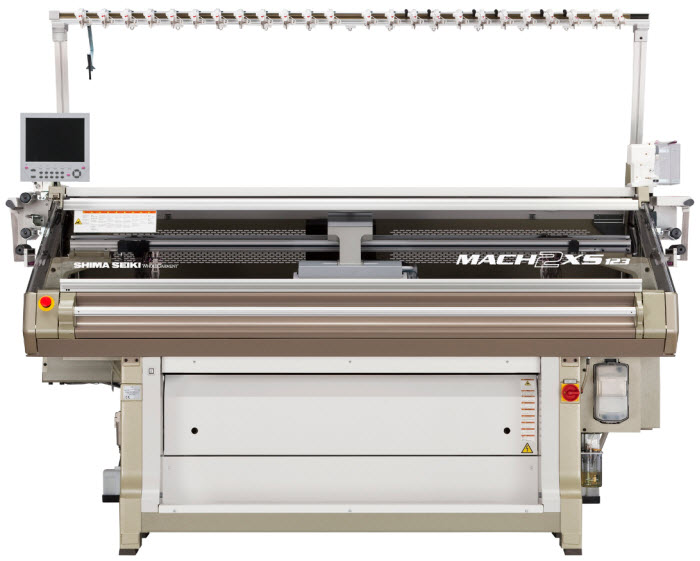 Shima Seiki's latest Wholegarment machine, the MACH2XS
Scientists are bringing together old and new as they re-examine ancient practices and consider innovative techniques to bring new products to market. And with sustainable fashion finding a greater following among consumers worldwide, demand is high.
Osaka-based Sasawashi Co Ltd has blended two distinctly Japanese materials – washi (paper) yarn and the plant kuma bamboo grass (kumazawa in Japanese) – to make a new branded fabric, Sasawashi.
“We made Sasawashi because we wanted to have a differentiated fabric based on Japanese culture and origin,” says company director Toshinori Itoi.
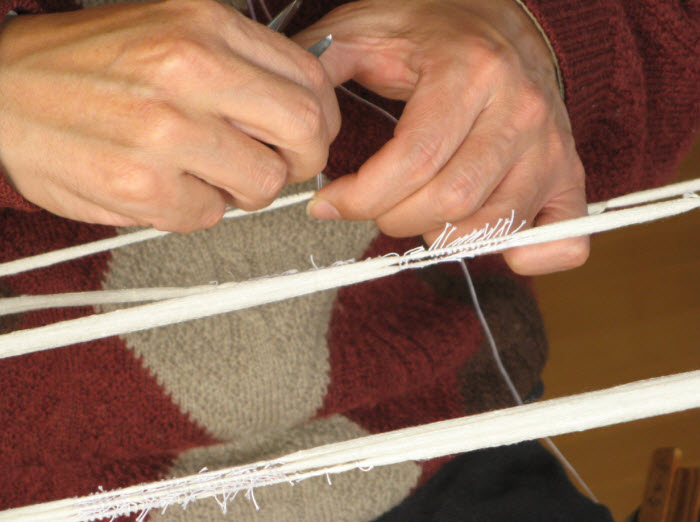 A yuki-tsumugi artisan spins yarn from floss silk
The production process involves adding flakes of kumazawa to washi to make a sheet of paper, which is slit to make long tapes. These are then twisted into yarn, which is woven into fabric.
According to the company, the finished product is lint-free, light, gentle on the skin and antibacterial. It is said to have an absorbency rate double that of cotton and the ability to block 98% of UV rays.
The Sasawashi range features fabrics for summer and winter undergarments as well as accessories and bed linen. It has gained a solid footing in Japan, which is mostly hot and humid in summer, and is also sold in the US, UK, France, Australia, South Korea and Ukraine.
“In the future, we want the comfort of Sasawashi to be known by as many people as possible worldwide,” says Itoi.
 Socks made from Sasawashi material
Manufacturing giant Toray Industries Inc is also tapping into plant resources. It produces several biomass-based products that are based on natural raw materials. Foresse is an eco-friendly fabric made from plant-based cellulose using a melt spinning process without the need for organic solvents. The process results in “a high-performance textile that would be unobtainable using traditional cellulose fibres,” according to Toray.
Another of Toray’s fabrics, “ecodear” PET, which is derived from waste sugarcane molasses, was in October 2015 awarded a Type I environmental label by the Japan Environment Association, a third-party certification body. The fabric is being used to produce uniforms.
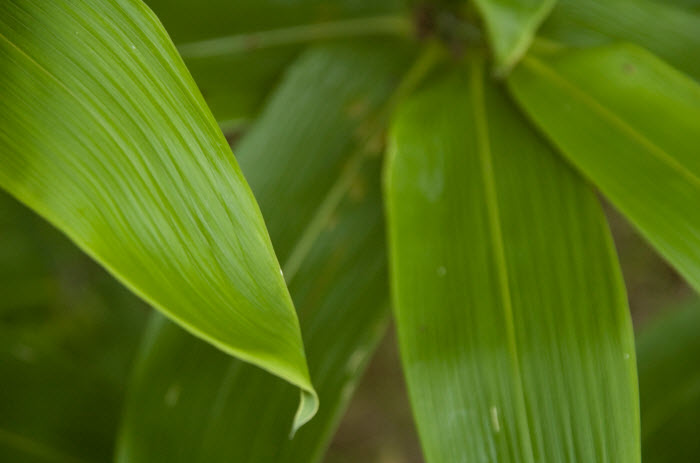 The kumazawa plant, used to make Sasawashi fabric
The idea of eco-friendly working clothes for the mass market is attracting attention. An All Japan Uniform Committee was established in 2014 by the Rebirth Project, a social enterprise led by actor Yusuke Iseya that focuses on sustainable development. The committee is working with major companies, including clothing brand Deluxe (made by DLX Co Ltd) and the Itochu Corporation, aiming to develop eco-friendly uniforms for 10 million people by 2020.
While companies such as Teijin Fibres Limited is making uniforms using recycled polyester in a closed-loop system, others, such as Ichimura Sangyo Co Ltd, are blending polyester with cotton or other natural fibres to offer what a company note calls “environmentally friendly, high-performance and high-fashion products.”
Work is also continuing on innovative production methods to decrease the environmental footprint of fibres and fabrics. Nisshinbo Holdings Inc has created a 100% cotton dress shirt called Apollocot that does not require ironing, thereby reducing consumers’ energy use.
Spokesman Kiyohiro Kida says the company succeeded in making the product “by repeating more than 15,000 experiments on the raw material as well as spinning, weaving and processing.”
In addition, domestic production of cotton fibre is expected to receive a boost thanks to the Tohoku Cotton Project. The new initiative, launched by Japanese clothing companies and a food chain, is supporting farmers to grow cotton in the north-east Honshu region after the 2011 tsunami made the soil too saline for rice cultivation. While crop volume remains low, farmers are making a living and interest is building in the sustainable garments that have been created from the cotton.
Japanese technology companies are also helping to boost the country’s output of eco-friendly textiles. The revolutionary Wholegarment knitting machine, launched by Shima Seiki in 1995, is reducing energy use and waste in manufacturing.
The machine uses four beds rather than the standard two, allowing the manufacturer to produce two panels and connect them to form a three-dimensional tube, thereby eliminating the need for sewing parts together. The technology can produce all kinds of clothing, from socks to hats and everything in between, in practically any natural yarn.
Shima Seiki showed its latest version, the MACH2XS, at ITMA 2015 in Milan.
“With this machine it is now possible for knitting companies to bring knit production back onshore to local consumer markets, while remaining competitive against imports from China and outlying Asian companies,” says Shima Seiki spokesman Masaki Karasuno.
“Aside from the economic benefits to local industries, Wholegarment knitting by definition produces knitwear using only the minimal amount of material required to produce a single garment, and is therefore one of the most sustainable forms of textile production available.”
To maximise the machine’s capabilities, Shima Seiki has developed an original needle that allows a greater variety of patterns and designs to be created, and a digital stitch control system. According to Karasuno, this system “has contributed largely to quality control in the knitting industry.” It manages yarn feed and tension to overcome changes in natural yarns caused by temperature, humidity, cone size, batch differences and knitting speed “to yield consistency in loop formation throughout each piece, from piece to piece and from batch to batch.”
For Karasuno, the future is bright. “After 20 years, Wholegarment technology is finally taking over mainstream production,” he says.
Meanwhile, a long established company, Okujun K.K., is also working to secure a future for its 109-year-old business in yuki-tsumugi, the craft of silk cloth used primarily to make kimonos. With 2,000 years of history and only about 130 craftsmen skilled in the technique, yuki-tsumugi has been added to UNESCO’s Representative List of the Intangible Cultural Heritage of Humanity.
Some 40 small, labour-intensive processes have been perfected to create the warm and light material – all yarn is hand-spun from cocoons of floss silk, and fibres are handwoven using a loom.
Okujun is firmly established as a kimono maker but it is broadening its offerings through new innovations. Artisans have created new textures using a motor for spinning, new patterns using a silk screen for dyeing, and wider fabrics using a mechanical loom. The outcome is a range of colourful shirts, scarves and hats for a broader audience.
“We are a well-established shop but we opened a yuki-tsumugi building 10 years ago, so more people would know about the charms of this fabric,” says a spokesperson.
With Japan’s natural fibre and fabric industry firmly rooted in tradition yet also striving to stay ahead of the curve, the country looks set to continue to offer innovation in textile products and manufacturing processes.
Have your say. Tweet and follow us @WTiNcomment