UK-based technology company, Kymira, is boosting athlete performance and helping to treat medical conditions. Founder and CEO of Kymira, Tim Brownstone, explains more to Jessica Owen.
Innovation is key when developing new technologies, and when it comes to smart textiles, Kymira is disrupting both the sports and medical retail markets with its patented infrared expertise.
Kymira is a technology company based in Reading in the UK. There are two application channels to the brand – Kymira Sport, which is operating now, and Kymira Medical, which will launch soon. The company uses its patented technology to produce wearable products that react and interact with the human body to convert heat into energy and information.
Through Kymira’s smart garments, the company helps to enhance the performance of athletes, aid circulation and accelerate recovery, with the aim to later monitor and report on human well-being.
Initiating Kymira
Founder and CEO of Kymira, Tim Brownstone, initially thought of the idea back when he was in sixth form. He read a NASA research paper about how they were using infrared light to grow plants quicker in space and wondered whether this could be used to grow human and animal cells, too.
To study infrared further, Brownstone went on to complete a BSc animal sciences degree at the University of Reading, UK, as this was the only degree in the country at the time that would allow him to study infrared at undergraduate level.
During this time, he worked with a Californian textiles company, where he had developed his technology and applied it to the medical sector.
“I was researching the effects of infrared when I was at university,” says Brownstone. “As I was coming up to graduating, the technology was developed but my research was applied to the medical space, but for this it needs to be certified and the cost of doing those clinical trials is rather large.
“So, I started to look at how I could get this in the hands of people who could help, and the way I did that was by starting the sportswear brand, Kymira Sport. This funded the medical research to help with medical conditions as well as sporting ones.”
Brownstone worked alone for a while and eventually hired his first part-time employee in 2014. Kymira has since grown, and the company recently moved from the University of Reading campus to its own unit and warehouse.
The technology explained
Due to the fact that he was studying for an animal-based degree, Brownstone first tested out his technology on horses.
“I worked with horses because it is firstly easier to pass the ethical paperwork, and also because I wanted an unbiased study as possible and the placebo effect may have occurred with humans,” says Brownstone.
Brownstone explains that he surprised himself with the results from this study. He was researching muscle suppleness, locomotion scores and measuring stride length of the horses. Brownstone expected a 3-4 cm improvement in the stride length, yet the average improvement was around 50 cm.
“That was the turning point where I thought there may be something more to this than I realised,” he says.
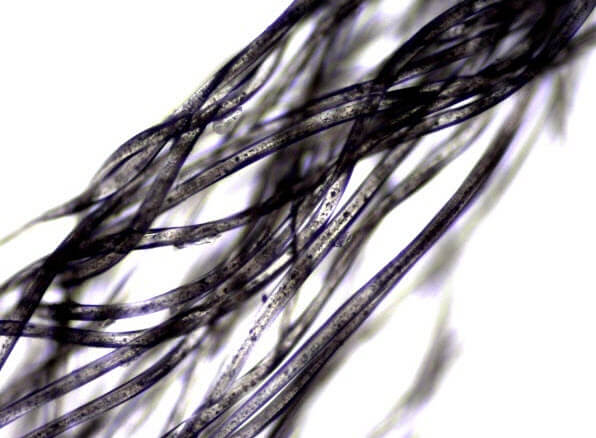
Kymira’s fabrics work by capturing the body’s waste energy and converting it to a specific wavelength of Far Infrared Radiation (FIR) that has proven beneficial effects on the body.
“We embed a mix of specific minerals into the fibres of the yarns during the extrusion process,” explains Brownstone.
“These minerals absorb body heat and visible light and when they absorb that it causes the electrons in their atoms to excite to a higher energy state,” he adds. “However, that’s an unstable form, so the electrons move back down to their original energy state and that discharges a photon of infrared light within the specific region that we’ve targeted.”
Currently in terms of infrared fibres, Kymira has both a polyester and nylon version. Manmade fibres are used because it is easier to apply the mineral mix inside the fibres themselves, which also helps to keep them inside when being laundered.
Benefits of the technology include increased circulation, an increase in tissue oxygen levels by 20%, increased cellular metabolism and energy productions, and pain relief. Additionally, Kymira fabrics retain heat 63% longer than standard fabrics in cold conditions and dry 35% quicker.
Kymira’s brands
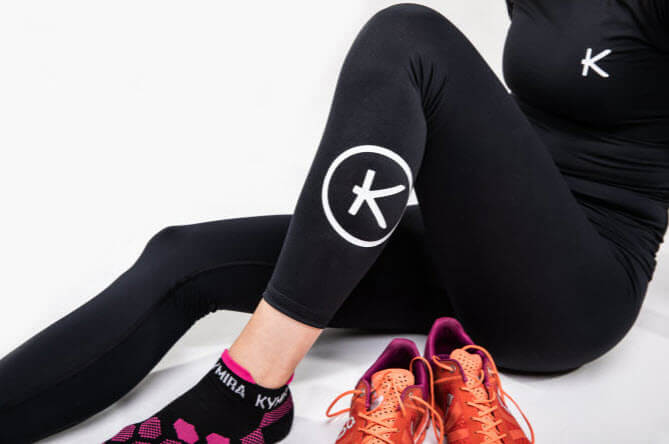
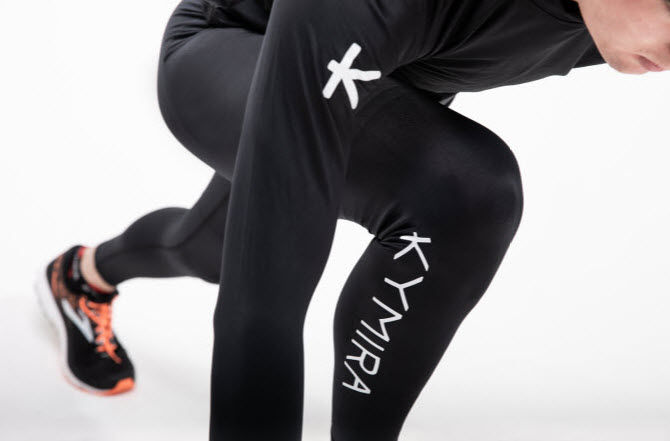
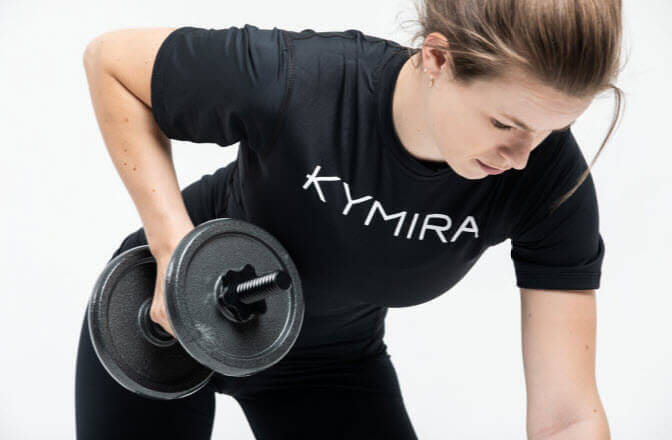
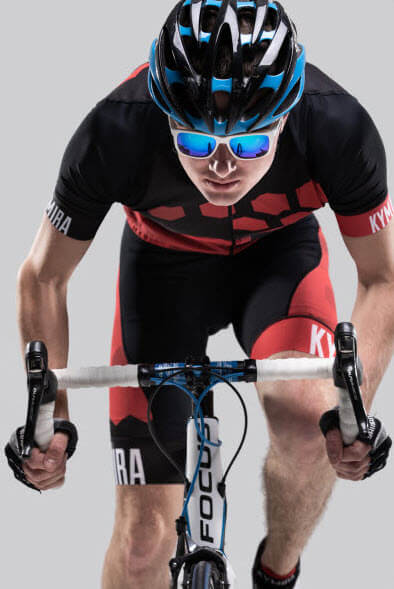
As previously mentioned, Kymira Sport was founded first in 2013 following five years of academic research. The brand has a range of products available that are used on every continent by both professional and amateur athletes, including leggings, tops, cycling attire, socks and gloves.
Brownstone says: “We have quite a few Team GB rowers who are using our products who have either been in the Olympics or are on the Olympic pathway. British, Italian and Hungarian Olympic fencers also use the kit, and there’s a few winter sports that are getting involved, too.
“In terms of the military, the special forces based in Hereford, UK, have used our garments as well.”
Kymira is now approaching the point of releasing a Kymira Medical website retail outlet to cater for the medical sector.
“We’ve got customers who have been buying through the sports website for a couple of years and so the medical side has been growing organically,” he says.
“Most of our physical retailers here in the UK are physiotherapists, chiropractors, healthcare clinics and the like, and through them we’ve been helping to manage and treat chronic conditions like arthritis, Raynaud’s disease, and help the rehabilitation process for stroke victims,” adds Brownstone.
“And then you have the grey area in between which is sporting injury, prevention and rehab. We also have anecdotal evidence from others with different medical conditions. For example, under our FDA certification over in the US, we’ve been helping to treat diabetic and myopathic foot pain.”
While Kymira Sport has been aiding those with medical conditions, Brownstone says that it can get confusing for customers who are on the website looking for performance wear and come across reviews about medical applications.
“While it’s fantastic that we’re getting five star reviews on our sportswear website for medical reasons, it paints a slightly confusing picture.
“If you are going on the website looking for some gym wear or performance leggings, and the most recent review you find is about treating infrapatellar bursitis, then you might think that you’re in the wrong place.”
This is where Kymira Medical steps in. To start off, the new brand will include select items from the sporting range that also have medical applications. Kymira Sport and Medical will go hand in hand with products transitioning in both directions.
Overcoming scepticism
To date, there have been around 10 independent trials published regarding Kymira’s technology, four of which have been peer-reviewed.
Brownstone says: “It was really important to me as a scientist that we had all the evidence to support our claims. You don’t get FDA approval or CE markings without having good evidence.
“We also have a growing body of anecdotal evidence. We have the consumer side which is all on the website via the reviews, and we also have some more in depth ones from our professional sporting customers who are able to speak a bit more scientifically about it.”
Kymira is also the owner of two capillary microscopes, which it uses to show potential customers and those who are curious about the technology just how it works.
Brownstone explains that when he notices that a customer is sceptical about the technology, he asks them if they would like to take part in an experiment. He applies some emersion oil to the person’s finger to help focus the lens and then places the finger under the microscope. Once the capillaries in the person’s cuticles have been found, Brownstone shows them how their circulation operates normally. Next, he lays a piece of Kymira fabric over the person’s arm and within 30 seconds the person should be able to see a significant reaction occurring.
“People usually want to do the experiment on themselves, so they know that nothing else has been used to enhance the outcome,” says Brownstone. “It’s very unbiased and they can see that the technology does what it says on the tin.”
Challenges
Although Brownstone does not see it as a challenge, he actually started researching and developing the company while finishing his degree dissertation and preparing for his final year exams. During this time, he was designing fabric compositions, testing different weights, and teaching himself how to pattern make and speak the textiles language.
“It was a very busy time, but it was very different to me,” he says. “I was a biochemist and so it was quite refreshing looking into this.”
For Brownstone, one of the biggest challenges has not been developing the technology but learning how to run a business.
“It’s mainly been business operational stuff that’s been challenging. For example, we had an issue with invoicing, a mistake that was down to naivety on my part, we had to go to court to resolve that.
“Now, it’s about resources, such as people hours and making sure we don’t all have to work 18-hour days to keep up as things grow.”
Truly smart textile plans
In addition to the launch of Kymira Sport, the company is busy adapting the production process to embed electronics into the yarns as well.
Only recently has Kymira released an early prototype of its new cardiac monitoring T-shirt. The garment wirelessly transmits the wearer’s heart rhythm to a mobile device and can accurately identify an unusual heart rhythm that could cause a sudden cardiac arrest.
The shirt was officially launched at the World Trade Centre in New York, US, in November 2018 and the scientists at Kymira will continue to progress the technology for medical purposes in the future.
“We’re already at the point where you can log into the garment and see a full ECG trace in real time to see what part of the heart is beating,” he says. “These future garments are the truly smart textiles.”
Kymira will be exhibiting at many shows throughout 2019, including ISPO in Munich, Germany. To find out more about Kymira, visit: http://kymira.co.uk/