In recent years, the number of people suffering from chronic wounds has risen sharply. The bacterially infected wounds, which take more than eight weeks to heal, are often underestimated in their burden on the individual, the healthcare system and society. In Germany, €5-8bn are annually spent on the treatment of chronic wounds. Longer life expectancy suggests that the number of patients suffering from chronic wounds will continue to increase.
Innovative and modern concepts for care, as well as efficient forms of therapy control and support for home care situations are needed. In terms of efficient forms of therapy control, previous research showed that low-level light has been documented as a promising addition to enhance wound healing. This is especially the case for treatment with blue light, which can improve the perfusion of chronic wounds and has an anti-inflammatory effect that would accelerate the healing of the diseases.
To address this need, the research project ‘LEDSensTex – LED and sensor-assisted textile wound dressing’ aims to develop a flexible intelligent wound dressing system with integrated LEDs that enables the illumination of chronic wounds. The integration of low-level light into wound dressings could be an alternative method of treatment for patients with chronic wounds. The intelligent dressing, which enables the illumination of chronic wounds, would be more effective at healing the wounds and reducing pain for the patients. Accelerated healing would reduce the amount of dressing changes, the length of hospital stays for patients, and would require fewer interactions with physicians. This in turn would save costs for the healthcare system and society. Furthermore, the risk of infections for patients would be decreased, and a faster return to a tolerable level of pain would be made possible, enabling patient activity.
The collaborative research project funded by the German Federal Ministry of Education and Research (BMBF) comprises an interdisciplinary consortium with the clinical partner Charité – Universitätsmedizin (Berlin), the industrial partners Julius Zorn GmbH (Aichach), Turck duotec GmbH (Halver), Lumileds Germany GmbH (Aachen), W Zimmermann GmbH & Co KG (Weiler-Simmerberg), and the research facilities Hahn-Schickard-Gesellschaft für angewandte Forschung e.V (Stuttgart/Villingen-Schwenningen), Heinrich-Heine-Universität Düsseldorf – IPkM (Düsseldorf), and the Institut für Textiltechnik of RWTH Aachen University – ITA (Aachen).
Within the project, an interactive wound dressing system is aimed for, which allows therapy control via the selection of light parameters and exposure time. The graphical user interface as an interface to the wound dressing is done with the help of an app, to be developed in the project. This app could also be used in the future to send the data obtained on the wound status directly to a doctor who is not on site. This telemedicine approach would mean further support for the patient, since therapy control can be performed directly by the physician or through communication between physician and patient.
The basic structure of the wound dressing is composed of several layers (Figure 1). The functional layer forms the basis, followed by the diffusion and the separating layer which faces the wound. The LEDs are embroidered on the functional layer, which is used to control the diagnostic and adaptive therapy. The light is distributed through the diffusion layer in the form of a spacer textile, allowing uniform irradiation of the wound. The separating layer is in direct contact with the wound and serves to absorb wound fluid and blood. To meet hygiene requirements and improve the sustainability of the wound dressing, the separating layer applied is exchangeable.
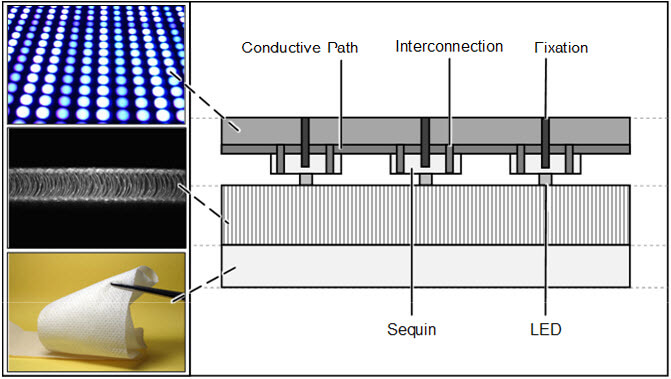
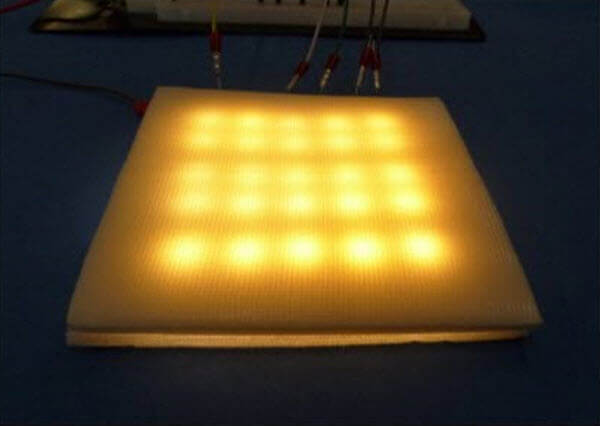
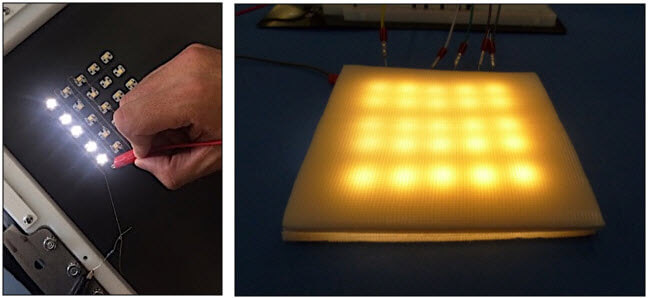
In this project suitable materials for diffusion and separating layers, as well as connection technologies for the integration of LEDs by means of sequin embroidery, are investigated. Regarding the guideline VDI 2221, partial solutions of the development process were examined on the basis of classical and modified textile test methods. In particular, the influence of the material composition was evaluated and characterised with regards to the mechanical, thermal and optical properties of the overall system. The system solutions were evaluated by a utility analysis and the best evaluated system solution was transferred to a textile prototype. The basic functionality of the multilayer intelligent wound care system was demonstrated (Figure 2). Further work will focus on increasing the elasticity and drapeability of the systems in order to also ensure even illumination of difficult to access wounds in the ankle area.
The implementation of a first prototype of the overall wound dressing system with integrated LEDs offers promising perspectives for the modern treatment of chronic wounds, as accelerated healing would reduce the number of dressing changes, the length of stay of patients in hospital, and the need for less interaction with physicians. This in turn would save costs for the healthcare system and society. It would also reduce the risk of infection for patients and allow a faster recovery to a more bearable level of pain, enabling the patients to become more active.
The project underlying this report is funded by the Federal Ministry of Education and Research under the grant mark 16SV7760K. The responsibility for the content of this publication lies with the author.