Cotton Futures moved marginally, staying nearly unchanged as an early rally attempt failed to gather much outside support. Traders were looking at the moves seen in the world stock indices and energy complex and the stronger US$ as good reasons to sell cotton, and funds and other speculators appeared to be the best sellers. There were talks of a recession coming – which could hurt demand for cotton eventually. World production and supplies were still lower due to bad weather in the growing season for major producers around the world, including India, Pakistan and Australia. China had problems with its unconducive weather, too. Demand for US cotton was disappointing, as the weekly export sales reports have shown average demand at best since the start of the marketing year.
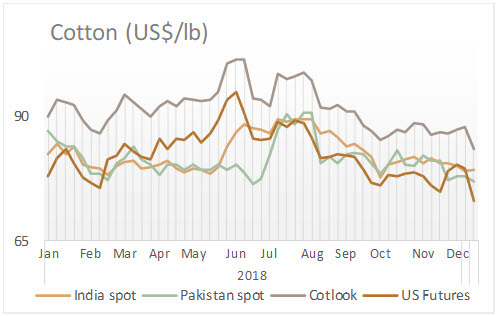
The International Cotton Advisory Committee has predicted the average global cotton price for 2018-19 to be US cents 86 per pound, lower than its earlier projection of US cents 89, on a likely decline in consumption. The forecast is based on the assumptions of marginal reduction in world cotton consumption at 26.7 million tons for the period as against 26.81 million tons reported in the same period last year. World cotton ending stocks, however, are projected at 18.2 million ton, as against 18.76 million ton. Consumption growth will be slower at 26.8 million projected to exceed production, the ICAC said.
Global spot benchmark, the Cotlook A index, edged down US cent 0.90 week-on-week to close at US cents 79.65 per pound.
In China, the spot cotton market was range-bound on weak note given slow trades, with offers for Xinjiang-origin grade-3128 mechanically-picked at 15.50-15.60 Yuan a kg (US cents 103 per pound) and hand-picked at 15.80-15.90 Yuan a kg (US cents 105 per pound). The China Cotton Index fell by 31 Yuan this week, to close at 15,352 a ton (US cents 102 a pound).
In Pakistan, the cotton market was in weakness although New Year cotton futures rose in earlier sessions while exporters are estimated to have picked up nearly 100,000 bales. The KCA spot rate dropped PakRs160 to PakRs8,700 per maund ex-Karachi. The current cotton crop output is likely to range from 10 to 10.8 million bales and could touch nearly 11 million bales (155 kg). According to Pakistan Cotton Ginners Association, cotton production up to 1 January stood at 10.27 million bales, 7.5% short compared to the 2017-18 season.
In India, cotton prices were seen rising, although slowly, and losing their export competitiveness in global markets. Benchmark Gujarat Shankar 6 was quoted at INR43,400 per candy up INR100 week-on-week. Meanwhile, cotton output for 2018-19 is expected fall way below initial estimates, reports said based on arrivals in early January as a fair measure of the estimated output. The current arrivals suggest a drastic decline in output. The Cotton Association of India, had pegged 2018-19 cotton crop at 34 million bales last month, down from 36.5 million bales in 2017-18. However, recent arrivals have been dismal, with the total this season standing at only 11.5 million bales, down from 16 million bales last year, indicating that the crop is much lower than earlier estimated.
Cotton yarn
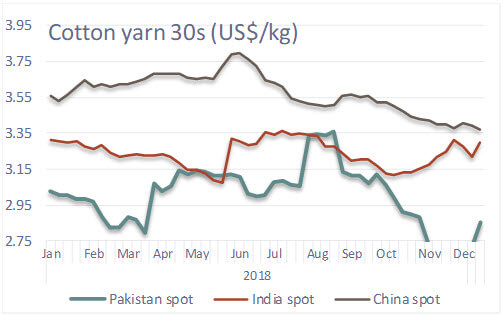
Cotton yarn markets did not see large trading volume this week in Asian markets, as most of them had shorter trading week due to festive season. In China, while prices of some individual varieties still went down somewhat, demand for 32s and 40s combed yarn was relatively better, while the transaction of other specs was modest. Upstream cotton spot market was range-bound, on weak note. Some spinning mills in Shandong were using Brazil-origin cotton, for mixing due to more competitive prices compared with Xinjiang-origin cotton. In India, cotton yarn market was under weak correction amid poor transaction. Downstream weaving mills set to be hit by lower cotton production this season which may push prices up. In Pakistan, cotton yarn prices were stable in Karachi market but moved down for most counts in Faisalabad market reflecting recent fall in cotton prices.
In China, 32s cotton yarn prices edged down to 23.00 Yuan a kg (US$3.35 a kg), while 40s fell to 24.10 Yuan a kg (US$3.51 a kg), both down US cent 1. Coarser yarn prices of 16s were stable at 14.50 Yuan a kg (US$2.11 a kg) while 21s sobered to 18.30 Yuan a kg (US$2.67 a kg, down US cent 1). In Pakistan, 30s carded prices in Karachi remained unchanged at PakRs175-180 per pound (US$2.76-2.84 a kg), while 32s cone in Faisalabad gained PakRs3-4 to PakRs184-196 per pound (US$2.90-3.09 a kg, up US cents 5). In India, 30s carded cotton yarn for knitting remained unchanged at INR231 a kg (US$3.31 a kg, up US cent 1 due to weak INR) in Coimbatore while export offers were flat at US$2.88 a kg.