The Australian wool market declined for a third successive week despite a further weakening in the Aussie dollar.

The Australian Wool Exchange (AWEX) Eastern Market Indicator (EMI) lost 21 cents (1%) for the week to close on 1,992 cents per kilo clean on Thursday 4 October. The EMI fell under the 2,000 cents mark for the first time since sales resumed after the mid-year break in August, and has now fallen for three consecutive weeks, losing a total of 102 Australian cents. AWEX said that it is difficult to attribute these losses to currency movements, highlighted by the fact that when viewed in US dollar terms, the EMI over the same period has fallen by 93 US cents.
This week, in US dollar terms, the EMI declined by 51 cents (3.5%) to finish on 1,410 US cents.
The Australian dollar against the US dollar was 1.48 cents (2%) lower compared with last week to close at 70.85 US cents on Thursday.
Sales were held this week at all three selling centres on Wednesday 3 October and Thursday 4 October. On Wednesday the EMI fell by 20 cents to 1,993 cents and in US dollar terms declined by 29 cents to 1,432 US cents. On Thursday the EMI dropped by just 1 cent to 1,992 cents but in US dollar terms fell by a further 22 cents to 1,410 US cents.
Despite the EMI recording overall losses for the week, there were positive signs apparent later
in the series, albeit helped by the weakening of the local currency. The Northern and Southern indicators were essentially unchanged on Thursday. Trade reports indicated that competition improved as the day progressed. Fremantle, which finished off the selling for the week, recorded overall positive movement on Thursday, pushing the Western Market Indicator up a healthy 17 cents.
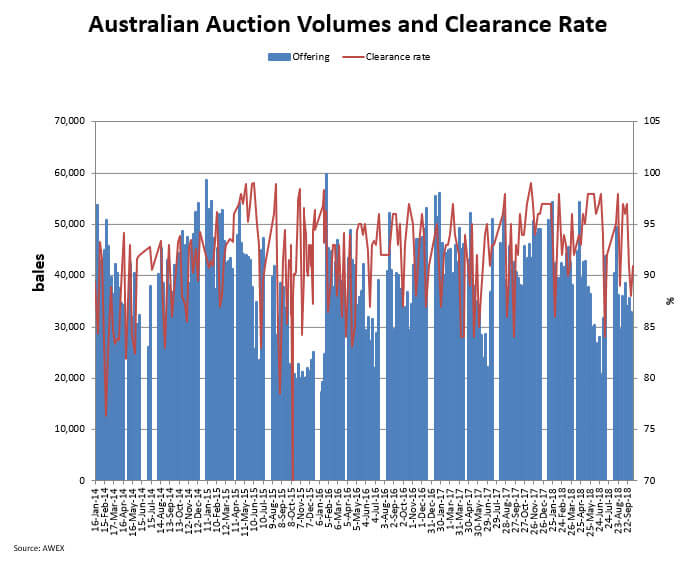
The total national offering increased from 32,985 bales last week to 39,261 bales this week – the highest offering since the first week after the mid-year recess. The clearance rate this week was 91%.
The New Zealand Merino Company offered 944 bales in Melbourne on Wednesday, with a clearance rate of 80.2%.
The fine end of the Merino types was more affected this week, with the falls in the average closing AWEX Micron Price Guides (MPGs) decreasing up to 18.5 microns, after which there were small increases.
16.5 microns fell by 100 cents (3.3%); 17 microns was down by 80 cents (2.8%); 17.5 microns declined by 43 cents (1.6%); 18 microns decreased by 25 cents (1%); 18.5 microns fell by 21 cents (0.9%); 19 microns was up by 4 cents (0.2%); 19.5 microns gained 10 cents (0.4%); 20 microns increased by 20 cents (0.9%); 21 microns climbed by 6 cents (0.3%); and 22 microns rose by 3 cents (0.1%).
The skirting sector had a week of mixed results. AWEX reported that wool carrying less than 2% vegetable matter (vm) attracted spirited bidding, resulting in gains for the week of 20 to 30 cents. As the amount of vm increased, buyer demand decreased, causing prices to generally fall by 20 to 40 cents. Lots with more than 8% vm were most affected.
Among the national AWEX average MPGs for the crossbred types, 26 microns lost 40 cents (2.8%).
The oddments continued to record further losses, with prices generally falling by 35 to 50 cents.
AWEX reported that the total value of the wool sold this week was AU$81.4m (AU$2,379 per bale), taking the season total to AU$910m (also AU$2,379 per bale). Buyers for China were dominant, with support from buyers for India and Europe.
The offering is forecast to be lower next week (Week 15), with 34,467 bales currently rostered for sale in Sydney, Melbourne and Fremantle. The projection for Week 16 is 38,290 bales, and Week 17 37,161 bales. The offerings for the next three weeks are expected to be 12.9% lower than in the same period last year.
The volume of wool tested by the Australian Wool Testing Authority (AWTA) compared with last year was down by 19.2% in September and by 11.4% for the July-September period. Analysts said that the continuing lack of wool will keep the pressure on the market.
Meanwhile, good widespread rain was reported in New South Wales on Thursday and Friday.