The Australian wool market continued its positive start to the year this week despite the volumes of wool at auction being the largest of the season so far.
The Australian Wool Exchange (AWEX) Eastern Market Indicator (EMI) rose by 13 cents (0.7%) for the week to close on 1,923 cents per kilo clean on Thursday 17 January. In US dollar terms, the EMI gained 4 cents (0.3%) to finish on 1,375 US cents.
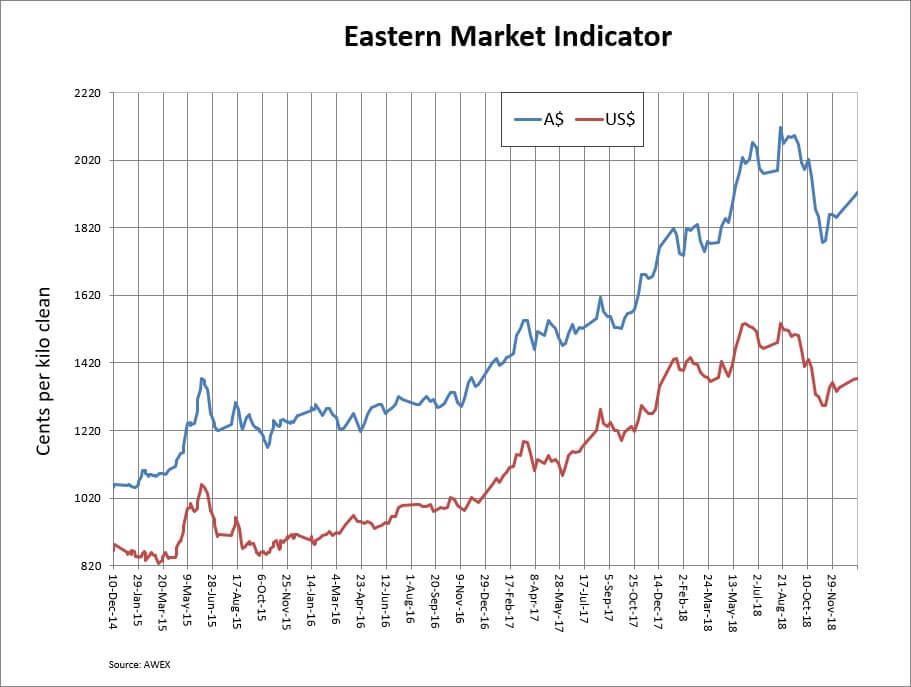
The Australian dollar against the US dollar finished 0.33 cents (0.5%) lower to close the week at 71.52 US cents.
This week’s total national offering was 51,703 bales, up from 47,593 bales last week, and was
the largest offering of the season so far. It was also the biggest since April 2018 and the first time 50,000 bales has been exceeded this season.
AWEX noted that quantities remained high due to the wool accumulated over the recent three-week recess and with this week’s sale being only the second of the calendar year. The clearance rate this week was 92.9%.
Sales were held in Melbourne on Tuesday 15 January and at all three selling centres on Wednesday 16 January and Thursday 17 January. On Tuesday the EMI gained 1 cent to close on 1,911 n cents and in US dollar terms lifted by 7 cents to 1,378 US cents. On Wednesday the EMI increased by a further 13 cents to 1,924 cents and in US dollar terms rose by an additional 7 cents to 1,385 US cents. However, on Thursday the EMI declined by 1 cent to 1,923 cents and in US dollar terms fell back by 10 cents to 1,375 US cents.
In Melbourne on Tuesday there was an easing among the Merino types, but further strong gains among the fine and medium crossbreds. Wednesday’s sale produced good all-round results, apart from some mixed outcomes at the fine end of the Merinos. There were further good gains among the fine and medium crossbreds. The sale closed on a steadier note in the East on Thursday, but on a stronger note in the West, where the Western Market Indicator finished 9 cents higher than on the previous day.
The Merino fleece market was mixed in its performance. The three centres behaved slightly differently, with varied positive and negative movements recorded across the board. Although there was an inconsistent pattern, the overall trend was upward.
Among the average AWEX MPGs for the Merino fleece types, 16.5 microns fell by 30 cents (1.2%); 17 microns was down by 25 cents (1%); 17.5 microns fell by 1 cent; 18 microns decreased by 2 cents (0.1%); 18.5 microns was down by 3 cents (0.1%); 19 microns increased by 2 cents (0.1%); 19.5 microns gained 4 cents (0.2%); 20 microns rose by 6 cents (0.3%); 21 microns increased by 14 cents (0.6%); 22 microns fell by 2 cents (0.1%); and 23 microns gained 16 cents (0.7%).
Skirtings managed to record upward movements, generally between 20 and 40 cents, with wools coarser than 19 microns attracting the most attention and as a result enjoying the largest gains.
The crossbreds were the best performing sector for the week, with large gains of 50 to 80 cents experienced in the 26 to 28 micron range. Among the average AWEX MPGs for the crossbred types, 26 microns climbed by 68 cents (5.3%); 28 microns lifted by 56 cents (6.3%); 30 microns increased by 13 cents (1.8%); and 32 microns fell by 9 cents (1.8%).
As with the fleece types, the results among the oddments varied between centres. The North and West recorded 20 to 30 cent rises, whilst the South posted a small reduction but again the overall trend was positive.
AWEX reported that the total value of the wool sold this week was AU$101.2m (AU$2,098 per bale), taking the season total to AU$1.737bn (AU$2,227 per bale). Buyers for China were dominant, with support from buyers for Europe and India.
Despite the strong market the national offering is forecast to be lower over the next few weeks. Most of the wool is from sheep shorn in recent weeks, as the back log of wool delivered during the break has mostly been cleared. Currently, the forecast for next week (Week 30) is 41,503 bales. For Week 31 the forecast is 37,995 bales and Week 32 37,005 bales.
Offerings for the next three sales are currently expected to be 4.3% less than in the corresponding weeks last season. The forecast progressive difference for the season as a whole up to Week 32 is 15.6% lower than the same period last season.