Hernia repairs are among the most frequently performed operations worldwide and around 20 million hernia meshes of varying types are used as reinforcement materials globally each year.
Increasingly, biomedical textiles with customised structures are replacing traditional rigid materials such as metals in this field, and the area continues to be the subject of intensive research and development in Europe – especially in Germany.
Protrusions
A hernia occurs when an organ protrudes through an area of weakness in the surrounding muscle or connective tissue.
Uncomplicated hernias are principally repaired by pushing back, or ‘reducing’ the herniated tissue, and mending the weakness in muscle tissue with the assistance of meshes.
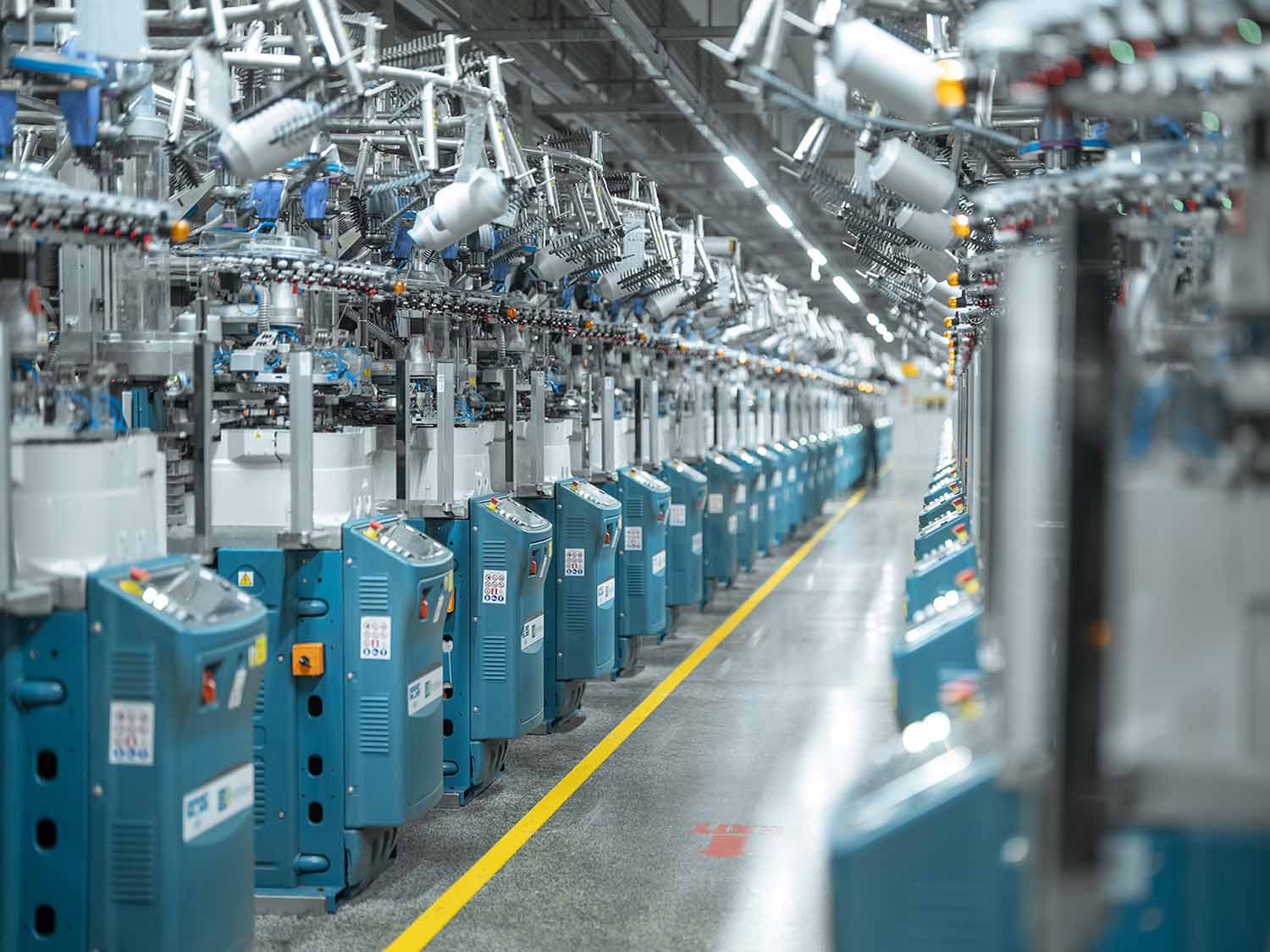
Knitted mesh implants are often most suitable for this function, since they can typically accommodate a higher number of individual fibres than most other techniques for biomedical textile engineering, allowing for greater intricacy and performance capabilities in the structures created.
Knitted implantable applications that undergo more severe instances of stress and stretch are often able to achieve the higher strength characteristics of ceramics or metals with the lifelike movement of a fibrous composition.
Dynamesh
Aachen, Germany-based FEG Textiltechnik is a very successful supplier of knitted mesh implants for hernia repair and similar operations – despite strong competition from major players such as Gore and Johnson & Johnson – and sells its Dynamesh-branded products to hospitals in more than 50 countries.
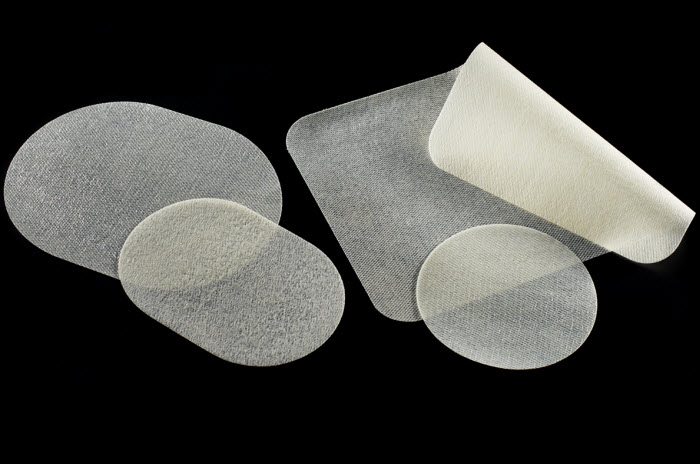 Gore’s Synecor hybrid biomaterial for hernia repair received clearance from the US Food and Drug Administration at the end of 2015
Two years ago, the company opened a new €7m production hall and administrative centre in Aachen, equipped with a state-of-the-art cleanroom, from which its air is replaced 20 times an hour, along with advanced energy systems to ensure the highest environmental standards.
It has also introduced a significant innovation to its knitted mesh products, since there is always the possibility that the repair of a hernia may not be successful, leading to further pain for the patient and the potential of more surgery being necessary.
One problem with many hernia meshes based on synthetic fibres such as polypropylene is that they are undetectable post-operatively by either X-ray or MRI scans.
Dynamesh products, by contrast, are based on polyvinylidene fluoride (PVDF) fibres and contain an additional iron oxide component that allows the meshes to be properly detected and the healing process analysed.
“Until recently, nobody knew what was happening in the body,” says FEG sales director Matthias Vietmeyer. “Now we can, and we have been able to further improve our implants accordingly, introducing a ‘bending zone’ into the design that adapts more readily inside the body.”
In the future, he adds, such implants will be increasingly adapted to each specific patient – not only in respect of the type of injury and the surgical technique to be applied for the repair, but based on the size, weight and type of connective tissue of the patient.
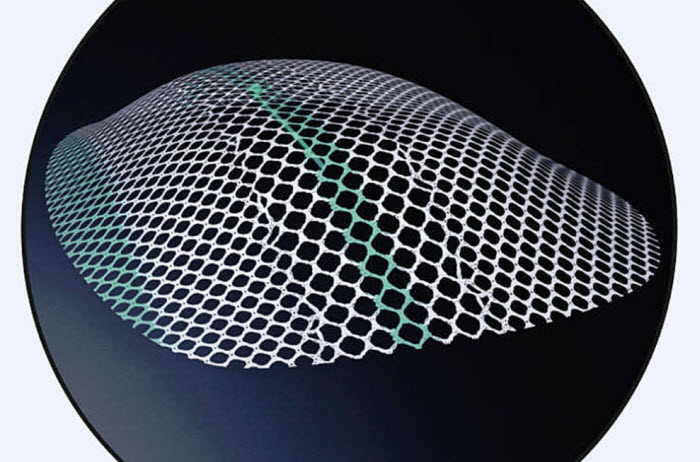 FEG Textiltechnik’s Dynamesh now has a ‘bending zone’ allowing it to adapt more readily inside the body
Chitosan
PVDF fibres are also being employed in hybrid structures with chitosan in an interdisciplinary research project in Germany, in order to further improve hernia meshes.
“Most commercially-available hernia meshes lack any useful mechanical behaviour, and while the hernia orifice needs a mechanically stiff support, the surrounding tissue is soft and needs a flexible support,” says Moritz Eger of the Technical University of Dresden. “Current implants offer either one or the other.”
The researchers at TU Dresden are looking to create a hybrid implant that is not only adapted to the locally different requirements of an abdominal wall hernia, but also partially resorbable over a period of three years and cell growth further enhanced by a collagen coating.
Graded patterns
The anisotropic behaviour of the human abdomen has been the subject of 3D-displacement analysis, leading to the design of hernia meshes combining a base and graded embroidery patterns as adjustable areas of stiffness, in order to mimic the anisotropy of the human abdomen.
Chitosan is being employed as the base yarn for the meshes due to its biocompatibility, long-term enzymatic resorption and anti-inflammatory properties. High and consistent quality chitosan fibres without cytotoxic effects have been successfully manufactured and spun at TU Dresden into both mono and multi-filaments with tensile strengths of up to 15 cN/tex and knot strengths of up to 12 cN/tex.
Embroidered specimens made of chitosan and PVDF were coated with two collagen types – fibrillated bovine collagen and dissolved murine collagen. Coating was realised by dip-coating the specimens in a water-diluted collagen solution with concentrations of up to 2.5 mg/ml.
The embroidered chitosan meshes have been analysed for cytotoxicity, inflammation, seeding techniques and degradation in citric acid. Both the direct and indirect cultivation of the specimens with human mesenchymale stem cells (hMSCs) and fibroblasts (NHDF) resulted in non-toxic behaviour.
Synecor
Another significant recent development is Gore’s Synecor, a hybrid biomaterial for hernia repair, which received a 510(k) clearance from the US Food and Drug Administration at the end of 2015.
Hernia repair has traditionally required a surgeon to choose between a permanent material for a durable, single-stage repair or absorbable, non-permanent materials, the company explains.
Synecor combines the advantages of both and is comprised of three materials:
• Bio-A web – a tissue-building nonwoven scaffold providing rapid vascularization and ingrowth for complex repairs.
• A macro-porous knitted patch of dense, monofilament polytetrafluoroethylene (PTFE) fibres which provides strength and contributes to reducing the risk of harbouring bacteria due to the solid fibre.
• A non-porous PGA/TMC film that minimises tissue attachment to the material at the visceral side.
Like PVDF, because of the density differences between PTFE and the rest of the body, high-resolution imaging techniques, such as MRI, both immediately follow implant and after ingrowth at longer time frames. X-rays, however, offer a fairly low-resolution level and will not show a PTFE product.
Caution
It goes without saying that medical materials intended for implantation should be correctly designed and tested at every stage of development, even though stringent standards are in place for them.
However, in a recent US case, the Ethicon business unit of Johnson & Johnson was found guilty of negligence in respect of a defectively-designed vaginal mesh implant.
The product, launched in 2006, was not withdrawn until 2012, by which time thousands of the implants had been used in operations in the USA, UK and Australia.
The Philadelphia court ruled that the company was responsible for the injuries suffered by Ella Elbaugh after she was given the TVT-Secur miniature implant designed to reinforce tissue around the urethra, in order to prevent incontinence.
She received a record $57m in damages and further class action law suits are currently underway in the US, UK and Australia.
Have your say. Tweet and follow us @WTiNcomment