Polyester input: MEG
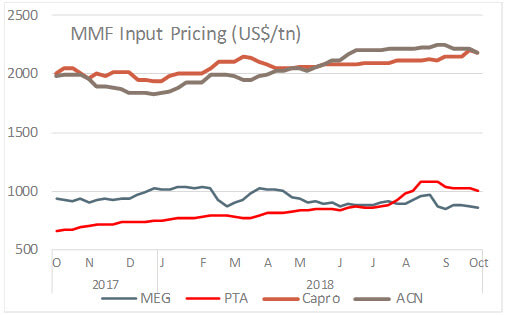
MEG markets in Asia continued to remain under correction this week, and prices fluctuated, down from the previous week. In China, prices declined initially under the influence from poor sales in downstream but later recovered gradually due to rigid demand and restocking activities by players in short position. Meanwhile, inventories in east China increased 8% on the week to 619 kilo ton, due to arrival of more import cargoes. Spot prices were down US$15-20 on the week with CFR China at US$853-858 a ton and CFR South East Asia at US$860-870 a ton. In contract markets, both SABIC and MEGlobal nominated November down from the prior month, citing a slowdown in polyester sales. SABIC nominated the November contract price at US$1,080 a ton CFR Asia, US$40 lower than October, while MEGlobal announced its November contract price at US$1,100 a ton CFR Asia, down US$20 from its October nomination.
In Europe, mono ethylene glycol spot prices continued to slip on plentiful supply, along with weak sentiment from the lower prices in Asia. There was a flurry of lower offers floating around the market this week. Spot bulk prices were assessed Euro 15 down at both ends of the range, with prices at Euro835-850 a ton CIF NWE while truck spot prices were down Euro 10 at Euro 880-995 a ton FCA NWE.
In US, MEG prices remained unchanged as demand from PET resin sector generally fades in Q4, but is rebalanced by pick-up in demand from anti-freeze sector. However, with winter to set in mildly initially, demand from anti-freeze is likely to be delayed going into Q4. Contracts prices remained unchanged over at US cents 41.5-47.5 per pound FOB.
Polyester input: PTA
Purified terephthalic acid prices declined in Asian markets amid seasonal downturn in downstream polyester sector. The price drop also eroded production margins as demand declined in the polyester chain in the region. The transition of production costs in the entire polyester chain is unsmooth currently since polyester run rates is yet to recover in a large. Thus, PTA market may hardly move up, and is expected to remain under fluctuation in the short-term. PTA markers edged down US$28-30 week-on-week, with CFR China at US$992-994 a ton and offer from Taiwan/Korea at US$1,000-1,020 a ton. In China, offers for bonded goods were maintained at US$1,020-1,080 a ton, and discussions for nearby-month cargoes were below US$980 a ton amid muted transaction.
In Europe, Indorama recently restarted Artlant PTA plant in Portugal and a shipment was transported to Egypt’s EIPET, a JV of Indorama and India's Dhunseri. Meanwhile, PTA contract were stable at Euro 904-938 a ton FD NWE.
In the US, the restart of Alpek's two downstream PTA lines last month rebalanced supply in the region. Indorama is on planned maintenance at its 600,000 ton a year PTA plant in Montreal, Canada, until 28 October. However, upcoming turnarounds in the PTA market are expected to balance the global supply/demand outlook in Q4. During the week, PTA prices were assessed at US cents 60.10 per pound DEL.
Nylon input: Caprolactam
Caprolactam offers in Asian markets fell this week after downstream conventional grade nylon chips took a hit due to poor downstream demand. Producers had no choice but to reduce their offers since downstream demand was so poor that goods were practically not moving along at all. In China, buyers were reluctant to bid for imported caprolactam amid uncertainty in domestic prices and opted for wait and see for a while before deciding. Asian caprolactam markers moderated US$20 week-on-week with SE and FE Asia at US$2,180-2,220 a ton. In China, spot prices for liquid goods declined to 16,600-16,900 Yuan a ton (US$2,390-2,435 a ton, down US$170) while flake goods fell to 17,000 Yuan a ton (US$2,450 a ton, down US$150). Major producer, Sinopec adjusted its list price down to 17,800 a ton (US$2,565 a ton, down US$80 from last week). In contrast, Japan’s Sumitomo Chemical announced its October contract price for caprolactam at US$2,250 a ton CFR NE Asia, up US$70 from its September contract price.
No activity was reported in European caprolactam markets, hence prices are notionally carried forward. September contracts settled at Euro 2,272-2,433 a ton FD NWE rolling over from August.
Acrylic input: Acrylonitrile
Acrylonitrile prices fell sharply in Asian markets this week as sellers tended to liquidate cargoes at low prices, while buyers took non-committal position, waiting for majors to announce monthly settlement price. Upstream crude oil and propylene prices also slumped easing cost pressure. Demand was weakening as acrylamide suppliers ran at 60% capacity with prices at lower level while ABS market was range‐bound. Acrylic yarn makers continued to operate at lower run rate, with poor appetite for acrylonitrile. Asian markers were down US$40-50 on the week with Far East CFR at US$2,179-2,181 a ton and CFR China at US$2,150-2,220 a ton. In China, self-lifting values at Lianyungang port fell US$80 to US$2,610-2,640 a ton. PetroChina Jilin Petrochemical cut its offers by US$58 to 17,700 Yuan a ton (US$2,550 a ton) with effect from 18 October.
In Europe, acrylonitrile October contract prices increased month on month, supported by higher raw material costs and was in line with the ratio formula that market follow when negotiating their monthly contracts. Spot prices dropped US$70 at US$1,998-2,002 a ton CIF Mediterranean despite October contract price settled at an increase of Euro38 from September at Euro2,171-2,239 a ton FD NWE.
In the US, spot export acrylonitrile offers fell on declining values in Asia and Europe amid softening demand in the key downstream acrylic fibre and ABS sectors. Global supply remained tight but was offset by softening demand in the consuming sectors. Spot export prices were down US$20 at US$2,110-2,130 a ton FOB USG while domestic contracts were at US cents 81.07-85.07 per pound (US$1,787-1,875 a ton) DEL USG.