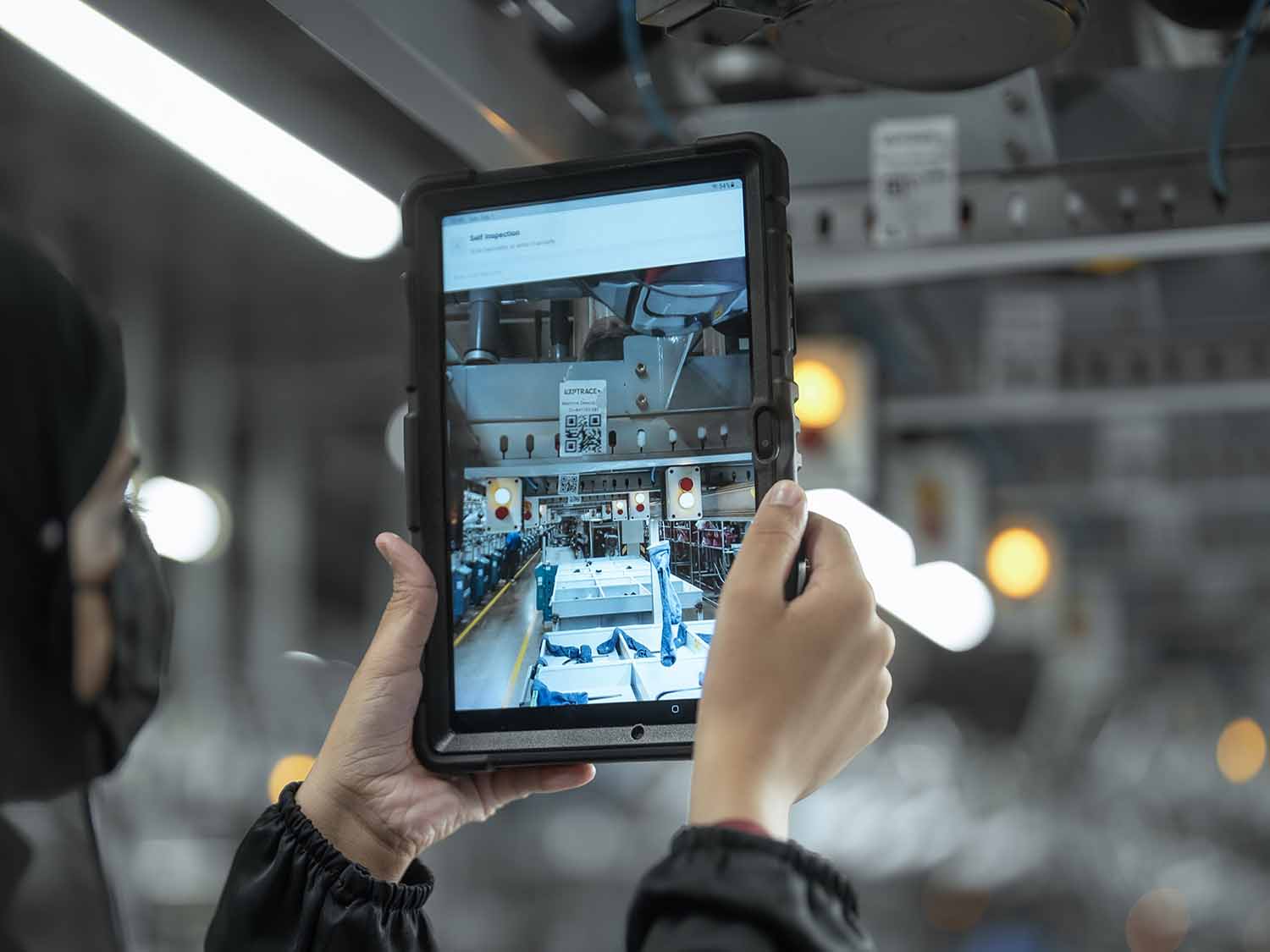
Smart Factory is one of four futureTEX base projects, which have been set off in the initial phase of futureTEX. These four projects form the basis for research projects and activities. Within the futureTEX base project Smart Factory, the aim was to develop the specific requirements of selected Industry 4.0 (I4.0) applications in the textile industry based on the current state-of-the-art technology in this industry sector, according to STFI. This sector was analysed and described using three representative case studies, STFI adds.
STFI says that, in order to ensure scientific high-quality and at the same time practical and usable results, “an interdisciplinary consortium consisting of ten research institutes and companies addresses itself to the complex objective. As a result, design proposals for the textile factory of the future were developed. On the basis of the results of the base project, a reliable assessment of the status quo and the requirements in the company on the way to the textile factory of the future could be made.”
These were:
• The basic prerequisite is that each company analyses critically its own processes. There is no general way
• Stepwise digitisation is not only useful, but urgent
• The basis for all activities is the availability of clean master data, a clear process description and a sufficient IT infrastructure
• The improvement of the reproducibility of textile process steps is a central research field for the organisation of the textile factory of the future
• Industry-specific test and research areas, to demonstrate the achievable customer use through digitisation solutions, are enormously important in order to stimulate the textile industry
The project generated significant results for the implementation of Industry 4.0 in the textile industry. According to the STFI, these results are to be developed further by follow-up projects, which lead to the establishment of new digitisation approaches in the industry and the continued development of the smart factory.
Smart factory components
So, what different components are involved in a smart factory, and how are they connected? STFI states that, depending on the granularity of a company analysis, different things have to be listed: “In a smart factory all departments are affected by the digitisation. It starts with acquisition, purchasing, production planning and control up to service and sales. The linking element is the flow of information.” The organisation continues: “Digital tools help to make the flow as efficient and consistent as possible, in order to make the development of new products efficient or to shorten the production time.” Thus, the smart factory will have more streamlined processes that communicate with each other.
The ‘digital twin’ is also important when it comes to the mart factory and its components. Which is a virtual copy of the real product or production system. STFI explains: “It allows feasibility analysis by modelling tools during the early development phase without having a real product. Digital twins can also help with production planning and control. If the entire production is depicted in a simulation system, various production scenarios can be simulated without affecting the real production.” Using the digital twin, textile manufacturers can therefore experiment with different variations of technologies, connections and datasets in real-time without the heavy investment and wasted set-up time, and importantly, without the need for any downtime.
In terms of a continuous information flow which is a significant component in any smart factory, a particularly important factor in enabling this is communication, especially between machines (machine2machine communication). STFI says that one example for an I4.0 communication protocol is OPC-UA (Open Platform Communication Unified Architecture), “which enables reliable, manufacturer-independent and platform-independent industrial communication. Furthermore, the inter-operating data exchange between products from different manufacturers is possible.”
OPC-UA therefore allows the machinery both within manufacturing facilities and between facilities to speak the same language. OPC-UA technology from Honeywell Process Solutions, which is part of multinational conglomerate Honeywell International, is one example of this enabling technology. A key part of Industry 4.0, OPC-UA runs on mostly anything, including: servers; networked sensors; mainstream operating systems (OSs), such as Linux and Microsoft Windows; real-time operating systems (RTOSs); or devices without any OS. OPC-UA enables the connectivity and data sharing between the devices and systems that provide the deep-shop-floor visibility required by smart factories.
Where to begin
For the textile industry in particular, the smart factory can be particularly advantageous as the margins in the industry are so small and energy and water usage are so high, any streamlining of utility usage, as well as labour usage, will help manufacturers increase their revenues. And, as manufacturing shifts back to the west, where utility costs and labour costs are much higher, digitalisation is needed increasingly. STFI comments: “Digitisation offers a wide range of opportunities that the textile sector should also make use of, especially as it is an industry that would like to continue production in high-wage countries such as Germany. Investments to improve efficiency and optimisation are required.”
In this way, however, a variety of potentials can also be raised. STFI continues: “Through the digitalisation of processes, for example, data acquisition and its evaluation are possible in a more efficient way, so that the results can be used more quickly. The increase of flexibility production facilities makes it possible to address the issue of customer-specific production and also to implement it economically.” This is particularly important as the customisation trend continues to accelerate.
Additionally, digital tools can fast-track product development, which enables companies to bring their products to market much quicker, says the organisation. “Additional potentials through digitisation result in the monitoring of processes, whether for safety aspects or for quality control,” adds STFI. The topic of autonomy is also addressed, which makes it possible for plants and also transport systems to act more independently. “Within certain limits they can make decisions independently, which leads to a reduction of waiting times. Furthermore, assistance systems will play a more important role in the production. These can assist the employees in decision-making tasks, provide additional information for commissioning activities, or even support them in learning a new system,” STFI says.
Thus, the rapid technological developments, when it comes to digitalisation, offer the most diverse potential in all areas of the company. And, in order to be able to “continue an economical production in the future, it is extremely important for the textile industry to integrate digitalisation and the related technological developments into business planning,” STFI argues.
However, despite all these benefits for textile manufacturers and textile machinery manufacturers, it may not be a case of when to begin or whether it is a right thing to do, but where to begin and what the costs will be, particularly as the breadth of technology and information continues to develop.
STFI’s project ‘Smart Factory’ showed that the status quo of the textile sector is very heterogeneous. Depending on the field of industry, history, product portfolio and region, very different situations prevail, the research found. “This can refer to the plant engineering, the IT infrastructure and the degree of automation. The status quo is therefore crucial to where one begins with its development efforts to a smart textile factory,” says STFI. It continues: “A stepwise approach is also important. For this purpose, the German Academic Society for Production Engineering has defined development stages on the way to I4.0. These range from simple data acquisition and processing over decentralisation to autonomy as the highest level.”
Specific technical requirements and qualifications are necessary for each level. Companies should assess their initial situation realistically to derive a set of achievable goals, according to STFI. The five levels should serve as an orientation:
• Where am I?
• Where do I want to go?
• Which steps are required?
The resulting overall costs are difficult to estimate, because they are influenced by factors like the initial situation, the goals set or the time frame, for example. However, solutions which can be implemented at short notice, with little effort and which offer value quickly; so-called ‘low hanging fruit’ are important to SMEs due to limited financial resources. As a result, STFI argues that these should be strived for as a first step towards achieving a smart factory.
The reality
However, while the advantages of having a smart factory in the textile manufacturing supply chain far outweigh any negatives, due to the medium-sized structures of the German textile industry, companies can’t overcome all the hurdles themselves and rely on cooperation at various levels and across company boundaries, according to STFI.
This can be achieved through industry associations and, in some cases, already existing business partnerships. “In order to create the currently missing standards for the digital description of textile products, processes and technologies, there is also a need of extensive cooperation between textile manufacturers, research institutes and textile machinery. To ensure the connectivity of the standardisation approaches, as well as the compatibility with the standards in the sales markets, standardisation boards and stakeholders of these sectors must be involved in the process and their requirements must be taken into account,” says the organisation.
In addition to the lack of standardisation, another problem for SMEs is the shortage of the necessary access to relevant, real-time data and information from production, or solutions for processing and interpretation. Therefore, STFI argues a ‘digital twin’ of the process chain and the products is often difficult at present. “While some modern production facilities already provide the necessary interfaces partially, there is still a lack of suitable retrofit options for the machine park in the plant-intensive textile industry. Here, the textile machine manufacturers, together with their systems users, must identify the relevant information, develop or adapt appropriate sensor systems, elaborate appropriate modernisation concepts and make them available on the market,” adds STFI.
STFI
The STFI (Sächsisches Textilforschungsinstitut e.V.) is a non-profit research institution in the Free State of Saxony, Germany and is continuing the long-standing traditions of the Saxon textile research and textile industry.
Process-related and product-related research work covers classical textile technologies and innovative technical solutions for a wide range of applications, according to the institute. It cooperates with national and international companies as well as research institutions and supports the companies of the regional textile industry.
futureTEX
The futureTEX project is funded by the Federal Ministry of Education and Research within the framework of the programme Twenty20 – Partnership for Innovation. In the project, companies, scientific institutions and associations are working together to develop a future-oriented German textile industry from its roots as a traditional industry.
As the mainstay of the German textile industry, the focus is on the value-added segments of technical textiles. These demand a high level of R&D competence and enable a strong differentiation through innovation compared to the competition, according to the institute.
Over a series of articles WTiN is looking at STFI and futureTEX’s work into the smart factory in the textile industry, RFID in textiles and STFI’s research and test area for the textile factory of the future.