The New Zealand wool market weathered the recent peaks and troughs seen in Australia since the last South Island sale and showed definite signs of recovery. All merinos generally saw increases averaging 5%, although coarser wools, 18-20 microns, saw higher increases. Better specified wools continued to attract strong competition as has been consistently the case. Coarser wools up to 30 microns showed significant increases between 5-10%. There was widespread healthy competition across the catalogues.
The New Zealand wool market weathered the recent peaks and troughs seen in Australia since the last South Island sale and showed definite signs of recovery. All merinos generally saw increases averaging 5%, although coarser wools, 18-20 microns, saw higher increases. Better specified wools continued to attract strong competition as has been consistently the case. Coarser wools up to 30 microns showed significant increases between 5-10%. There was widespread healthy competition across the catalogues.
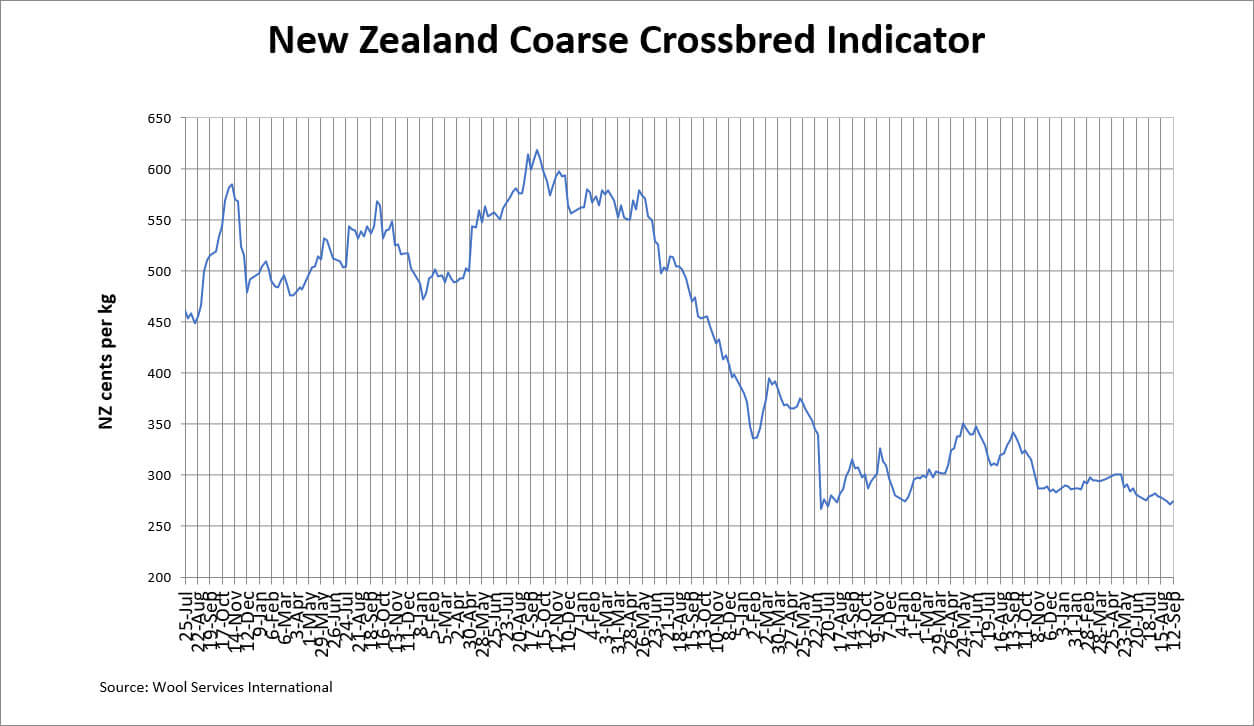
Prices recovered both in domestic currency terms as well as in US dollar terms. The coarse crossbred indicator was at 274 NZD cents, up 1.1% or 3 cents, while in US dollar terms it gained 1.7% at 176 US cents.
Only South Island operated, with 10,000 bales on offer, of which 9,146 bales were sold clocking a clearance rate of 88%, as against 76% in the previous sale.
The selection consisted of 35% good style/average style crossbred fleece 35.0 to 40.0 microns, 15% good style second shear average 3-inch, 33.0 to 40.0 microns, 15% good/super style half-bred fleece 23.0 to 30.0 microns, 8% good/super style merino fleece 17.0 to 22.0 microns, and 27% associated oddments and miscellaneous types.
Major buyers were MAS (1,900), NZWSI/JSB (1,710), and B&B (1,150) this week, among others.
Price movements in South Island compared to the South Island sale on 29 August were as follows: Fine crossbred second shear of 32-36 microns: good style lots were firm to 2% dearer while fine crossbred early shorn types were firm. Coarse crossbred fleece of good styles were firm, average 2% dearer and poor styles firm to 2% dearer. Coarse crossbred early shorn and second shear types of good 3/5 and 3/4 inches were 2-4% dearer, and good 2/4 and 2/3 inches were 2-3% dearer. Crossbred oddments for clothing were 1-2% cheaper and combing 2% dearer.
The next sale will be held on 19 September in North Island with approximately 6,300 bales on offer.
Source: Wool Services International