
This summer, one of the planet’s biggest celebrations of sport will return as Russia hosts the 2018 FIFA World Cup. With 32 nations and teams set to battle for supremacy on the pitch, sportswear manufacturers such as Nike, Adidas and Puma have spent the last few years developing kits the athletes hope will give them the advantage.
The four years between each World Cup allow these companies a great deal of time to work on the next series of high-performance kits. Although the kits may not look too different at a glance, a number of alterations to the engineered materials, the manufacturing processes and even the design methods mean that every four years, athletes benefit from the latest in performance sportswear technologies.
This year, only Adidas, which has produced 12 kits, has been selected as the official kit provider to more national football federations than Nike, which has produced 10. Major international tournaments are often dominated by these two heavyweights of the sportswear world, with their performance qualities and aesthetically-pleasing designs proving popular. Thus far, Nike has unveiled the kits and wider garment collections for the English, Nigerian, French and Portuguese teams, each of which received the acclaim of football fans around the world.
Ahead of the World Cup, which takes place from 14 June to 15 July 2018, WTiN spoke to Dan Farron, design director, Global Football Apparel, Nike, and Bert Decorte, senior product line manager, Global Football Apparel, Nike, to learn why the company’s 2018 kits are its most innovative to date.
World-leading innovation
Farron emphasised the level of research and development that goes into each of its uniquely-designed kits, including individual body analysis of some of the world’s top players. “The journey started by doing extensive body scans of our elite athlete portfolio globally,” he said.
“This results in an actual sport-specific body form. Using this allowed us to make a football-specific fit which is called out by our elite athletes as best-in-class and gives them full focus on the game with zero distractions. We design for the body in motion.”
The extensive research undertaken to produce each new series of kits is an ode to Nike’s motto ‘there is no finish line’, and as Farron explains, the company is in continuous contact with its athletes to stay ahead of the competition.
He said: “The vision of our top-level players is incredible, and they are accustomed to setting audacious goals for Nike to reach. We are in constant contact with the players, so the feedback loop is forever ongoing; as we say at Nike, ‘there is no finish line.’”
Farron continued: “These kits have blown the athletes away and it’s been incredibly gratifying to get that kind of reaction as their standards and expectations are very high. We’re proud of these kits, but of course, we’re already hard at work trying to outdo ourselves.
“The 2018 expression is a chapter in the constant quest for ultimate performance, starting the journey in 2015 exploring engineered knits on pitch. Listening to the needs of the athletes while driving a bold aesthetic,” he added.
One of the main reasons the athletes are so impressed with the new generation of kits and the performance benefits they offer is due to the engineered materials they are composed of and the manufacturing processes behind the scenes
Engineered properties
A key component of the new kits is Nike Fastfit Vaporknit yarn which, according to Nike, saw the company take a new direction, as Farron explained. “All the innovation is in the knit,” he said. “For Nike VaporKnit technology, we took a whole new approach by not starting with the end product, but by going back to the yarn level. From the yarn, then to machine, to the engineering of the knit and eventually to the final kit.”
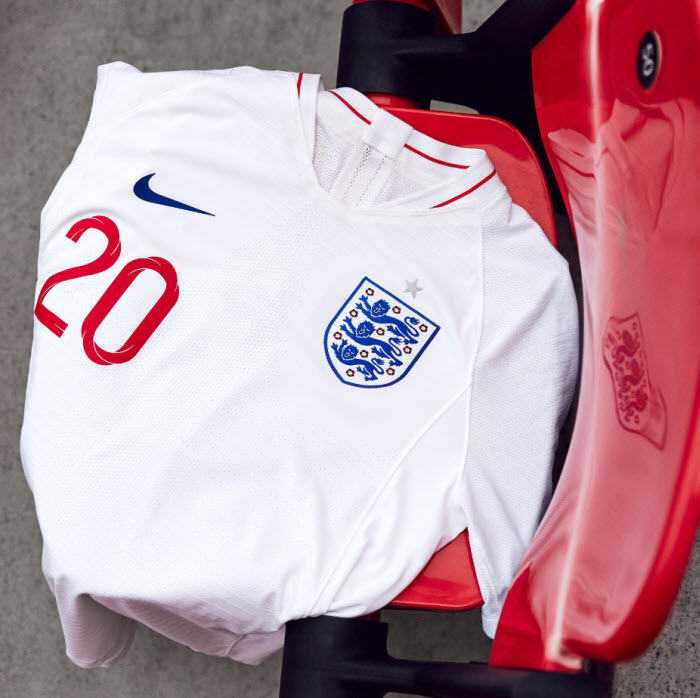 Nike's VaporKnit yarn is used throughout, supporting increased airflow and reducing cling
He went on to explain that the setup of the machine and its specific parameters also had a big influence in the makeup of the final garment. “High level performance is based on the combination of yarn and machine. We pushed the limits of performance yarn to ultimate quick-drying capabilities, while fine-tuning the machine to deliver enhanced stretch and breathability. This is the perfect combination for on-pitch performance levels.”
The two kits unveiled so far are more refined compared to their predecessors. For example, the shorts feature no outer seams to reduce friction and increase the athletes’ range of motion, while the new heat transfer crests of England and Nigeria are 64% lighter, making them more breathable.
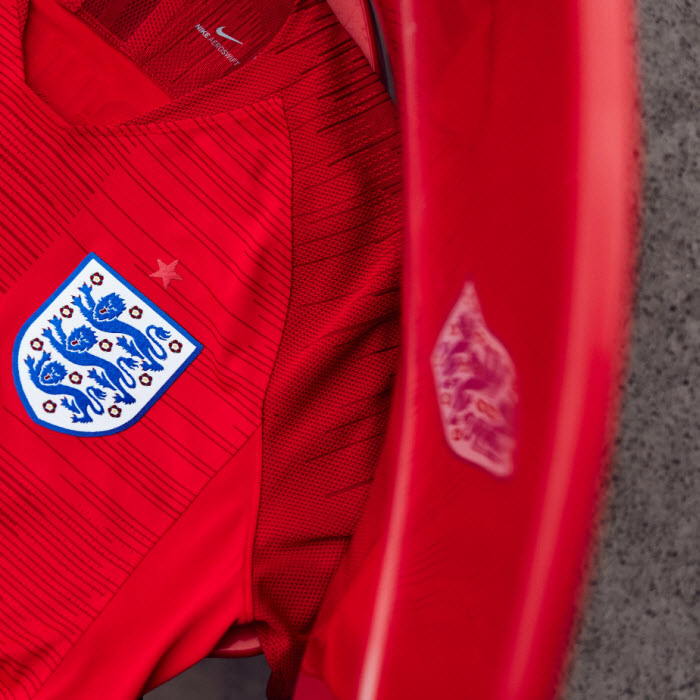 The new heat transfer crest is 64% lighter, enhancing breathability
By engineering the knit in its own way, Nike is able to optimise the yarn to achieve a range of essential qualities. Attributes such as breathability continue to be at the forefront of Farron and Decorte’s thinking, with open hole structures positioned throughout the garments plotted precisely against players’ heat and sweat maps for optimal breathability.
Meanwhile, great emphasis has also been placed on reducing distractions from the kits and also ensuring that they do not restrict the athletes’ range of motion. Engineered yarns on the sleeves contribute to the speed aesthetic of the kit, while the VaporKnit yarn supports increased airflow by producing a duct-like effect, and built-in ribs on the inside of the kit help reduce cling to the athlete.
“Vaporknit technology performs at a much higher level when fitted to the athlete,” said Farron. “We call that Fast Fit; it’s about looking fast, feeling fast, and playing fast.”
Cultured aesthetics
A key part of Nike’s designs for this year’s England and Nigeria collections was that they were truly reflective of the countries each athlete represented. England’s shirt, for example, features the famous rose which adorns the caps won by senior players, while the Nigeria home shirt is a subtle throwback to the 1994 shirt worn by the first Nigerian team to qualify for a World Cup.
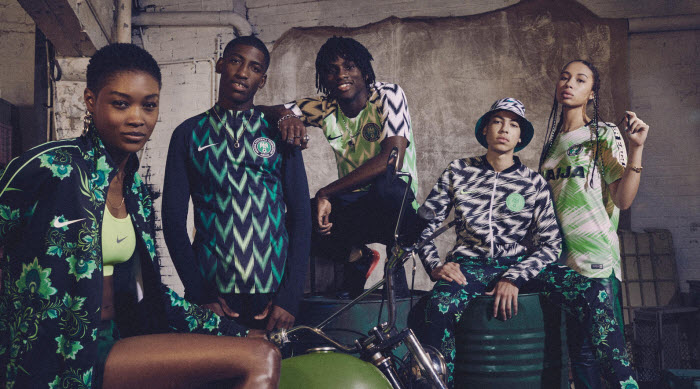 The full Nigeria team collection includes a travel suit and training apparel
“We know how important football is to each of these countries we are designing for and it’s an honour to showcase unique elements of each culture through these national team collections,” said Farron.
While a large focus has been placed on the kits, Nike has also created a wider collection of clothing for the two teams of athletes which they will wear throughout the World Cup journey. Farron said: “Many of the collection pieces will stand out and tell a story just as much as the kits themselves, for example, the bucket hat for Nigeria and the pre-match jersey for England.”
With the 2018 World Cup now less than two months away, Farron and Decorte are now looking ahead to future national and international tournaments including the 2022 World Cup, which will take place in Qatar, and the challenges the country’s climate will bring.
Have your say. Tweet and follow us @ARhodes_WTiN and @WTiNcomment


