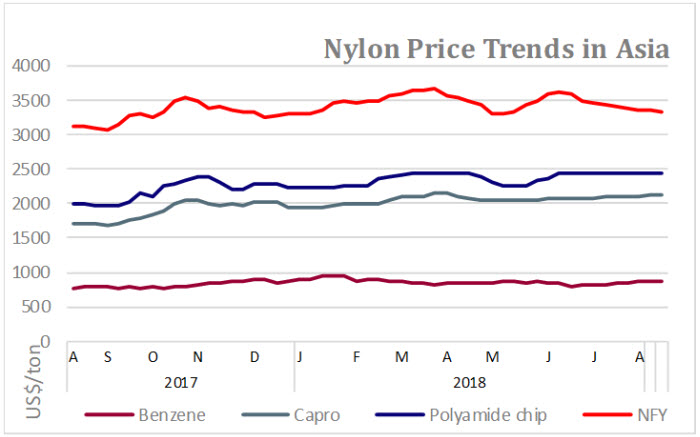
Nylon filament yarn markets remained firm amid rising costs, and prices generally rolled over on the week. Nylon FDY prices held stable on the back of high chip prices but had thin demand, while nylon DTY prices were range bound on a stable note on high feedstock cost. Downstream demand was cautious. Demand remained flat as textile producers operated at stable rates with thin liquidity of FDY, DTY and POY. Warp knitting mills and covering mills were operating at 70% run rates, and circular knitting mills and lacing mills at 50%. Nylon FDY70D/24F SD prices were flat on the week at 23.00-23.50 yuan a kg (US$3.34-3.41 a kg), while DTY70D prices rolled over at 23.50-24.50 yuan a kg (US$3.41-3.56 a kg), both down US cents 2-3 due to weak yuan.
Demand for cord fabric was ideal, while that for fishing net yarn and staple fiber modest but tepid for monofilament. With stable demand in the downstream, nylon yarn market may go stable to firm in coming week. Cord fabric 1,260D prices offers were unchanged at 26.50-27.500 yuan a kg (US$3.85-3.99 a kg) while mono filament 30D prices were at 23.50-24.50 yuan a kg (US$3.41-3.56 a kg), down US cents 3. Nylon staple fibre 1.5D prices rolled over at 20.00-20.50 yuan a kg (US$2.90-2.98 a kg, down US cents 2).
Nylon chip prices gained in Asian markets on rising feedstock cost. Producers had no choice but to increase offers in order to protect their margins. Thus, short feedstock supply further supported nylon chip market. Demand for chips was flat as downstream buying appetite was modest since terminal sector was sluggish. Chip buying was mainly for rigid demand. With caprolactam market likely to hold firm, chip prices may follow up under cost support. Thus, the trend may be strong in the coming weeks. Taiwan‐origin SD high-speed nylon chip prices rolled over on the week at US$2,430-2,450 a ton. In China, prices rose US$10 with conventional nylon-6 chip offers at US$2,585-2,670 a ton, while SD high-speed chips offers up at US$2,630-2,715 a ton.
In Europe, early nylon 6 August contract agreements were heard at rollovers so far. Some contract discussions were ongoing, but the unchanged supply and demand conditions have kept things steady at the moment. Supply was ample and demand a bit lower, as expected in August, which is the peak summer period. July contracts for nylon 6 virgin polymer were assessed steady at Euro 2.28-2.43 a kg FD NWE and nylon 6,6 virgin polymer were in the range of Euro 3.93-4.34 a kg FD NWE.
Caprolactam prices increased further on the back of rising benzene costs and supported by a short supply in Northeast Asia. In China, caprolactam spot and contract offers hiked up, although demand was termed modest. Run rates of polymerisation units were at 80%, while yarn makers were at 82%. The benzene market was favourable, so caprolactam prices may pick up further amid tight supply. Asian markers were flat on the week with SE and FE Asia at US$2,120-2,160 a ton. In China, spot prices for liquid goods were up at 16,800-17,200 yuan a ton (US$2,440-2,500 a ton, up US$25). Japan's Ube Inds released its August caprolactam contract price at US$2,155 a ton CFR NE Asia, up US$15 from July.
In Europe, caprolactam contract discussions were ongoing for August and some are yet to begin because of the summer holidays. There was some talk on the buy-side of sharing of benzene movement between buyers and sellers early this month. On the sell-side, there was mention of targets for stable pricing but so far, talks were yet to progress. Meanwhile, supply was ample, and demand mostly down due to the summer slowdown. A planned maintenance at Domo Caproleuna's facility is planned in September. In Europe, July contracts were assessed at Euro 2,282-2,443 a ton FD NWE.
Benzene prices continued to rally and bolster Asian markets amid the ongoing US-China trade war. Sinopec and PetroChina raised their benzene list prices early in the week to motivate cargo-holders to hike offers and buyers to make purchases. The weak yuan was dampening demand for imports of Chinese buyers, who increasingly turned to domestic cargoes to meet their requirements. However, as slumps in world stock and bulk commodities markets weighed down the economic outlook, benzene prices started to drop by weekend. Meanwhile, benzene inventories along east China fell 9% to 164 kilo ton this week. Prices inched up US$1 in China to US$892.50-893.50 a ton, while FOB Korea was up US$6.50 at US$880.67-881.67 a ton. PetroChina northwest branch raised its benzene list price to 7,400 yuan a ton (US$1,074 a ton). Sinopec also hiked its ex-tank benzene offer in East China to 7,250 yuan a ton (US$1,052 a ton).
In Europe, oversupply continued to rule the benzene market, but prices were supported by the open arbitrage to the US, which could divert some of the oversupply. Spot prices rose US$12.50 on the week, with both FOB Rotterdam and CIF values at US$867.50-868.50 a ton.
In the US, spot benzene prices were slightly higher as strong downstream demand for styrene and phenol counterbalanced the effect of lengthening supply arising from higher refinery operating rates. Prompt month spot prices were assessed US cents 2 up on the week at US cents 296.95-297.05 a gallon FOB USG.