Otis Robinson speaks with Matthew Cochran, chief operating officer (COO) at OnPoint Manufacturing, about the company’s plan to forge a global, on-demand, sustainable textile supply chain using Industry 4.0 technologies.
In recent years, to cater to consumer trends and demands, fast fashion has rapidly become the priority of many brands and retailers. Unfortunately, this has been to the detriment of the environment, and the fashion industry has fast-achieved the status as one of the most pollutant global industries.
The impact of fast fashion is clear in numbers: in a report by McKinsey in 2016, it was revealed that the trend had led to the doubling of apparel production from 2000 to 2014 and, subsequently, ‘the number of garments purchased each year [by the average consumer had] increased by 60%’. To manage this rate of overproduction, ‘one garbage truck of textiles is landfilled or incinerated’ every second, according to the Ellen MacArthur Foundation. This pollutive effect on the environment can be traced back to garment overproduction by brands trying to keep up with trending styles.
“Some [brands] have 20, 30, maybe 40 releases [of fashion collections] a year, and they’re getting into micro collections, too,” says Matthew Cochran, chief operating officer (COO) at OnPoint Manufacturing, a production facility with a unique factory model that is able to reduce overproduction with ‘purchase-activated’ manufacturing. “[At OnPoint Manufacturing] when we talk about sustainability, we talk about overproduction and striving towards eliminating overdevelopment.”
Founded in 2014 and based in Florence, Alabama, US, OnPoint Manufacturing is an apparel manufacturer that produces garments with a number of Industry 4.0 tools to develop an on-demand, end-to-end process that has the dual benefit of reducing manufacturing time and overproduction. One of the key differentiators of OnPoint’s manufacturing facility, Cochran says, is that they believe “digitisation and automation [will] bring apparel manufacturing into the 21st century”.
Interoperable ecosystem
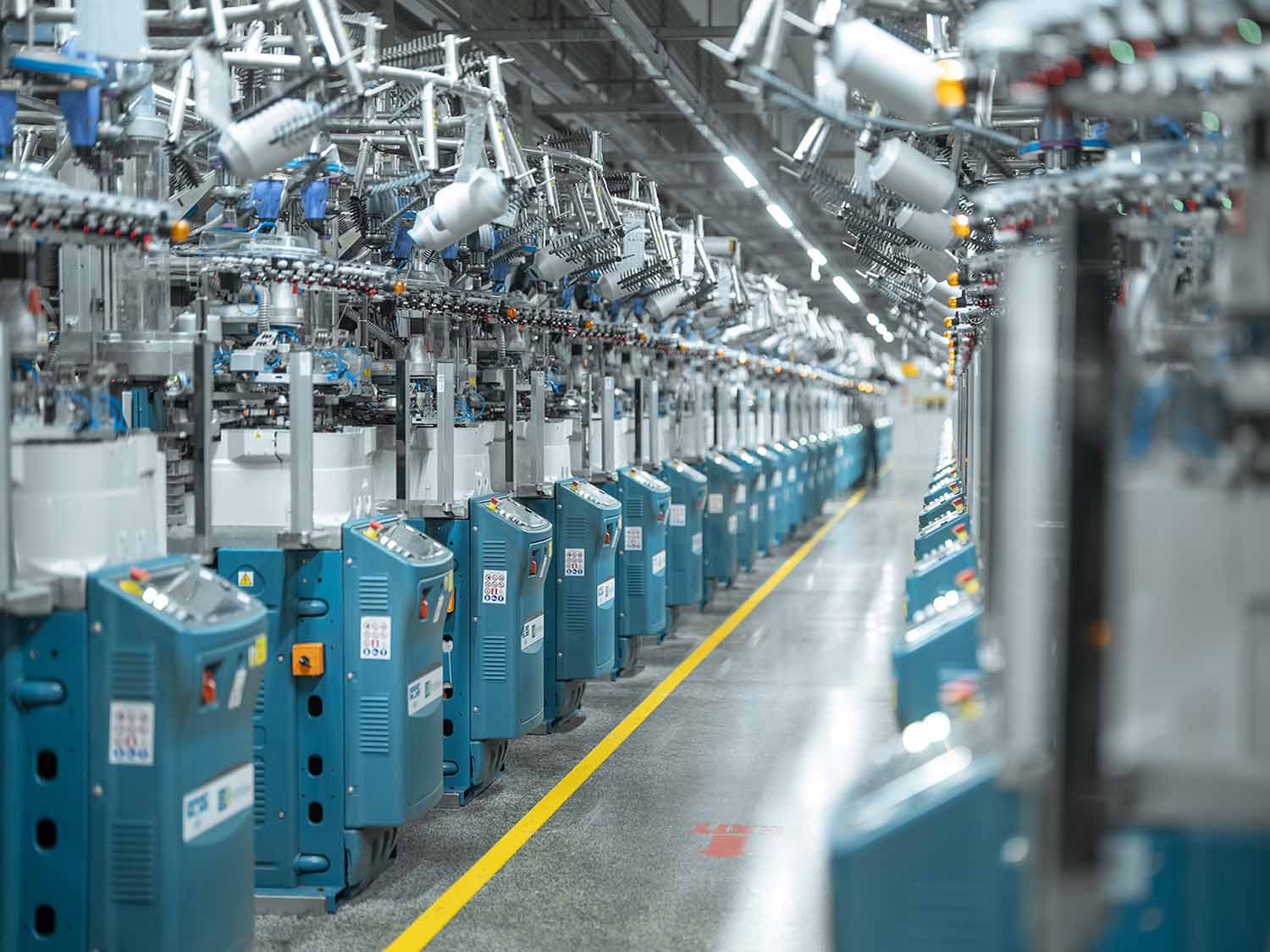
“Much of the manufacturing routines (outside of the sewing aspect of each individual garment) [are] automated in our facility,” he says. “We [have] a system of automated conveyors that route a garment in its unconstructed form – essentially, its pattern pieces – around the assembly floor.” Utilising totes marked with barcodes, scanners can pick up where each tote needs to go and when it needs to get there in order to correctly assemble the garment.
Additionally, OnPoint’s automation runs on software and programming developed by another company, of which Cochran is a member: PAAT International. This company collaborates with brands and technology companies to develop ‘Smart Tech Packs’, which are product-specific, machine-readable files that contain “all the DNA to produce [their] garment”. PAAT International also aims to build a global network of manufacturing facilities that are able to use the machine-readable files.
“PAAT is forming an interoperable ecosystem and network by looking to create a new file format (the Smart Tech Pack) for use in the industry. In the future, a designer, a retailer, a brand, whomever, can actually bring a product to market [with] a formalised Smart Tech Pack,” says Cochran. “Our vision would be to give the Smart Tech Pack owner the ability to send it to any manufacturing facility that can accept the files, to kick off an automated manufacturing routine.”
Currently, contemporary, traditional tech packs utilised by brands, retailers and manufacturers require human interaction to make sense of ‘cobbled-together Excel spreadsheets’ or ‘proprietary PLM (product lifecycle management) system outputs’. OnPoint manufacturing believes that PAAT’s Smart Tech Pack can invalidate many of these ‘arduous’ manual tasks with its machine-readable format.
“There is a lot of disfunction and there are a lot of inefficiencies in this industry, and this presents a lot of opportunity for businesses and organisations to get together, collaborate and drive positive change in a responsible manner,” he continues, before indicating that inspiration for OnPoint’s technologically-focused model came from the publishing industry.
“Our founders actually brought this model to fruition in the book industry – the on-demand printing of books. What most people don’t realise is that a large percentage of books that are purchased from Amazon are printed, bound and shipped within 24 hours. They’re produced on-demand, so there’s no inventory.”
Inspired by this model, OnPoint Manufacturing now offers a ‘service that […] is very unique’ to the fashion and apparel industry. Cochran adds: “We have no minimum order quantity, which is exclusive in this industry. Additionally, we can ship directly to the end-consumer and we can also produce products in a matter of business days. Sometimes, delivery to the end consumer can take place anywhere from five to seven business days.”
Sustainable benefits
This on-demand model has a specific purpose that links directly to sustainability. Cochran draws attention to the inevitable effects of garment overproduction in the fashion industry – monetary losses, inventories gathering dust, and most importantly, pollution – by citing a controversial decision made by a popular British fashion designer.
In news last year, it was revealed that Burberry had chosen to discard its unsold apparel and cosmetic products. Although the company says the items were destroyed in an ‘environmentally friendly’ process, the British fashion label had burned £28.6m worth of products and caused a stir among environmentalists such as the NGO (non-governmental organisation) Greenpeace. Incidents such as this, in conjunction with fast-fashion trends, have led many to endorse the development of on-demand production processes that can limit or eradicate overproduction and pollution.
“On-demand is something that can fully support those sorts of [trends]. It’s about making a more agile, quick-response supply chain, and one that is more environmentally conscious,” Cochran says. “When you look at the fashion and apparel sector as a whole, OnPoint Manufacturing can mitigate pitfalls such as overdevelopment and inventory glut. So many companies are beginning to understand the major detriments of having too much inventory on hand and the financial strain that coincides with it.
“We also believe that overdevelopment and overproducing is something that is causing many of the negative environmental impacts within the fashion and apparel industry. When we speak with large or emerging companies, they totally get it. They say yeah, if we could produce things quickly, on-demand – after they’re sold – that would be the perfect model.”
The shared goal of both OnPoint Manufacturing and PAAT International has the potential to make big waves within the apparel industry. Among the logistical benefits that come with a network of automated manufacturing facilities – such as quick-turn delivery, the ability to produce closer to consumers, and efficient production methods – environmental negatives like delivery by ‘land, sea or air’ can also be reduced to meet the rapid demands of the consumer while adhering to the social responsibility of manufacturing in a sustainable way.
Develop, adopt, implement
OnPoint Manufacturing’s unique, ‘agnostic’ ideology and its fight for Industry 4.0 connectivity has been noticed by industry professionals, too. Most notably, the Alabama Manufacturer of the Year Awards program, a ‘prestigious annual celebration’ of manufacturing leaders, awarded OnPoint Manufacturing the Small Manufacturer of the Year Award at a ceremony held in the Alabama Activity Center in Montgomery, Alabama, US. The awarding body cited the company’s ability to ‘maximise time and capital’ through ‘ground-breaking’ and ‘technically-advanced manufacturing and distribution solutions’.
J Kirby Best, chairman of the company, said: "All of us at OnPoint Manufacturing are incredibly honoured to be the recipient of the Alabama Manufacturer of the Year award.”
Cochran continues: “We’re particularly excited about this because that award was across several different technologically-advanced industries in Alabama, such as aerospace, defence, automotive and agriculture.”
Cochran cites their automated processes for the success of the facility. “Automation can really help apparel production. We’re talking about creating better jobs; we’re talking about creating more efficiencies and agile supply and product development chains. This can be brought to fruition with technology, automation, and getting data into an interoperable space.”
The company additionally credits its success to the implementation of Industry 4.0 processes. According to its website, OnPoint Manufacturing “adds a whole new dimension” to traditional production practices, including the aforementioned automation, computer integration, barcode technologies and more. Its forward-thinking approach to garment production has even allowed OnPoint Manufacturing to anticipate global growth.
“We’re working on it. We’re keen on working with different types of partners. We don’t want to be the sole proprietors of this model; we want other people to help us develop and adopt and implement this technology,” Cochran concludes.
“The model is revolutionary, but it’s also evolutionary.”