
Francis Rainsford reports from Peru on the alpaca industry’s shifting focus on fashion designers to guide its future.
Background
There was a time when you consulted anyone in the alpaca fibre processing industry about what was the key to its success and future, and the answer inevitably was – ‘fibre selection.’
This was usually followed by a lengthy description of microns, fibre qualities and the mysterious world of ‘yarn engineering.’
In short, the explanations were a justification of the skills and technical know-how long thought to be paramount in alpaca’s transition from fleece to top to yarn and finished garment.
Gradually, the principles that have driven the commercialism of textiles in recent years have entered the alpaca world – these being that the sales of its products are market driven and dependent on the whims of fashion and inspiration of creative talents.
Catwalk categories
Held annually in the Peruvian capital Lima, successive Peru Moda textile shows (the most recent being from April 9-11) have increased the number of fashion shows taking place during the programme of events.
Short, sharp catwalk presentations that focus on a particular designer’s collection, and the fibres contained therein, serve to quickly grab the audience’s attention and publicise the designer in question’s ‘story.’ Once over, the audience can resume visiting the stands on exhibition.
Each catwalk presentation is categorised into seniors (established designers) and juniors (up-and-coming designers).
Peru Moda 2014 featured a variation on the junior theme with a new competitive category ‘Young Creators to the World.’ The 2014 award was won by Peruvian designer Mishel Lopez, with her autumn/winter 2014 collection ‘Freedom.’
The concept of staging a series of catwalk presentations is to be introduced at the Alpaca Fiesta 2014 in Arequipa (November 10-15). This year’s Fiesta, organised by the International Alpaca Association (IAA), will be the fifth such event to be staged over the past 17 years.
In partnership with the Peruvian government’s commercial promotions body Promperu (the organiser of Peru Moda), the IAA’s Alpaca Fiesta 2014 will feature a three day fashion spectacular called ‘Alpaca Moda.’
Alpaca Moda will be a small version of Peru Moda, made up entirely of brands that manufacture and promote alpaca and other camelid fibres. The daily pattern of short catwalk presentations will be applied, together with a conference focusing on fashion issues and market trends. The event will conclude with a major fashion show featuring a well known international designer, to be held at night in one of Arequipa’s Spanish colonial-era buildings. The historic city centre is a World Heritage site.
Cesar Lutgens, manager of Alpaca Fiesta 2014, explains: “Alpaca Moda will be the beginning of a new chapter for the alpaca fibre processing industry in Arequipa as it marks the acknowledgement of what drives this business today.
“The week long programme of events showcasing alpaca and other camelid fibres will be built around the central theme of the importance of design, colour and fantasy when it comes to selling textile articles in today’s market. Hopefully, new talent will be discovered to strengthen Peru’s longstanding alpaca reputation.”
As with Peru Moda, the daily catwalk presentations will be structured to promote the collections of Peruvian designers in senior, junior and artisan categories, and will give the individuals concerned a chance to show their talent to an international audience from the alpaca world.
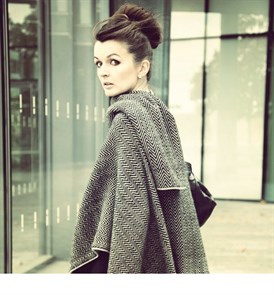
| Alpaca wear by Arlette Lee |
Designer image and brand
There are signs that some designers in Peru are moving to emulate a practice more common in other parts of the world with alpaca businesses - that of selling products using one’s name.
Two such examples of British designers that spring to mind are Samantha Holmes and Arlette Lee.
Samantha Holmes was at Peru Moda 2014 and took time to fly down to Arequipa to look for new suppliers for her alpaca lines. Her range of handknitted alpaca garments is embellished with signature alpaca fur trimmings - a look that sets her work apart from the competitors.
Peruvian designer Julia Barreda is the daughter of legendary alpaca breeder, Julio Barreda, who raised the finest alpacas in Peru for 60 years and was the first alpaca breeder to export animals to the US from his Accoyo Farm in Puno.
“My father’s work in breeding top quality animals influenced me with respect as to the fineness of fibre that could be produced from our animals,” Barreda explains. “I always had a flair for colour and design, which led me to establish my own knitwear company exclusively using the fibre produced from our herd of alpacas.
“I wasn’t very imaginative when naming the brand, using the farm’s name of Accoyo as a continuance of our family tradition with alpaca. With hindsight, I would probably have made a greater initial impact in the marketplace if, like others worldwide, I had had the confidence to use my own name to stamp out a stronger identity for the exclusive products that I am designing and producing.
“This kind of edge is important in a competitive consumer market and also portrays a unique and individual image to one’s final customers.”
Peru’s alpaca sector seems bent on signing-up and encouraging rising stars from the design world in a similar manner that a football team, hungry for trophies and titles, is wont to do.
Future
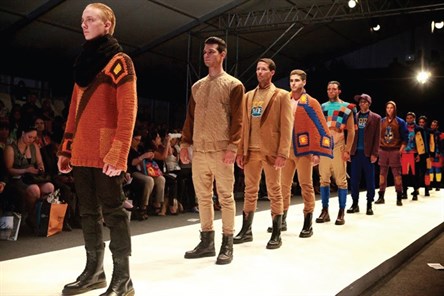
| A fashion focused alpaca collection on the catwalk at Peru Moda. |
Whilst this sea change in the alpaca industry gathers pace, a new initiative in Arequipa is providing encouragement for young designers of the future.
The French Institute, Alianza Francesa de Arequipa, together with the Instituto del Sur (part of the San Pablo Catholic University) and alpaca fibre processor Michell & Cia S.A, has recently launched the First Arequipa Festival and Competition of Fashion Design open to young designers.
Each entrant will receive 3kgs of alpaca yarn from Michell, which they will use to create ten textile designs to be judged and put on display to the public from June 25-27.
The winner of the competition will receive a scholarship from the French government to study for one year at any fashion design school in Europe. The runner-up will receive a scholarship to study for two months at the Instituto Mod’Art in Lima and the designer in third place will be able to study for a term in the textile department of the Instituto del Sur in Arequipa.
Mariana Masias, textile design director of the Instituto del Sur, who herself previously worked as a designer in Arequipa’s alpaca industry, is impressed by the amount of textile design talent in the Arequipa area. “There are many young people in Arequipa who possess a flair for design. We need more initiatives to nurture and channel their talent for the benefit of the alpaca industry as a whole. Only in this way will we see creativity transformed into future commercial success.”