
Francis Rainsford reports on a new initiative seeking to harmonise Peru’s alpaca and mining interests.
Background
Whenever problems involving issues of social conflict arise in Peru it is practically inevitable that the mining sector is at the fore.
Whereas mining investments can be a source of great wealth to neighbouring local communities, with the provision of employment and social programmes such as road improvements, the building of new classrooms for schools and medical clinics etc., they can also generate deep resentment in matters affecting the environment - mainly in the field of water management.
As a rule mining operations consume vast quantities of water, often in areas where the supply is limited. Despite sophisticated water treatment processes, in many cases contamination of surrounding land is often a cause of grave concern.
None more so than when mining companies and alpaca farmers are forced to be unwilling neighbours.
The Regions of Puno and Arequipa occupy first and second place as production centres for alpaca farming in Peru and, almost without exception, the farmers in these two regions are bordered by various mining concerns.
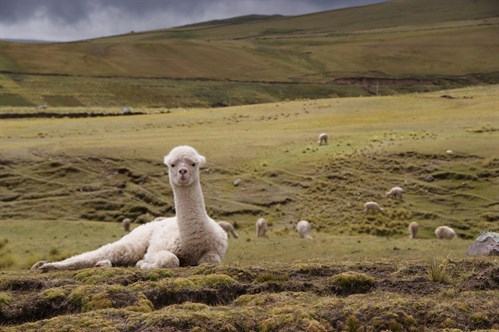 |
| Peru's fragile alpaca ecosystem is under threat from mining operations. |
Minera Chindin S.A.C.
One very new player on the scene is Minera Chindin S.A.C., an exploratory mining company set up in 2010. Owned and managed by a Taiwanese family, Minera Chindin has invested heavily in two sites in southern Peru. The company’s president, David Chen, is assisted in the business by his two sons, Martin and Antonio. He has established Arequipa as the centre of Minera Chindin’s operations.
Dedicated to the search for copper, zinc and iron deposits, the company has one centre of exploratory excavations in Pocsi, situated on the outskirts of Arequipa, and another in Santa Lucia, Lampa in the Puno region.
General manager, Antonio Chen, explains more: “When we selected the two sites for our operations it was purely coincidental that they both had connections with alpaca farming. In the case of Pocsi, we learnt that the area was used to farm alpacas some years ago, though not any more.
“Santa Lucia, however, is at the heart of the Region of Puno’s alpaca farming activities and has been instrumental in focusing our attention to study the needs of our alpaca farming neighbours.”
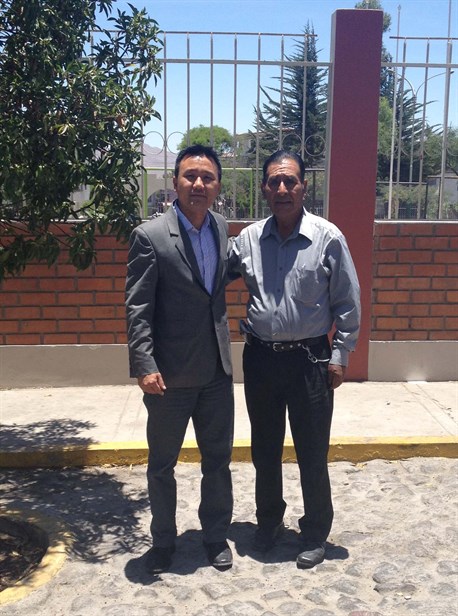 |
| From left to right: Antonio Chen and Alcides Nina (Inca culture and agricultural expert) in Pocsi. |
A strategic business model for alpaca farmers
A generalistic view of the two protag¬onists is that, on the one hand, there is the wealthy mine and, on the other, the poor alpaca farmer. This being the starting platform, the onus is on the mine to conduct itself in a socially responsible manner in order to keep the peace. Usually, this is achieved by good works such as donations to the improvement of educational and medical facilities in the neighbouring community.
For the alpaca farmer, his existence is one of attempting to overcome an economic trap of trying to earn his living from a natural resource that has been in decline in terms of quality for at least four decades. An alpaca producing an inferior fibre quality, that can only be sold at low prices, does not provide its farmer with sufficient income to live nor to reinvest in his herd. This scenario gets progressively worse as each season passes.
Countless studies conducted in Peru over many years have highlighted the importance of strengthening the country’s alpaca population with improved selection and genetic techniques. The fibre processing industry has indicated that it is prepared to pay better prices for higher quality fibre.
The road to a brighter future has been clearly signposted, but the investment required to bring this about has been sadly lacking. As a result Peru’s alpaca farmers find themselves fighting a losing battle to survive, whilst their mining neighbours have the luxury of being able to extract a product that never seems to be out of demand and commands ever stronger prices.
In the case of Minera Chindin, the company has embarked on a different approach that encompasses a strategy of partnership and opportunity for both parties:
a) Pocsi
With the knowledge that the area histor¬ically farmed alpacas, an investigation was carried out to determine why this practice was abandoned. It concluded that the area’s water table could only support pasture for the animals for half the year.
In order to rectify this, Minera Chindin has re-routed natural water sources on its 1,600 hectare site to provide sufficient volume for its excavation requirements. The water is then purified and recycled to irrigate the current cultivation of grasses for alpacas.
Working in partnership with members of the local community, particularly Alcides Nina, a professor of Inca culture and expert in agricultural cooperative models, alpacas will be reintroduced to graze once more at Pocsi’s elevated pasturelands, 3,000 metres above sea level. The aim is to produce first class fibre for the commercial benefit of the new partnership.
Additionally, plans are underway to construct a state-of-the-art on-site laboratory to monitor the herd’s genetic markers, so that optimum selection can be employed in breeding. The introduction of equipment for freezing embryos is under consideration as a means to reach other alpaca farmers within Peru, as well as exporting to other countries such as the US and Australia.
b) Santa Lucia
The community in Santa Lucia consists of some 500 inhabitants, who farm around 4,000 alpacas and llamas on 6,500 hectares of land.
The community’s leader Pablo Salas is also Puno’s Regional Coordinator of the Confederación Nacional de Comunidades Afectadas por la Minería (CONACAMI) - a body that possesses an anti-mining agenda.
Working with an anti-mining activist of many years standing has prioritised Minera Chindin’s goal of establishing a firm working relationship where environ¬mentally friendly mining can co-habit with, and commercially benefit, the community’s alpaca farmers.
As the Santa Lucia site is currently more active in alpaca terms than Pocsi, the company is providing opportunities for the farmers to improve the quality of their fibre through modifications in diet and breeding programmes. Minera Chindin is also offering farmers’ families the chance to knit and export their finished products - an activity traditionally associated with alpaca farming communities.
Minera Chindin has a good working relationship with Wu Han Jia Yi Lin Trading Co. Ltd., a textile distribution company based in China. Its general manager, Xu Li, has spent many months in Peru meeting with the alpaca fibre processing industry and Santa Lucia’s community knitters to advise on styles and designs for the Chinese market.
Her idea is to use all the alpaca fibre produced on Minera Chindin’s two sites, both in top and finished garment form, and sell the products into China. The aim is to promote higher fibre quality and traditional hand-made garments direct from the alpaca farmers, whilst at the same time supporting this new initiative. Any shortfall in supply will be sourced from other communities recommended by Santa Lucia.
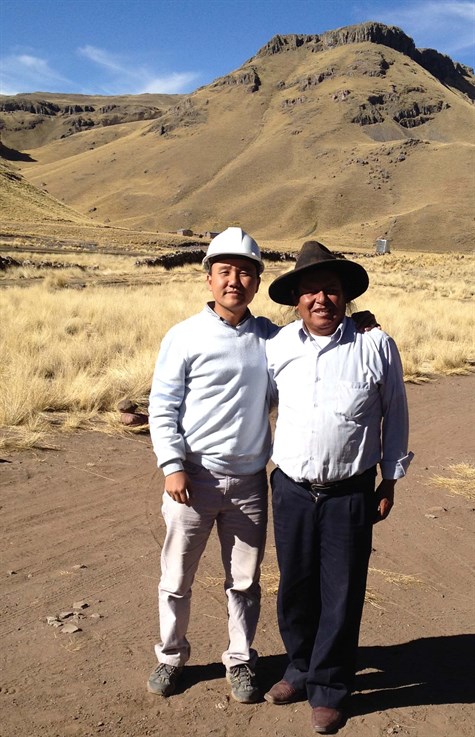 |
| From left to right: Antonio Chen and Pablo Salas at Minera Chindin’s Santa Lucia site. |
Future
To summarise the advancement of the working partnership between his company and the neighbouring communities on both sites, Antonio Chen compares the new business model to that of the practices carried out during Peru’s Inca civilisation some 500 years ago.
“Historically the Incas were great miners in Peru, extracting both gold and silver. They also farmed alpacas and llamas for textile and religious needs. They were successful in combining these activities and, at the same time, protecting the environment. This fact has been the benchmark for our strategy with our neighbouring communities.
“I believe that Minera Chindin’s initiatives have created commercial opportunities for its neighbouring alpaca farming communities that will generate income for them to become self-sufficient entrepreneurs for the years ahead. As a miner, I have found that I have now developed a new and personal interest in alpaca products too!
“Most importantly, our partnership has set the way forward for commercial growth based on environmental and cultural sustainability. This indeed is an excellent strategy for today’s world.”