Crude oil prices jumped midweek and weekend to reverse the consecutive weeks of fall in both international benchmarks. Prices settled sharply higher midweek as traders hailed report showing US crude supplies fell by more-than-expected last week. A large draw in crude supplies emerged as imports fell exports fell faster than import. By weekend, both benchmarks were up for the week as China decided to resume purchases of US crude while US$ fell after Federal chair signaled further rate hikes.
Although this week saw the disconnect between oil markets and polyester continue as prices were driven again by ongoing maintenance period. Regular or seasonal demand is expected to begin from September through the Christmas and New Year season.
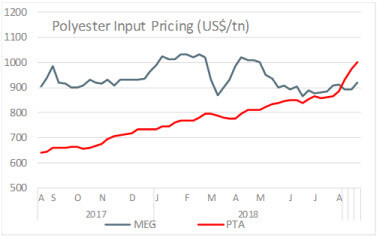
PTA prices continued to march up in Asian markets on rebounding downstream polyester market. However, there was little momentum for spot PTA prices to rise further after reaching a peak. PTA market is ready to brace any adjustment in the coming week but in medium to long-term, PTA market will continue to go up unless there are some changes in market fundamentals. PTA futures market had retreated significantly on the weekend and the spot PTA market inched up, with most gains seen on Thursday. Markers gained US$30 on the week with CFR China at US$990-992 a ton and offer from Taiwan/Korea rose to US$1,000-1,002 a ton. In India, prices were at US$935 a ton CIF. In China, surged to US$1,050-1,055 a ton, and offers for nearby-month cargoes to US$1,000 a ton, with discussions in the range of US$990-1,000 a ton.
In Europe, purified terephthalic acid supplies remained short with feedstock prices elevated. Inventories were yet to recover from earlier production problems. Spot spread over paraxylene widened, following spikes in Asia. August PTA contract price were at Euro 763-797 a ton FD NWE.
In US, markets were quiet as demand remained subdued. June contracts rolled over at US cents 50.21 per pound (US$1,107 a ton).
Asian paraxylene prices continued to increase sharply but at slower pace as strong demand growth in polyester sectors remained supportive. According to sources, polyester demand in China was grew double digit in H1 of 2018 and this was boosting demand for paraxylene, via healthy purified terephthalic acid margins. Supplies are expected to begin lengthening in late September early October as cargoes arrive and turnarounds are completed. Spot prices soared US$48 on the week with CFR Taiwan/China at US$1,245.50-1,246.50 a ton and FOB Korea to US$1,226.17-1,227.17 a ton.
In Europe, spot paraxylene prices jumped sharply by US$63 to US$1,169 a ton FOB Rotterdam. as participants were closely watching developments in Asia for export opportunities to the region. Players expect prices for September will still go up if Asia is anything to go by.
In US, paraxylene prices rolled over this week at US$1,060-1,070 a ton FOB, based on bids and offers, as producers looked to hold a margin of at least US$125 a ton to mixed xylene to breakeven on paraxylene production. Margins are expected to remain strong until Asia demand softens toward the end of the September.
MEG prices reversed the two-week falling trend in Asia amid an increasingly bullish market sentiment as producers benefited from a rebound in prices on short-covering by traders. Buyers have started restocking ahead of the peak demand season in September for polyester sector. Meanwhile, inventories in east China fell 10% week-on-week to 490 kilo ton due to fewer import arrivals and steady off take rate. From late July levels, the inventories have fallen 20%. Taking cue from spot Sinopec raised its August settlement prices, in line with the strong spot market. Spot prices gained US$30-31 on the week with CFR China at US$934-939 a ton and CFR South East Asia to US$922-924 a ton.
In Europe, mono ethylene glycol bulk spot prices rose after some sustained stability on lower supply. Bulk spot levels rose on supply snug and bullish outlook for September amid limited supply expected. An initial contract settlement for July was agreed but lacked support for rollover. Bulk offers were in the range of Euro 880-890 a ton CIF NWE this week, reflecting increase of Euro 10 on either side of the range. A dual agreement is expected for July and August contracts. Meanwhile, the July contract was fully settled at Euro 1,010 a ton FD NWE, unchanged from June.
In the US, mono ethylene glycol prices were steady in August on balanced supply and demand conditions, as China began imposing 25% tariffs on US goods this week, including MEG. July contract prices were stable at US cents 41.5-47.5 per pound FOB USG.
Polyester staple fibre prices continued to surge on the back of rising purified terephthalic acid and mono ethylene glycol costs this week. However, trade activity was dampened as buyers hesitated to accept such a drastic hike in offers. The persistent strengthening of the US$ against most currencies also curtailed buying appetite. In China, prices moved up sharply on the week, but the weekend saw range-bound purified terephthalic acid futures and polyester fibre market covered by wait-and-see sentiment. PSF suppliers were actively offloading goods. PSF market in Shandong and Hebei also remained stable.
In Jiangsu and Zhejiang, offers for 1.4D direct-melt PSF were raised to 11.10-11.30 a kg (US$1.62-1.64 a kg) while the same in Fujian and Shandong were up at US$1.62-1.66 a kg, up US cents 7-9 on the week. Export offers were also raised to US$1.40-1.42 a kg FOB China, as against US$1.32 a kg a week ago.
Polyester spun yarn markets were supported by rising polyester fibre prices in China, while other Asian markets were taking cue. In China, 32s polyester yarn offers were hiked further to 16.30 yuan a kg (US$2.37 a kg) and 45s to 17.40 a kg (US$2.53 a kg), both up US cents 9. 60s were slightly up at 16.30 yuan a kg (US$2.37 a kg, up US cents 2).
In Pakistan, spinners raised concerns over rising costs, and a meeting was held to consider the market situation. Deep dismay was shown over the unsustainable hike in prices of polyester fibre. The basic fact is that basic raw materials cotton and polyester fibre were both short of industry demand because of protection and incidentals on imports of PSF (20%) and cotton (11%). Exporters were forced to cross subsidise on PTA and PSF plants, whereas exporters are given rebates and drawbacks in other countries. It was stated that the main causes of the non-viability of domestic polyester fiber was the protection extended to obsolete PTA plants over the last 25 years.
Thus, yarn makers were urging for reduced import duties on imported polyester fibre from 7% to 2% as local prices have almost doubled in the last year. This week, polyester yarn prices were flat in Karachi with 30s at PakRs145 per pound (US$2.61 a kg) and 60s to PakRs165 per pound (US$2.97 a kg), both up US cents 1.2 due to strong currency.