The crude oil market was subject to oversupply worries, trade disputes and slowing global economy dampening demand for oil. US crude declined for the seventh consecutive week, while global benchmark European Brent was down for a third week. However, price fall was limited by US sanctions on Iran, which target the financial sector from August and will include petroleum exports from November.
This week had negligible impact of oil markets on the polyester chain, but prices were driven by prevailing maintenance shutdowns and planned in the coming period. I understand this as a regular or seasonal period and situation that will go back to normal with peak demand season on the anvil. Prices may tend to moderate in coming weeks, as the current built up is temporary.

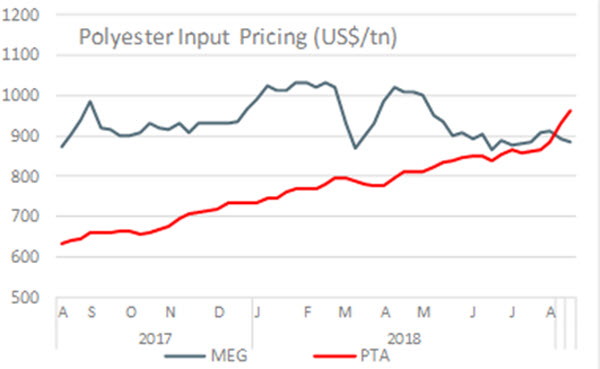
PTA prices were on a four-year high in China and will fluctuate at that level in September and October supported by heathy demand, tight supply and firm feedstock paraxylene prices. On 15 August spot prices in China reached a new high when they were last seen around January 2015. Another major factor supporting PTA prices was the depreciating yuan. The PTA market relies on imported paraxylene and depreciation in currency implies increased production cost. Further, several big PTA plants, involving around 7.55 million ton capacity, were heard to have turnaround plans in the short run, which will aggravate the supply situation. Asian markers surged US$32 on the week with CFR China at US$945-947 a ton and offers from Taiwan/Korea surging to US$962-964 a ton. In India, prices were at US$915 a ton CIF. In China, offers for bonded goods picked up to US$1,000-1,010 a ton, and nearby-month cargoes also surged to US$1,000-1,010 a ton.
In Europe, the PTA August contract increased, moving alongside August paraxylene reference contract. The market was also affected by recent startup of Indorama's PTA plant in Portugal. However, downstream demand was weak as the peak season for PET ended. August PTA contract price was up Euro 40 to reach Euro 763-797 a ton FD NWE. In the US, June contracts rolled over at US cents 50.21 per pound (US$1,107 a ton).
Paraxylene spot prices hit their highest in more than three years in Asia, driven by strong downstream markets and despite softer energy and naphtha prices. Tight supply for prompt cargoes further supported uptrend as unstable operations at two new facilities resulted in tight supply. The strong trend is likely to continue as several producers in Asia with a total capacity of 4.7 million ton a year are planning plant turnarounds. Asian markers jumped US$70 on the week with CFR Taiwan/China at US$1,199-1,200 a ton and FOB Korea at US$1,180-1,181 a ton.
In Europe, spot paraxylene prices sat at four-year highs, driven by high Asian prices, while the contract for August was agreed at an increase. Supply also tightened, affected by production issues including BP's recently lifted force majeure, while demand increased with the recent startup of Indorama's purified terephthalic acid plant in Portugal. Spot prices also soared US$44 on the week to US$1,092 a ton FOB Rotterdam. August contract reference price were raised Euro 60 to Euro 950 a ton FD NWE.
In the US, paraxylene spot export prices continued to rise, tracking gains in Asia. The soaring of prices in Asia also opened US-to-Asia arbitrage window. The Gulf spot paraxylene prices were US$1,060-1,070 a ton FOB, up from US$1,000-1,045 a ton last week, based on bids and offers.
MEG markets in Asia were under pressure from a weakness in Chinese yuan and softer crude oil prices. Trading activity was thinner this week, as buying appetite from China tapered off amid sharp depreciation of the yuan against the US$. Market sentiment was also hit by falling crude oil prices. Meanwhile, MEG inventories in east China increased 5.2% to 544 kilo ton, further adding to the price downtrend. Spot prices declined US$9 on the week with CFR China at US$895-900 a ton and CFR South East Asia to US$884-886 a ton. MEGlobal nominated September Asian contract price at US$1,100 a ton CFR Asia, US$20 lower from its August nomination. SABIC listed its September MEG Asian contract price at US$1,110 a ton CFR Asia, up US$30 from August.
In Europe, July and August contracts for MEG are not yet agreed.
In the US, players were contemplating long-term impact of China's tariffs on MEG, especially when new capacity is slated to come online in 2019. China will impose 25% tariffs on US goods starting 23 August, including MEG. However, the imposition will have limited impact on MEG exports to China since they account for just 2.1% of total MEG imported by China. July contract prices were stable at US cents 41.5-47.5 per pound FOB USG.
Polyester staple fibre makers faced strong cost pressures from surging prices of PTA because of tight supply. This led to an increase in selling indications as makers looked to maintain margins. In China, demand remained healthy, with plants running at relatively high levels. Prices were seen rising in China and Pakistan amid higher cost pressure. However, trades were difficult to conclude as it was still not seasonal peak demand period. Buyers were also resisting the hikes in view of the lackluster demand and persistently stronger US dollar causing prices in US$ term to fall.
In Jiangsu and Zhejiang, offers for 1.4D direct-melt PSF were raised to 10.65-10.85 a kg (US$1.55-1.57 a kg) while the same in Fujian and Shandong were in the range of US$1.54-1.57 a kg, up US cents 8-11 on the week. Export offers were also higher at US$1.32 a kg FOB China, as against US$1.30 a kg, a week ago. In Pakistan, 1.4D PSF offers were hiked PakRs5 prices rolled over to PakRs.185-187 a kg (US$1.50-1.52 a kg, up US cents 4).
Polyester spun yarn prices moved up in China and Pakistan this week in line with the rising cost of polyester staple fibre. However, the rise in yarn prices were not in line with the increment in cost, thus implying that spinners are unable to pass on the entire cost but taking hit on their margins as this being a dull season period. It is expected that the polyester yarn markets will be strong in the near future as demand will improve in the traditional peak season beginning September.
32s polyester yarn offers were hiked to 15.70 yuan a kg (US$2.28 a kg) and 45s to 16.80 a kg (US$2.44 a kg), both up US cents 3. 60s were flat at 16.20 yuan a kg (US$2.35 a kg). In Pakistan, polyester yarn prices gained PakRs2 in Karachi with 30s at PakRs145 per pound (US$2.60 a kg) and 60s to PakRs165 per pound (US$2.95 a kg), both up US cents 3.