Cotton futures continued to lose ground, although marginally this week, supported by a new North America trade agreement which saw futures bounce off an eight-month low. However, the market remained under pressure after another round of weak US export sales. The US and Canada reached a last-minute trade deal that includes Mexico to revise the NAFTA into a new pact dubbed as the United States-Mexico-Canada Agreement or USMCA. Under USMCA, continued duty-free access for US cotton to Mexico and Canada will be assured. Mexico is among the top five raw cotton export markets for the US, and both Canada and Mexico are top five export customers for cotton textile and apparel exports.
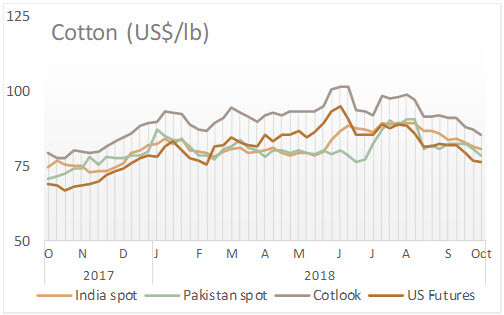
December lost US cents 0.27 week on week to close at US cents 76.10 per pound, the lowest close since 20 February. March shed US cent 0.15 to finish at US cents 77.14, widening its closing premium over December by US cents 1.04, still well shy of full carrying charges. December 2019 slipped US cent 0.02 to close at US cents 75.75 per pound.
Global spot benchmark, the Cotlook A Index moderated by a sharp US cent 1.85 on the week to close at US cents 85.35 per pound, having lost US cent 0.60 on the weekend.
In China, raw or seed cotton buying activity was negligible this week as the country celebrated its week-long national holiday. In the previous week, prices for hand-picked goods were at 7.0-7.2 yuan a kg (US$1.02-1.05 a kg) and for mechanically-harvested goods at 6.0-6.2 yuan a kg (US$.87-0.90 a kg). This week saw the China Cotton Index fall by 157 yuan, to close at 16,086 a ton (US cents 106 a pound).
In Pakistan, the Karachi spot rate declined, opening the week and steadied later only to fall at the weekend. The rate ended at PakRs7,960 per maund ex-Karachi, down PakRs200 week-on-week. The leading buyers concluded deals for better and second grade lint on slightly higher prices, while shrinking better grades pushed price in green zone during trading session. Spinners in Sindh and Punjab were reportedly engaged in a price war with buyers on better grades of lint besides growing demand, which kept market sentiments positive despite shrinking domestic stocks. Expert opined that with looming higher inflation, cotton prices will continue to move up over the longer-term on a domestic and international front.
In India, the Cotton Association of India pegged the crop size for 2018-19 at 348 lakh bales (each of 170kg), in its first cotton crop estimate, from 365 lakh bales in 2017-18. The reduction is attributed to adverse impact of drought-like situation in key growing areas of Gujarat, Maharashtra and Karnataka. As per the estimates, cotton crop in Gujarat is set to decline by 15 lakh bales to 90 lakh bales for 2018-19. The state received deficit rainfall of about 23% until 5 October. Crops in Maharashtra, Andhra Pradesh and Karnataka are also projected to be lower. However, the crop in North India is estimated to increase by two lakh bales to 58 lakh bales with Punjab (10 lakh bales), Haryana (24 lakh bales) and Rajasthan (24 lakh bales) showing signs of better crop conditions.
Reports from spot market indicated that cotton prices are ruling 8-13% below MSP. The Cotton Corporation of India (CCI) has set an initial target to purchase a record 10 million bales of cotton this season. Arrivals usually pick up from mid-October. CCI may start procurement anytime in various states, including Punjab. Often, that arrive before October is of high moisture content and CCI is allowed to buy cotton with a maximum of 12% moisture content.
Cotton yarn
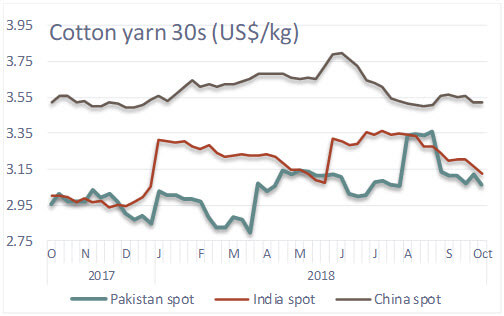
Cotton yarn markets in China were steady during the week-long National Day holiday, and the transaction was muted. Prices are notionally rolled over. Conventional varieties like 21s, 32s and 40s saw limited demand during the week since players had restocked inventories before the holidays. 32s traded at 24.25 yuan a kg (US$3.53 a kg) and 40s at 25.40 yuan a kg (US$3.69 a kg). Coarser yarn prices of 16s were at 15.30 yuan a kg (US$2.22 a kg) and 21s at 19.60 yuan a kg (US$2.85 a kg).
In India, cotton yarn prices stayed stable, by contrast with the decline observed in cotton prices in recent weeks. Meanwhile, export prices declined for 30s knitting as INR weakened against the US$. 30s carded cotton yarn for knitting rolled were steady at INR230 a kg (US$3.13 a kg) in Coimbatore.
In Pakistan, cotton yarn prices were flat in Karachi but moved down in the Faisalabad market, in line with a fall in cotton fibre prices. The decline has still left high margins for spinners. Export offers also moved due to lower demand from Far East and China where customers were in holiday mood. 30s carded prices in Karachi remained unchanged at PakRs168-170 per pound (US$3.00-3.04 a kg), while 32s combed in Faisalabad were down PakRs 3 at PakRs171.50-184 per pound (US$3.06-3.29 a kg, down US cents 6).