
Dr Jane Scott, senior teaching fellow at the University of Leeds, speaks to Fiona Haran about her work in programming biomimetic knitted textile structures.
The concept of programmability is gaining traction across the textiles industry, typically involving the development of tools to modify behaviour – whether it be systems, software or algorithms. This was recently seen in the Lumen knitted canopy structure by designer Jenny Sabin, but it is also a research focus of Dr Jane Scott, a senior teaching fellow at the University of Leeds, UK, who developed the idea of programmable knitting during her PhD at the Textile Futures Research Centre at Central Saint Martins College of Art and Design, London.
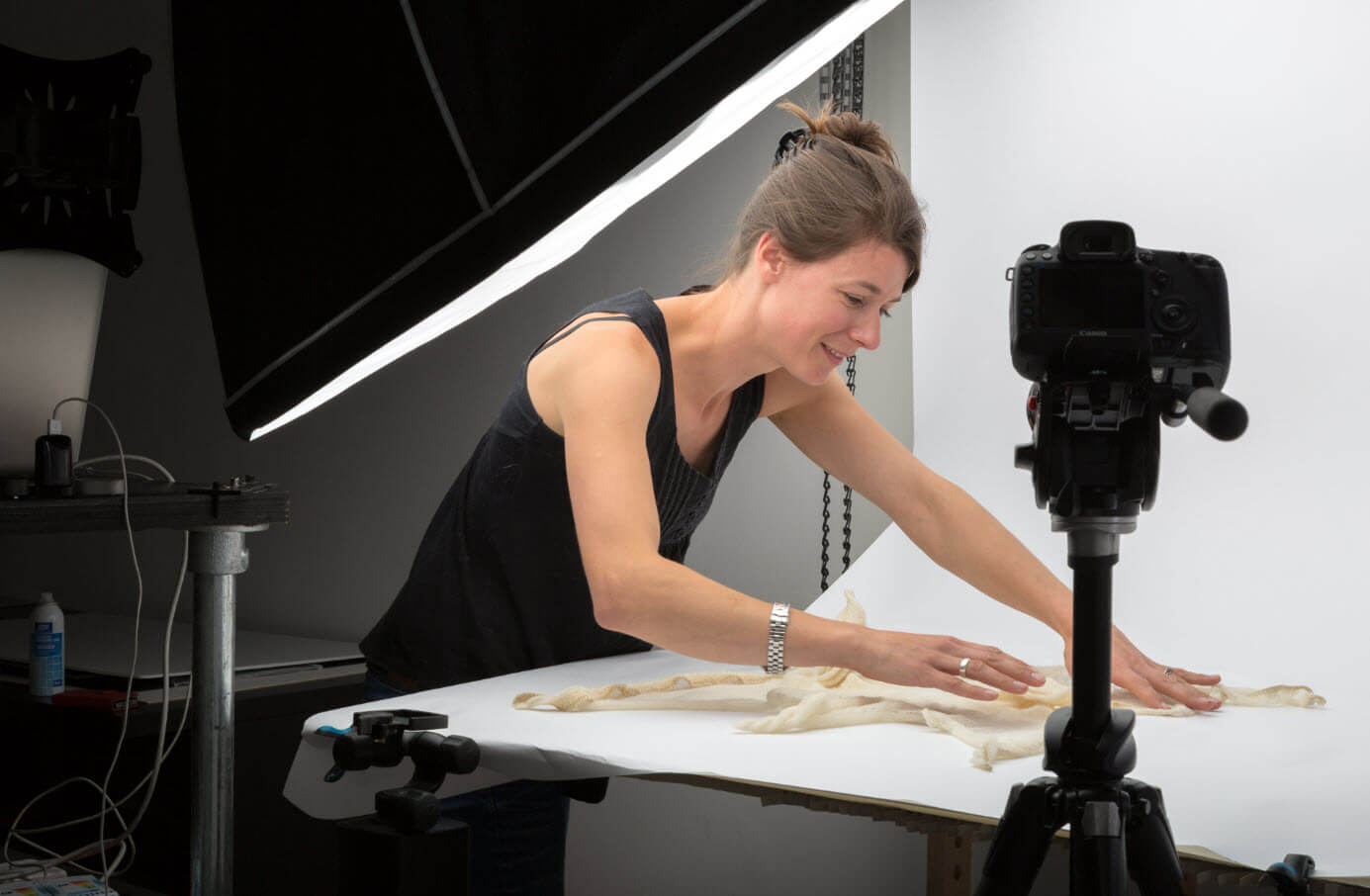 Jane Scott developed the idea of programmable knitting during her PhD
Earlier this month, I visited Scott in the new state-of-the-art textiles facilities at the University’s School of Design to discuss a presentation she delivered at this year’s Textile Institute World Conference (TIWC) on biomimetics and knitted textiles. And, as she explains, she used programmable knitting to develop knitted fabrics with shape-changing properties, so they can respond to environmental stimuli.
“I am particularly inspired by botanical systems,” says Scott. “For me, there is this natural relationship between plants and textiles in which the fibres that I work with are plant fibres. A lot of my work looked at how plants moved – thinking about actuation systems in plants and how we could replicate them in textiles.”
One such example, as seen in the biomimicry research of designer Dr Veronika Kapsali, is the pine cone model. “It’s interesting because the pine cone is made of material that can change shape – and it’s a dead material,” says Scott. “It’s about the geometry of the fibres within it, which are aligned. As a model for textiles it’s really interesting because there are so many points of intersection.”
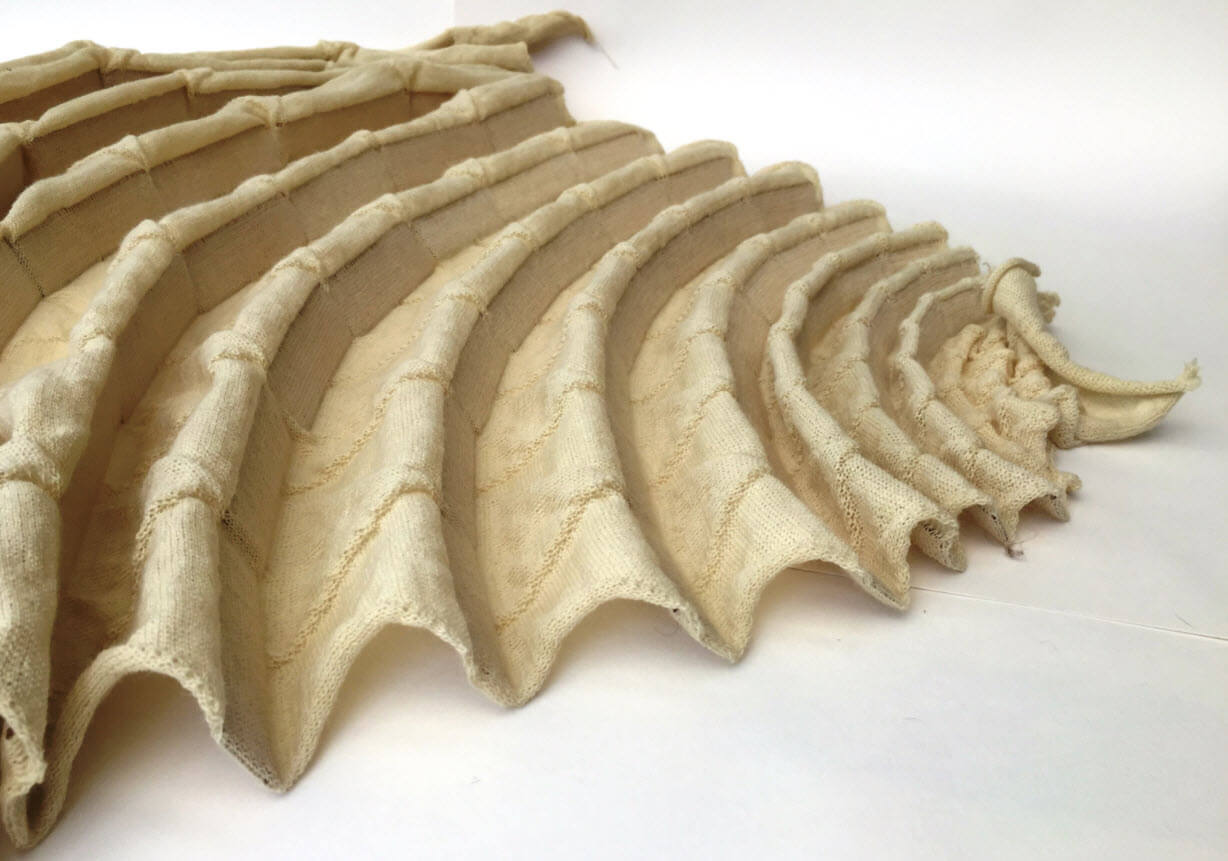 Scott's work stems from her interest in botanical systems
Photo by Jane Scott
In her presentation at TIWC, Scott says she was ‘setting the scene’ to address what digital textiles mean in terms of programming and knitting – ‘looking at 2D interfaces to develop 3D materials’.
Expanding on her biomimetic approach, Scott explains: “I’m interested in thinking about how plant forms grow, as they don’t have a pre-defined geometry at the beginning; they have a set of rules to grow from. From these really simple concepts you get these different forms emerging.”
By following those biomimetic design rules, Scott developed a programming rule for knitting and translated it into garment design. This was materialised in her project Bloom – a knitted dress that is moisture responsive. “When there are high levels of humidity the corsage on the neck curls, providing organic movements,” she notes.
The dress was displayed at last year’s Chelsea Flower Show, with visitors able to see the shape-changing properties in action. “It was in a greenhouse which was an ideal place for it to quickly dry and be ready for more moisture,” says Scott.
The dress combines two rules of biomimetics. “There is the level of looking at materials like the pine cone and the structure of the material enabling shape change, and then there is also this concept around growth and how we can use growth as a model for designing forms,” Scott explains.
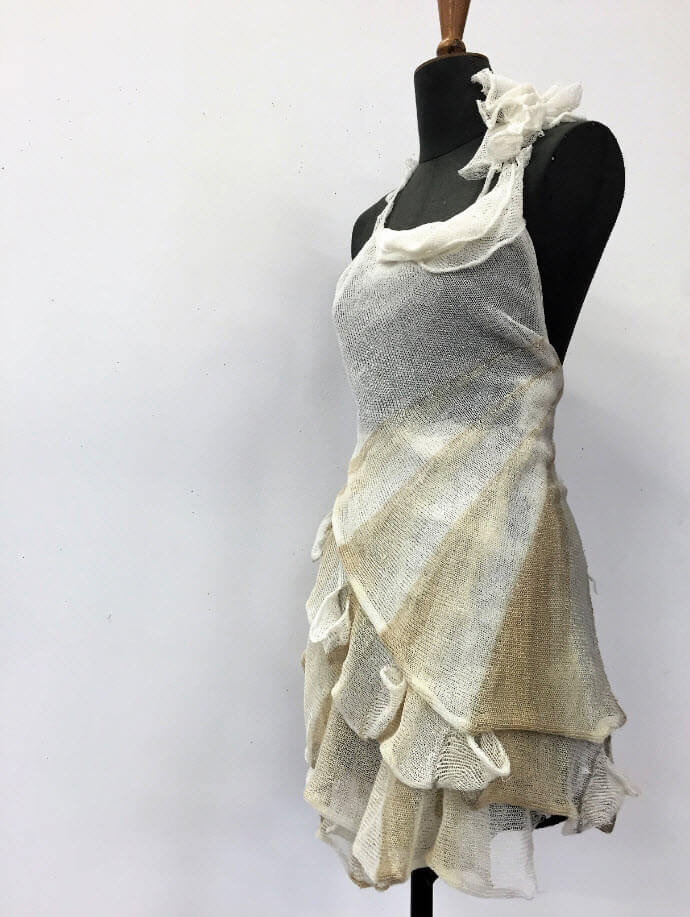
Using a programmable rule for knitting, Scott developed a dress called Bloom, which is moisture responsive
Photo by Jane Scott
Despite the digital aspect of programming knits, Scott chose to steer away from incorporating electronics into her garments, such as battery packs, to adhere to the rules of biomimicry. “It’s great that you can incorporate shape memory into knits to make something move, but I don’t think it’s a true textile behaviour if it’s got a lot of wires. The textile is passive and you’re putting an electronic system into it. My work isn’t about that; with mine, all the behaviour is integrated through the fibres, through the yarns and through the fabric structure. That’s how you get the shape change.”
And, what’s great about knitted fabrics, she adds, is that they can be used in multiple applications, suggesting that they could be used for shape-changing materials in the body – “something that self-heals or adapts as required – it might go all the way from medical applications to architectural applications”.
Scott has experience in both these areas, previously working on a 3D compression material. “Most of my work integrates design and technology,” she says. “I worked on compression supports that were much more attractive; they were personalised with a customisable design. If you can make something fit better, then it’s great if you can also make it look better. This gives it a comfort level and a usability – and people will be more prepared to use these things.”
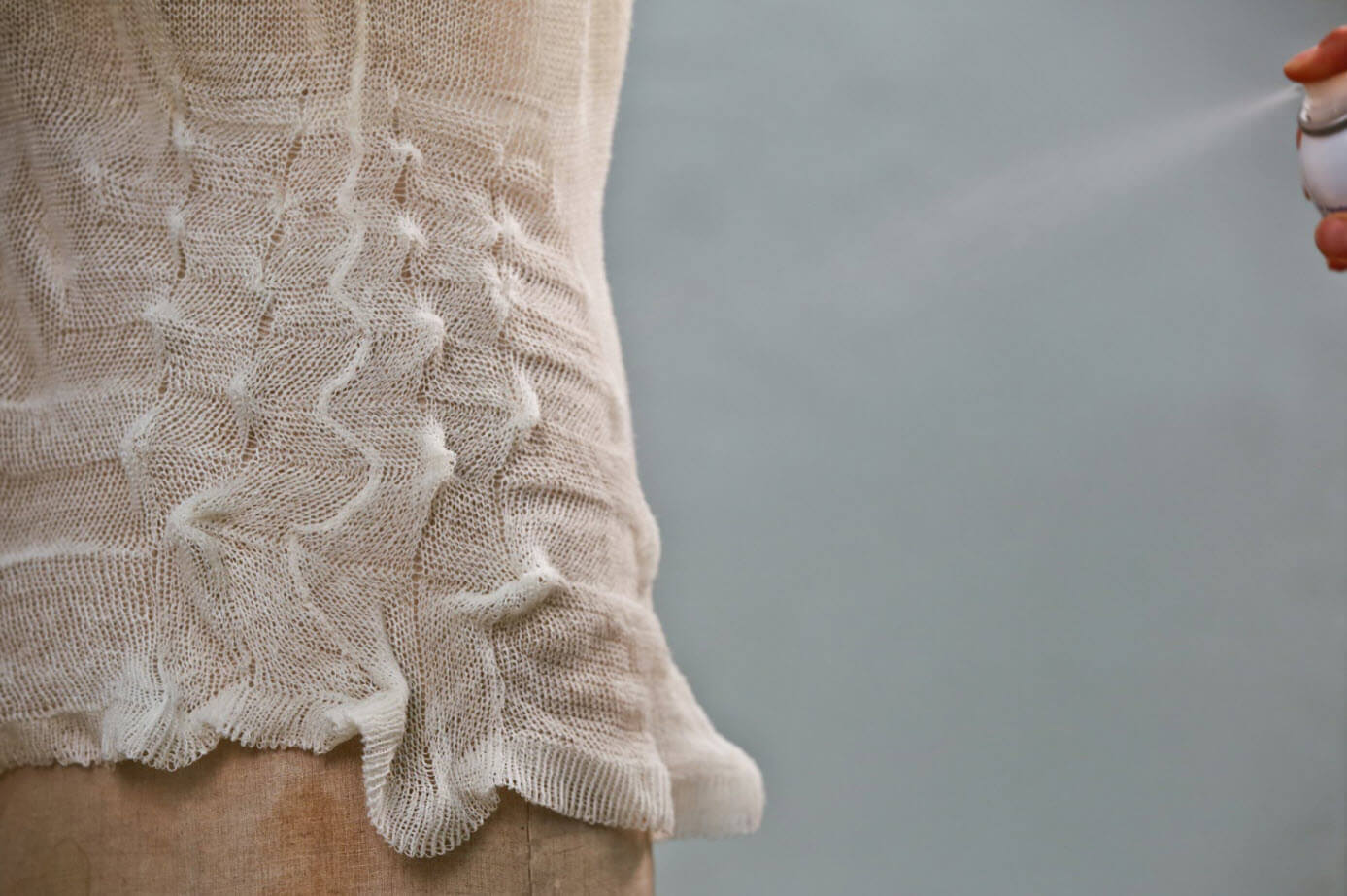 A knitted garment responding to moisture
Photo by Cristina Schek
And, what appears to be enabling such research is industry collaboration. “I’m excited about the new industries that are taking notice of what we’ve been doing for a long time. It’s important that we’ve got this body of knowledge already and people are now borrowing from it. What excites me is the interdisciplinarity that is out there now – most disciplines are now using textiles – and designers are playing a central role.”
Scott’s work also demonstrates a return to natural materials, which she is equally enthusiastic about as functionalising natural materials “takes sustainability very seriously from a material level”.
She adds: “Biomimicry brings a broader set of values. When you’re trying to mimic nature, you need to work with materials that aren’t going to harm the environment. So, a lot of my work uses 100% natural materials, such as linen, flax, wool – and they are grown with no chemicals. There is no negative impact of this work, and it can be allowed to biodegrade afterwards.”
This is being leveraged by a greater awareness of sustainability across the entire textiles industry, which Scott says underpins the future of textiles. “I do think people have got a much better grasp of what sustainability means and how we can use it as a foundation,” she concludes.


