Otis Robinson speaks with Lea Esterhuizen, founder of &Wider, about social sustainability, blockchain and how best to protect apparel industry workers from malpractice.
In April 2020, the European Union (EU) announced plans to push a legislative proposal that will require businesses to carry out due diligence on potential human rights abuses and environmental damage within their supply chains.
“Governments have a crucial role to play in the transition towards a sustainable and fair society,” said Paul Tang, a member of the European Parliament, in a press release issued by the RBC (European Parliament Working Group on Responsible Business Conduct). By making such practice mandatory, some believe human rights abuses in supply chains can be slowly eradicated.
On the contrary, within the fashion industry, where such crimes remain pervasive, a rising consciousness means some of the sector has already enacted much of what the legislation would require, opting to utilise new technologies and tools to gather insights and protect their workers from potential human rights violations.
“Brands are already stepping forward and actively seeking sources for better insights and ways to take on issues relating to working conditions,” says Lea Esterhuizen, founder of &Wider, a company that offers digital tools to gather worker insights. Working across industries – from fashion to construction – Esterhuizen and her company seek to aid due diligence to target specific and pervasive incidents within industry.
For example, across the board, there remains organised crime when it comes to subcontracting and labour providers. It’s a murky space, Esterhuizen says. “There’s forced labour, discrimination, exclusion and exploitation of migrant workers and language minorities – this is something brands understand. They’re stepping up to have a mature, collaborative approach with their suppliers and ask what we can do together to address these issues.”
Part of the solution is transparency and authentic investigation, something &Wider has put at the forefront of its priorities. Its approach to due diligence has proven popular: in September 2018, &Wider was involved in Batch 4 of an accelerator programme by Fashion For Good, a global initiative pushing for sustainable solutions. The collaboration led to partnerships with apparel brands, fundraising support and even an investment from Fashion For Good itself – overall, a sizeable demand for the service, with the company now handling over 50 clients. Esterhuizen accredits this to a shift in consciousness across industries, including the apparel sector.
“Brands are doing this less and less for compliance sake, and more and more because there’s an urgent need for better data in a climate of uncertainty – you can’t get more uncertain than a pandemic.”
Driving meaningful change
Esterhuizen is a data scientist backed by a history of designing systems to gather sensitive data from scared, invisible or unreachable populations. In August 2012, Esterhuizen was inspired to begin the &Wider project while working away in Beirut, Lebanon, during the Arab Spring. Over 5,000 miles away in South Africa, a wildcat strike by platinum miners was met with lethal force by South African security forces, which led to 34 deaths. Soon known as the Marikana massacre, the incident had huge impacts for the country.
“I started investigating to check who had known what: who had known about their working conditions? who had known how desperate these workers were? and why was the response to the workers’ protest so muscular?” asks Esterhuizen. “I was underwhelmed with what I found.”
Data on working conditions across industries (particularly the fast-moving consumer goods (FMCG) sector and fashion) is often incredibly at risk of inauthenticity. Although auditors will inspect premises and offer valid insights, these visitations are either announced or semi-announced to the business, meaning they can prepare and offer ‘their Sunday best’, says Esterhuizen. To ensure working environments are entirely transparent, and to consequently avoid incidents like the Marikana massacre, Esterhuizen believes a new auditing model should be implemented.
“One needs an anonymous channel for workers to report regularly as operation normal, and that’s where the business idea for &Wider came from.”
Thus, the company offers employers an automated calling system to gather information from employees – with their full consent – all while retaining worker anonymity. “It’s a five-minute call, in the language of the worker’s choosing. The worker never uses their voice, never mentions their name. They simply press one for yes, two for no, or three for don’t know, in connection with 20 simple, literal questions.”
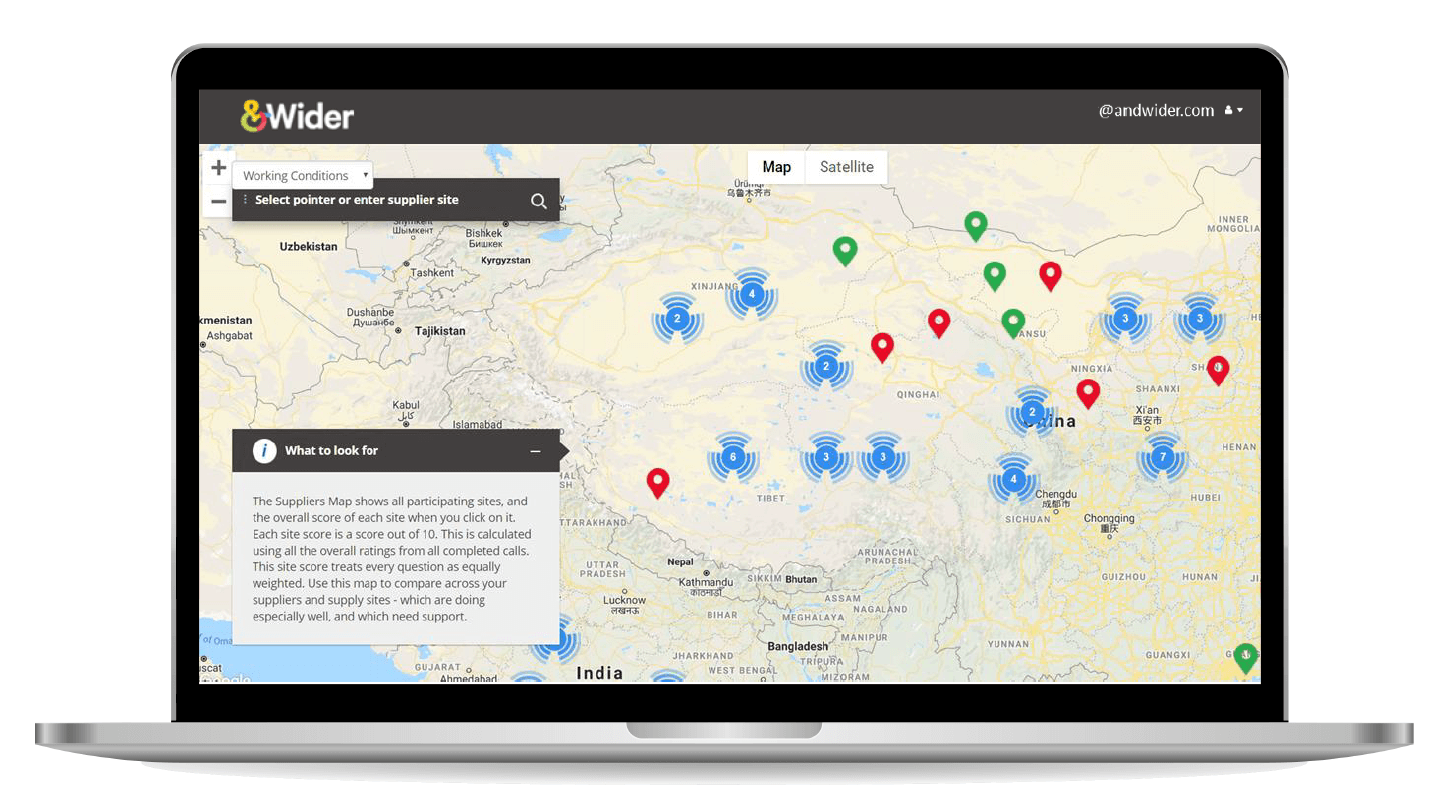
Employers can view this data on a traffic light dashboard, which will classify working environments as red (an emergency situation), amber (a mixed picture) or green (safe), alongside further details and progress information.
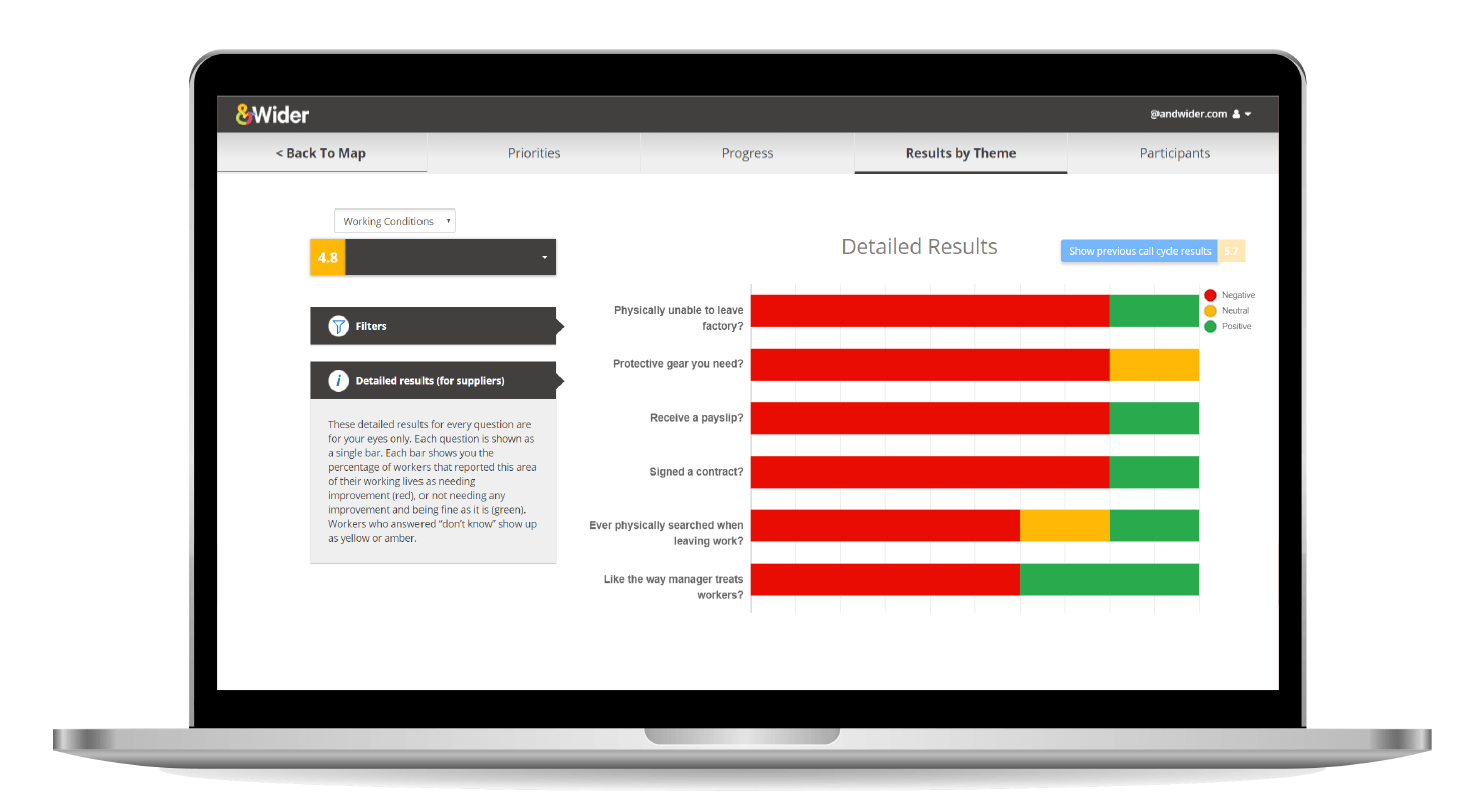
Esterhuizen says this allows businesses to drive meaningful change in the lives of workers without putting them at risk.
Over video call, Esterhuizen explores numerous incidents with regard to working conditions in the apparel sector, though she notes these topics require confidential, cautious and sensitive reporting measures as to not generate any unwanted consequences for workers. These incidents were related to living wage indicators, age and discrimination, among others. And, during the ongoing Covid-19 outbreak, it had been reported through &Wider’s tools that apparel industry worker incomes have taken a hit as a consequence of declining business success, which may impact workers’ food security. Esterhuizen hopes this data can help employers to problem-solve.
Blockchain
The use of a calling system seems unique as industry increasingly turns to blockchain.
Within the contemporary fashion industry, blockchain is increasingly the go-to technology to map the supply chain and improve transparency around working conditions, but this can generate problems because the technology relies on data from the aforementioned, potentially inauthentic auditing process. What’s more, most information on the blockchain regarding working conditions comes from secondary sources, the company claims, which can “create an often incomplete and sometimes misleading picture” where employers “lack sufficient understanding of what daily life is like for workers”.
But &Wider bridges this gap, enabling workers immediate ease-of-access to authentically document their experiences. However, rather than working as an oppositional tool, Esterhuizen concurs that blockchain is a necessary cheek-to-cheek solution that will ultimately support the company’s calling system by mapping collected data.
“Our system has a contribution to make, but I don’t think it’s a silver bullet. You need an anonymous channel to listen to workers at regular intervals, and our system does that very well, but it doesn’t do everything. It doesn’t inspect the premises. So, you need supply chains to be mapped to then engage with workers on those sites [via auditors]. Hence, blockchain is needed,” says Esterhuizen.
She carefully explains that &Wider is a steppingstone of data: it offers information on the extent of the problem to highlight when auditors need to put their ‘boots on the ground’ to problem solve an issue and improve working conditions.
Then, this collated information is available through third-party applications, and there are plans to allow this data to be mapped by blockchain and other third-party applications too.
“We work very closely with blockchain providers, as we do with audit companies, local teams or brands that work in regions where we engage with workers. All of this is important to establish a 360-degree picture and ensure that we’re not just generating results, but actually generating improvement in workers’ lives.
“We’re interested in a serious partnership with a blockchain provider and are keen to integrate and offer insights into blockchain environments.”
2020 onwards
Collaboration between digital tooling is not new to the fashion industry and is certainly increasing in popularity as it contends with a new normal. According to Esterhuizen, the pandemic, alongside push from government legislations, has led to snowballing interest in transparency tools such as &Wider and collaborations between brands and suppliers.
Not only do services such as &Wider’s calling system allow insight into worker malpractice, but they enable small-to-big players to repair their supply chains by stabilising workforces and getting production up and running.
Nevertheless, stronger than ever, there is a drive to gather genuine data that can better working environments, Esterhuizen says, and this reflects the future of the industry.
“The brands that are taking these steps tend to be the first adopters, the progressive brands – a growing cohort. They don’t want to only do the right thing, but they want to do the wise thing. They want to engage with their supply chains,” Esterhuizen explains.
As government legislation indicates stricter guidelines are to come, businesses need to prove their resilience against malpractice, but on the periphery are smaller brands that have willingly risen to the challenge, too.
“I spoke with a brand this morning which is doing their utmost to run a clean ship and have honest conversations,” Esterhuizen says.
She concludes by explaining how meaningful action is widening among industry players in the fashion industry, which offers hope to those who wish to improve the sector in positive, ethical ways. “It’s not just the front runners that have all the innovation at their disposal – the usual names when it comes to social sustainability and innovation – we also see a lot of brands early on in their journey who are diving in [to this challenge] too.”