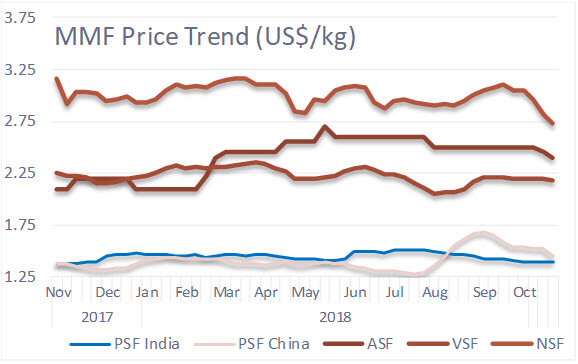
Polyester staple fibre markets extended weakness in Asian markets with prices declining sharply in China and Pakistan this week while offers in India were already reduced last week. In China, buying appetite tapered, as sentiment turned cautious over volatile feedstock and crude oil prices. Offers were subsequently lowered to boost sales while PSF inventory levels climbed. With bearish outlook and tight capital at year end, participants were cautious to purchase despite low prices. Offers declined further with 1.4D direct-melt PSF at 9.20-9.40 Yuan a kg (US$1.33-1.36 a kg, down US cents 8) in Jiangsu and Zhejiang while the same in Fujian and Shandong at US$1.33-1.36 a kg, down US cents 7-8. Export offers also declined by another US cents 5 to around US$1.25-1.28 a kg FOB China.
In Pakistan, the polyester fibre market mired in weakness, while mainstream offers for 1.4D were reduced sharply by 5.4% on the week. 1.4D PSF producers’ offers were reduced by PakRs11 to PakRs.194-196 a kg (US$1.45-1.46 a kg, down US cents 9).
In India, producers cut down offers for November last week but sentiment continued to remain soft. November offers were stable at with 1.2D at INR98.25 a kg (US$1.34 a kg) and 1.4-2D to INR97.50 a kg or US$1.35 a kg.
Nylon
In China, nylon staple fibre 1.5D prices were up at 19.50-20.50 Yuan a kg (US$2.781-2.96 a kg, up US cents 7).
Acrylic
Acrylic staple fibre prices rolled over in Asian markets, though there was a sharp markdown in upstream acrylonitrile prices. In China, acrylic fibre producers mainly focused on production cut or plant shutdown instead of cutting offers. The industry run rate dropped to 39% during the week, indicating cutting supply, as many units remained idled, while some others reduced production. With prices coming to a turning point, downstream yarn mills are unlikely to replenish in the near future. With acrylonitrile prices almost touching the bottom, acrylic fibre market received no cost support and thus will be heading for a downward trend. Looking forward, downstream players will adopt wait and watch stance as a guidance to next buying.
Taiwan origin 3D bright ASF tow offers rolled over at US$2.40-2.45 a kg, while offers in China for medium-length and cotton-type acrylic fibre remained unchanged at 20.50-21.90 Yuan a kg (US$2.96-3.02 a kg). In India, producers’ offers for November were steady at INR187.50-199.00 a kg (US$2.58-2.74 a kg, up US cent 1 due to strong INR). In Pakistan, 1.2D ASF prices rolled over in Karachi market at PakRs.345 a kg (US$2.57 a kg, down US cent 1 due to weak currency).
Viscose
Viscose staple fibre markets extended the downward movement in China while they were steady in India and Pakistan. In China, some medium-end producers were planning for maintenance, which failed to boost the sentiment. Facing limited bullish factors, viscose fibre prices declined rather sharply during the week. Downstream mills generally talked down prices on the back of high fabric inventories and heavy capital pressure. Thus, monthly settlement prices were more sought after. Thus, market discussions for medium-end and high-end goods moderated, representing the lower end of the market. Overall, market expectation weakened, so monthly settlement prices may dominate, if no clear guidance is provided. Producers may resort to production cuts to maintain the prices, or wait for the market to bottom out when they could effectively liquidate their stocks at low prices.
In China, offers for medium-end viscose declined to 14.20-14.50 Yuan a kg (US$2.05-2.09 a kg, down US cents 9) and those for high-end goods fell to 14.50-14.60 Yuan a kg (2.09-2.11 a kg, down US cents 4) from previous week. In spot, 1.5D VSF offers moderated to 14.61 Yuan a kg (US$2.11 a kg, down US cents 4) and 1.2D to 14.77 Yuan a kg (US$2.13 a kg, down US cents 5). In India, 1.2-2.0D VSF prices remained unchanged at INR150-200 a kg (US$2.06-2.75 a kg). In Pakistan, offers for 1.5D VSF were steady at PakRs270-273 a kg (US$2.02-2.04 a kg) in Karachi.