Polyester input: MEG
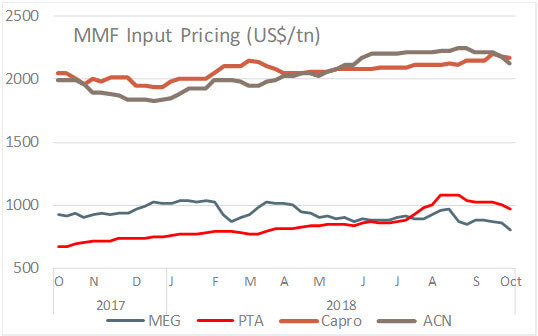
Mono ethylene glycol markets in Asia were under downward pressure amid increasingly bearish sentiment resulting from the losses in oil prices, Asian equities and polyester prices. Uncertainty over market outlook strengthened despite increased production of downstream polyester. Thus, market players were not willing to hold cargoes even though fundamental demand was healthy with downstream polyester operating rates being ramped up. Inventories in east China declined 6.5% to 579 kilo ton, due to fewer import cargo arrivals. Spot benchmark prices plunged US$60 week-on-week, with CFR China at US$793-798 a ton and CFR South East Asia at US$800-810 a ton.
In Europe, MEG spot prices continued to remain low on ample supply, amid weak sentiment from the lower prices in Asia. Larger buyers adopted a wait-and-see attitude, as sufficient supply pressured spot prices downwards last week. Spot bulk prices were assessed stable at Euro835-850 a ton CIF NEW, while truck spot prices were at Euro 880-995 a ton FCA NWE.
In the US, prices softened at the beginning of Q4, as supply lengthened with the end of peak demand season. Supply was excess due to slower demand, reduced exports and healthy production. October contracts prices were down US cent 1 at US cents 40.5-46.5 per pound FOB. Domestic spot prices were quoted in the upper-US cents 30 per pound for barge material and lower-US cents 40 per pound for rail/truck material.
Polyester input: PTA
Purified terephthalic acid prices trended down further, facing weak demand from the downstream polyester sector. Polyester sales ratio remained below 100% level, indicating that demand was weak, with inventories building up. A weak global macroeconomic environment and falling crude prices further exacerbated downward pressure on PTA prices. In China, PTA futures market was under weak fluctuation and offers for goods for October delivery were slightly higher than PTA futures. Weakening upstream paraxylene also eased cost support. PTA markers fell US$30-32 on the week, with CFR China at US$960-962 a ton and offers from Taiwan/Korea at US$970-990 a ton. In China, offers for bonded goods edged down to US$1,000-1,020 a ton, and discussions for nearby-month cargoes were around US$950 a ton.
In Europe, PTA markets were quiet seeing the fluctuation in Asian markets. Contracts were stable at Euro 904-938 a ton FD NWE.
In the US, Indorama’s PTA plant in Montreal was under planned maintenance, while supply improved with the restart of Alpek's two PTA lines last month. PTA prices were assessed at US cents 60.10 per pound DEL.
Nylon input: Caprolactam
Caprolactam spot prices continued to trend downwards, while import offers almost dried up in Asian markets. In China, offers for spot caprolactam imports dried up in the week as domestic prices weakened further. Lacklustre downstream demand waned buying appetite, and producers were under pressure to reduce offers as inventories started piling up. Sinopec settled its October contract price lower than its September price, while Japan's Ube Inds settled its October contract price higher from September, citing that tight supply in the region, as well as a turnaround, will support prices.
Asian markers moderated US$10 week-on-week with SE and FE Asia at US$2,170-2,220 a ton. In China, spot prices for liquid goods declined to 16,000-16,500 Yuan a ton (US$2,300-2,375 a ton, down US$90) while flake goods fell to 16,500 Yuan a ton (US$2,375 a ton, down US$75). Japan's Ube Industries settled its October contract price for caprolactam at US$2,240 a ton CFR NE Asia, up US$70 from its September contract price.
In Europe, October caprolactam discussions were mostly ongoing, but a stable-to-softer pricing tendency was discernable so far as early discussions were concluded at varying decreases. Some talks pushed for stability from sell-side being met with resistance from buyers. There was mention of sharing of benzene decrease this month and due to varying expectations, talks were not concluded across the board. September contracts settled at Euro2,272-2,433 a ton FD NWE rolling over from August.
Acrylic input: Acrylonitrile
Acrylonitrile prices extended losses across regions this week as sluggish demand continued to push down spot despite the limited spot supply. Supply in Asia remained balanced-to-short amid the ongoing plant turnarounds in China and South Korea, but could not prevent prices from falling as slower-than-expected economic growth in China coupled with escalating US-China trade war started taking toll on chemical industry. However, lacklustre demand was the major factor leading to price declines. Far East CFR marker fell US$50 to US$2,129-2,131 a ton while CFR China was steady at US$2,150-2,220 a ton. In China, self-lifting values at Lianyungang port fell US$105 to US$2,505-2,520 a ton. Sinopec Anqing settled its October price at 18,000 Yuan a ton (Us$2,590 a ton), down US$150 from September price while PetroChina Fushun reduced its October spot offers by US$129.50 a ton, to 17,400 a ton (US$2,505 a ton).
In Europe, spot prices fell sharply as downstream production cuts globally limited demand and pegged the market in balance. Prices also fell following Turkish acrylic fibre producer AKSA cutting production by 40% through October – which reduced demand for European acrylonitrile. In the US, formula-based domestic contracts increased, based on a rollover in propylene contracts and higher spot ammonia prices. Supply improved but remained snug and downstream cut operating rates for acrylic fibres and acrylonitrile-butadiene-styrene amid weaker margins, causing caused spot export prices to decline. Spot prices dropped US$100 to US$1,898-1,902 a ton CIF Mediterranean. In the US, spot export prices were down US$25 at US$2,085-2,095 a ton FOB USG. October domestic contracts settled higher at US cents 80.90-84.90 per pound DEL from US cents 80.48-84.48 per pound DEL in the previous month.