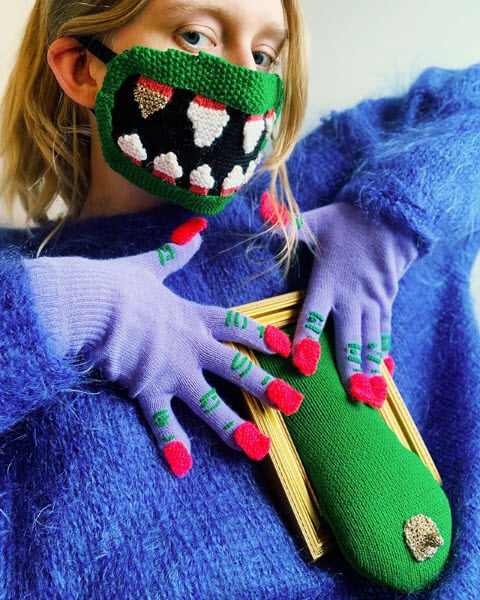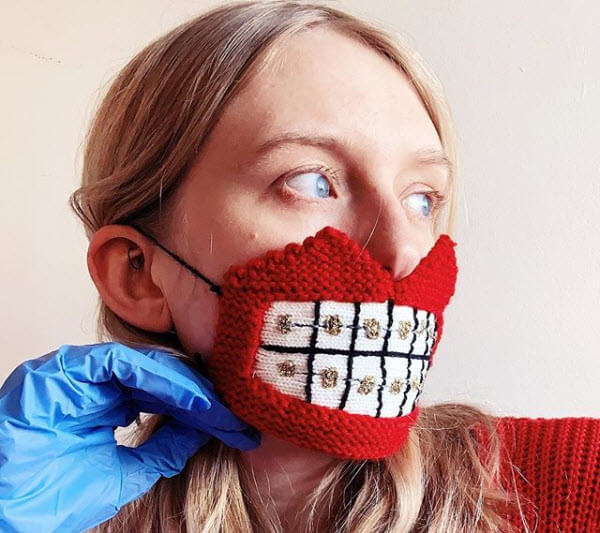
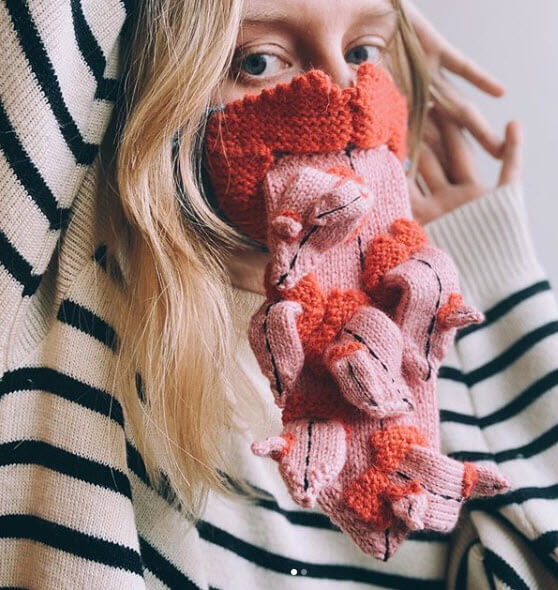
Icelandic designer Ýrúrarí Jóhannsdóttir, has created a unique range of knitted face masks in response to Covid-19. By Jessica Owen.
Compared to other countries, Iceland is dealing with the Covid-19 pandemic very effectively. There have only been around 1,800 confirmed cases, and of those, only 10 people have died, according to the Iceland Review. What’s more, 23 April marked the first day since February without any new confirmed cases of infection.
Although the country’s situation is looking positive, efforts are continually being made to protect the health of Icelanders. And one person in particular has decided to take a creative approach to helping the cause.
Ýrúrarí Jóhannsdóttir is a textile designer based in the country’s capital city, Reykjavík. She studied at Reykjavík School of Visual Arts, before getting her BA from Glasgow School of Art in 2017. Since 2012, her work has mainly involved creating sweaters and wearable knit sculptures, but thanks to her studies0 she now develops technical knit structures.
“My work comes mostly through knitting; adding knitted 3D elements to second-hand sweaters has been the theme of my work for the past years,” she says.
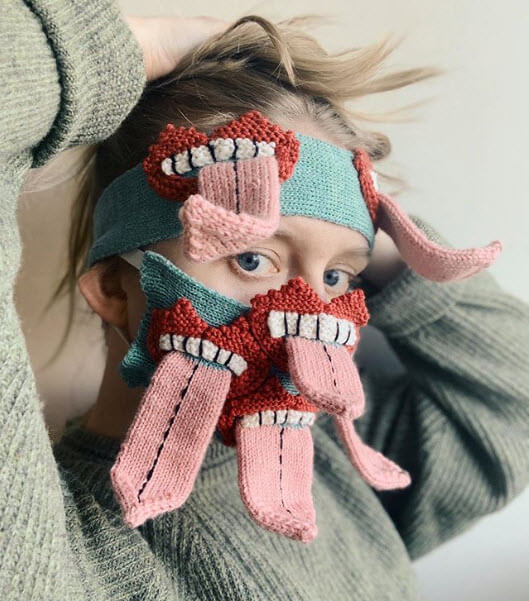
Jóhannsdóttir’s work is mostly done by knitting and working with the possibilities of new visual elements that knit can create in spaces and on the human body in a way of illustrating the everyday three-dimensional space. Her creations are on the wide spectrum from hand-knitting figurative fun pieces on old jumpers to machine-knitting abstract and complex mathematical textiles, working with the technique of weaving, OP art and making dimensions meet on the surface of knitted fabric.
Now, due to the ongoing coronavirus outbreak, Jóhannsdóttir has been creating face masks. She says: “I started making my knitted masks at the beginning of April when the virus was at its peak here in Iceland, but we are very lucky on how well we’re recovering from it.
“Before this, I was working on a big show of upcycled sweaters, collaborating with the second-hand stores of the Red Cross of Iceland for Design March in Reykjavík. Design March got delayed until the end of June, but after this mask adventure I’ll focus back on that project.”
The idea for the face masks evolved from Jóhannsdóttir’s former sweater creations. She would transform something normal and everyday into art pieces, using second-hand sweaters such as an empty canvas. But now, face masks are becoming such a necessity and part of everyday life that Jóhannsdóttir thought it could be interesting to translate her ideas into that form, inspired by current events.
She says: “I was not expecting to connect well with the form of the face mask, but it makes sense and I do use forms of the face and expressions a lot in my usual work. So before really noticing it, I had already made a small line of knitted face masks.
“In my mind it was just a pet project to keep on creating and doing something, and I was not expecting them to become so popular and being written about all around the world – I’ve seen articles in Russian, Japanese, Polish, Spanish, Chinese, Arabic and more.”
Jóhannsdóttir explains that she didn’t really make the masks to wear; in her mind they are more like wearable sculptures, not made for safety but more as a fun approach to the rule of safe distancing: “If you look scary enough people will stay away,” she says.
The masks could work as fashionable covers over the real face masks, she explains, however Jóhannsdóttir is not selling them. Although, people have started to use her experimental DIY tongue knitting pattern called Sleik-zine.
“People with basic knitting knowledge can easily transform that pattern into something similar to my masks,” she says. “I think this is the time to develop some new skills and knitting has proven to be soothing for some people.
“So far, I‘m very happy with the responses for my masks, and they seem to give people some laughs, smiles and maybe the occasional eye rolling, which is just fantastic. This is a good time to spread out some joy while we keep on following all safety measures, take care of each other and wait for this to end.”