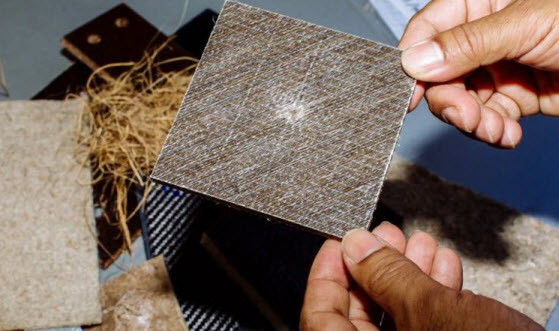
A team of researchers, led by the University of Portsmouth, have developed a bio-composite material using date palm fibre biomass (biomass is a term that includes waste material from plants, food waste and sewage) that can be used in non-structural parts, such as car bumpers and door linings.
The team also involved researchers from the University of Cambridge, UK, INRA (Institut national de la recherche agronomique, a French public research institute dedicated to agricultural science) and the University of Southern Brittany, France.
The date palm fibre polycaprolactone (PCL) bio-composite is said to be completely biodegradable, renewable, sustainable and recyclable, unlike synthetic composites reinforced by glass and carbon fibres.
Testing the composite
In a study, published in the journal Industrial Crops and Products, the researchers tested the mechanical properties of the bio-composite. They found that the date palm fibre PCL had increased tensile strength and achieved better low-velocity impact resistance than traditional man-made composites.
“Investigating the suitability of date palm fibres waste biomass as reinforcement in lightweight composite materials provides a tremendous opportunity of utilising this material to develop low-cost, sustainable and lightweight biocomposites,” says Dr Hom Dhakal, who leads the Advanced Materials and Manufacturing (AMM) Research Group at the University of Portsmouth and co-author of the study.
“The impact of this work would be extremely significant because these lightweight alternatives could help reduce the weight of vehicles, contributing to less fuel consumption and fewer C02 emissions. The sustainable materials can be produced using less energy than glass and carbon fibres and are biodegradable, therefore easier to recycle.”
The study is reportedly one of the first to provide a comprehensive assessment of the improved mechanical properties of date palm fibre PCL bio-composites.
About date palm trees
Date palm fibres are one of the most available natural fibres in North Africa and the Middle East. Date palm trees produce a large quantity of agriculture waste, which is burned or landfilled, causing serious environmental pollution as well as the destruction of important soil micro-organisms.
The part of the date palm tree which is often used as fibres is the sheath. The sheath is the part of the tree that surrounds the trunk of the plant and it is often torn lose when pruning the leaves.
“It’s a long journey, and we have to have patience and perseverance to make an impact. The challenge is getting consistent, reliable properties,” adds Dhakal. “It takes a long time to convince people to use a new class of materials, such as natural fibre-reinforced composites for non-structural and structural applications.
“Meeting these challenges requires further research and innovation between academic institutions and industry.”
Dhakal and his team have been working closely with industry to test the strength and viability of parts made from sustainable materials, such as date palm, flax, hemp and jute fibres. The AMM Research Group has been working in collaboration with researchers from institutions from around the world.
In the last 18 months, the group has published many high-impact factor papers in journals including the Composites Science and Technology, Composites Part A and Composites Part B.
A recent collaborative study published in the journal of Composite Part A: Applied Science and Manufacturing explored the potential of waste leaf sheath date palm fibres for composite reinforcement.