
Addressing delegates at the recent four-day Mohair Summit, Deon Saayman, general manager of Mohair SA, outlined several pilot projects presented to government to encourage employment in the Eastern Cape and establish more black mohair farmers as a means of keeping the mohair industry viable.
These projects included increasing the sale of Angora meat, whilst an Angora goat tannery is in the planning, with research underway for various products, such as slippers.
Talks are underway to send crafters to China for training to help develop an Angora craft industry to wash and dye mohair for high end products.
South African mohair producers averaged a price of R123 per kg in 2013, hitting a top price of R600 per kg for ultra-fine kid mohair, stated Saayman.
Senior Nedbank economist, Nicky Weimar, explained that the mohair industry would have to wait until the second half of 2014 for any improvement in exports. That, Weimar said, was when the US was expected to show a more robust growth.
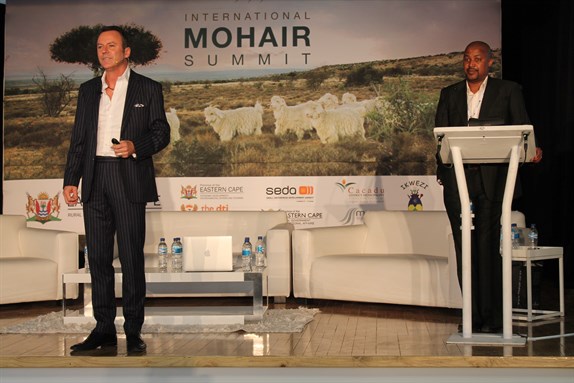
Born and educated in the Eastern Cape, US-based designer Colin Cowie told delegates that mohair could go from ‘drab to fab’ and with the right guidance become a luxury fibre sought after worldwide. Cowie continued that he saw mohair being used for carpeting in motor cars such as Ferraris.
Angora goats were first imported into South Africa from Turkey in 1838 and established on a farm in the Jansenville district, where the Summit was held. The Dutch Reform Church formed a parish there in 1854 and named it after the last Dutch Governor of the Cape. The countryside around Jansenvillve is known as the ‘Noorsveld,’ which is a distinctive spiky plant on which Angora goats thrive in the hot and dry Karoo conditions.