Rostec introduced its camouflage coating for military vehicles and soldier’s equipment alongside a passive exoskeleton at the International Military-Technical Forum – Army 2018, held in Moscow, Russia, on 21-26 August.
The company illustrated the possibilities of the material with a soldier’s helmet made for the advanced, third-generation equipment, Ratnik.
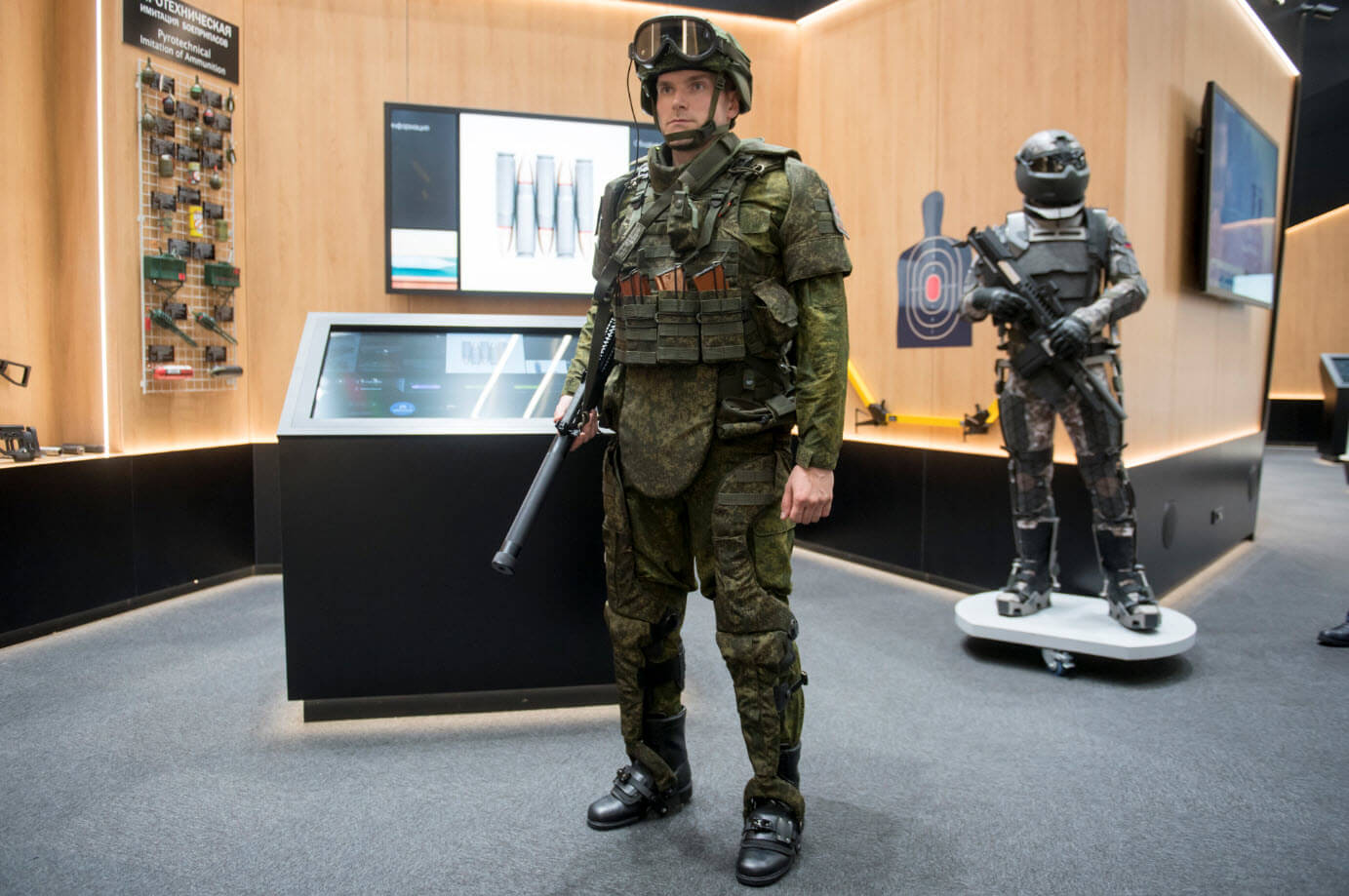
The passive exoskeleton significantly increases physical abilities of a soldier
The specialised electrically-operated material covering the helmet prototype is able to change colour depending on the camouflaged surface and environment. The material can display dynamic changes of colour intensity and simulate complex images, for example, the motion of leaves in the wind. Within Rostec, the development is performed by Ruselectronics and TSNIITOCHMASH.
“Existing types of camouflage do not change their masking properties depending on changes in the background,” says Sergey Abramov, industrial director of the Armament Cluster of Rostec. “For example, soldiers will not be seen in a forest against greenery, but they will be visible against sand or snow.
“An innovative coating created by Ruselectronics provides unique opportunities for masking,” he adds. “We are demonstrating how it works using one element of equipment, ie a helmet. However, its application is much broader. It can be used in clothing, weapons and military equipment.”
The coating is applied to the base, like ordinary paint, and does not require great accuracy in terms of thickness and uniformity. In particular, this means that repairs can be carried out in the field. The power consumption in continuous adaptation mode is no greater than that of an energy-saving lamp. The mass of the coating is just a few hundred grams per square metre.
In the future, the technology could be applied to civilian sectors as well. For example, in the textile industry, it can be used to create clothing that changes colour and pattern depending on a person’s mood.
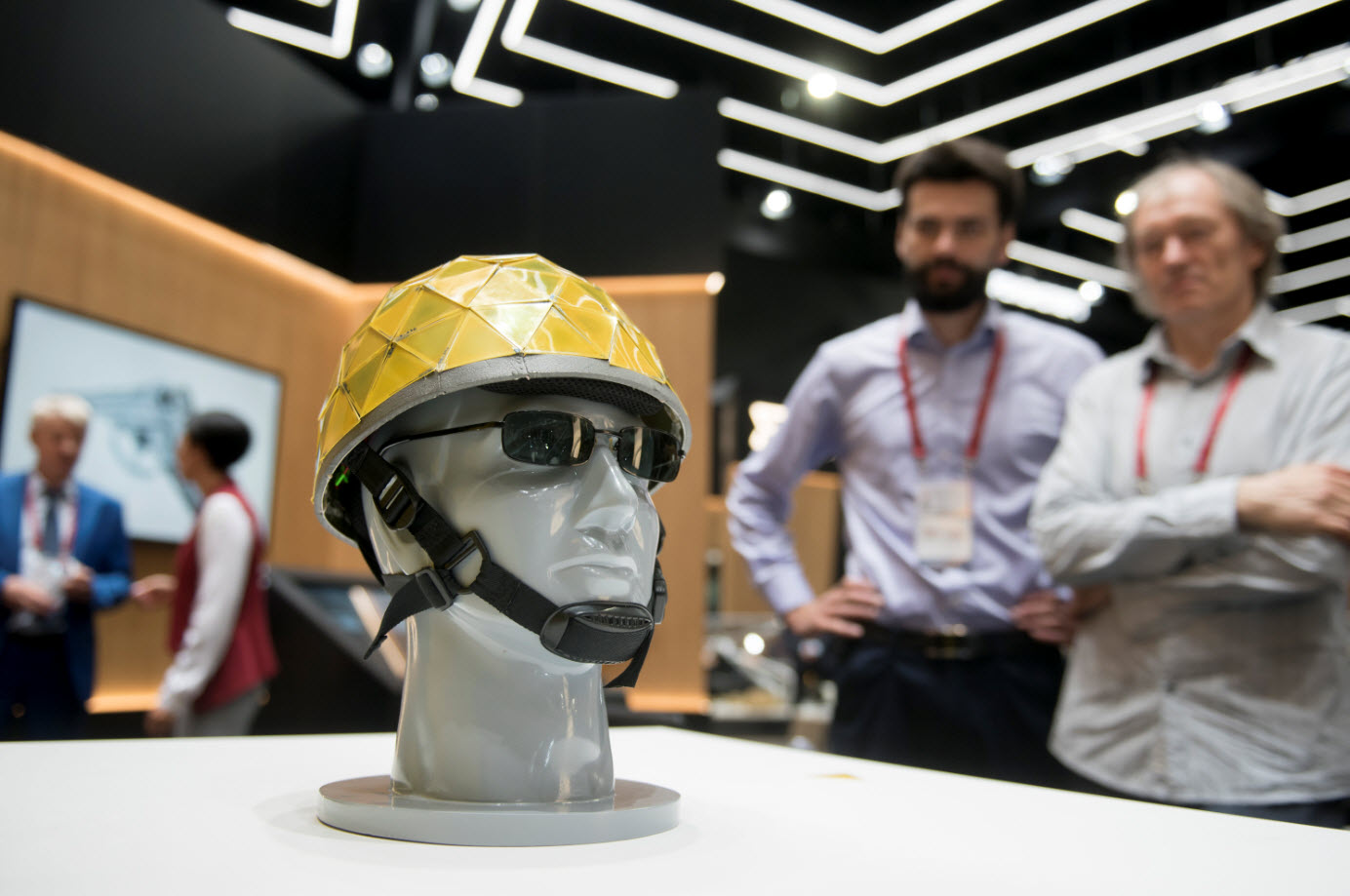
The material can display dynamic changes of colour intensity and simulate complex images
The Rostec exoskeleton
Rostec also presented its exoskeleton at the Army 2018 forum. A fully operative example of a passive exoskeleton significantly increases physical abilities of a soldier, protects joints and the spine, and can be adjusted to the height of a particular person.
“This prototype has already been tested during real military operations,” says Abramov. “The exoskeleton was tested by special detachments of the Russian Ministry of Defence and Internal Affairs bodies between 2017-18.”
The exoskeleton is made of lightweight carbon fibre and supports the musculoskeletal system when a person carries weights up to 50 kg during long marches and assaults. It is a mechanical device with levers and swivels in the shape of human joints.
Unlike active exoskeletons, the passive exoskeleton has no power sources or extra sensors. This makes it more reliable and lighter (4-8 kg depending on the configuration). It is also autonomous and easy to maintain.
The exoskeletons are developed by TSNIITOCHMASH and GB Engineering.